Medical Credentialing in 2026: Key Updates, New Requirements, and How to Stay Compliant
Learn the latest 2026 medical credentialing updates, CMS and NCQA requirements, and how healthcare providers can stay compliant and avoid delays in approvals.
Schedule Free Demo Today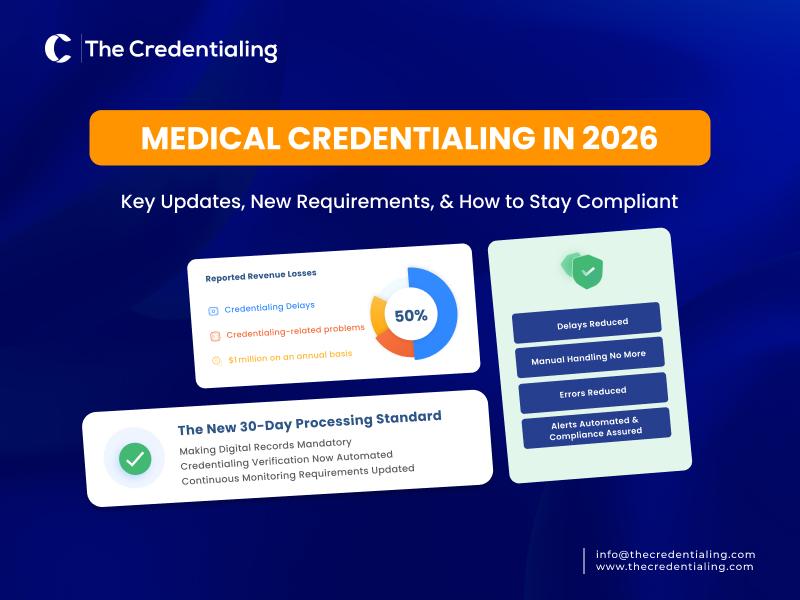
Did you know that over 50% of healthcare providers have reported revenue losses due to medical credentialing delays? According to data from the Medical Group Management Association (MGMA), processing bottlenecks can cause some hospitals to lose more than $1 million on an annual basis.
Credentialing-related delays cause severe cash flow blockages for healthcare organizations. This makes staying aligned with the latest 2026 CMS and NCQA guidelines absolutely critical. By leveraging modern, mandatory digital workflows, smart practices can bypass manual friction, aiming for an optimal internal 30-day application prep window to get files to payers faster than ever before.
What Is Medical Credentialing in 2026?
Medical credentialing in 2026 is the strict process of verifying a healthcare provider’s qualifications, licenses, and professional history. This ensures they meet federal regulatory and payer requirements before they treat patients or bill insurance networks.
Key Takeaways
-
Transition to Digital Workflows: Updated 2026 guidelines phase out paper options entirely. Mandatory secure digital submissions and automated Primary Source Verification (PSV) radically compress the time it takes to get an application in front of a payer committee.
-
Eliminating Credential Gaps: Maintaining a rigorous, live checklist of active state licenses, board certifications, clean CVs, up-to-date malpractice insurance, and NPI data prevents immediate payer rejections.
-
Continuous Compliance Monitoring: Payer networks now favor practices that employ continuous automated monitoring. Tracking license expirations and sanctions in real-time ensures your providers never accidentally drop out-of-network.
Provider Credentialing and Why It Matters
In simple terms, the purpose of provider credentialing is to verify a professional’s healthcare provider qualifications to make sure they meet the high standards of this industry. This requires them to make a thorough check of their education, training, licenses, and work history. It is a critical step for securing reimbursement & payments from each insurance payer network they’re enrolled with.
This is why, without going through proper credentialing, a provider can never be part of an insurer's network. They will not be able to receive the payment for the services they're delivering.
How Medical Credentialing Fits Into U.S. Healthcare Compliance
In the United States, medical credentialing is a strict regulatory requirement that directly impacts a provider’s ability to deliver care and receive reimbursement. Healthcare organizations must ensure that every provider aligns cleanly with standards set by the Centers for Medicare & Medicaid Services (CMS) and the National Committee for Quality Assurance (NCQA).
Credentialing is the bedrock of compliance, billing, and patient safety. Most healthcare organizations integrate credentialing directly into their onboarding workflows. However, it is critical to distinguish between two completely separate steps in this lifecycle:
-
Credentialing: The exhaustive verification of a provider's background, education, and licensing.
-
Payer Enrollment: The process of taking those verified credentials and formally contracting with an insurance network so the provider is assigned an active, in-network billing provider number.
True CMS and NCQA Credentialing Realities for 2026
The 2026 updates from CMS and the NCQA have modernized the medical credentialing landscape, but they have also drastically raised the stakes for administrative errors. The major technical and regulatory shifts include:
Shorter NCQA Verification Windows
The NCQA has tightened its parameters, moving to a strict 90-day primary source verification (PSV) timeline for credential verification organizations (CVOs). If your data gathering is slow or contains errors, there is no longer a soft buffer window to fix it before verification data expires.
The 30-Day CMS Mandate on PECOS Data Discrepancies
CMS has vastly increased its cross-program enforcement. If there is a data mismatch between the National Plan and Provider Enumeration System (NPPES) and the Provider Enrollment, Chain, and Ownership System (PECOS), claims will be instantly denied. Furthermore, practices are now under a strict 30-day reporting window to log any changes in practice location, ownership transfers, or adverse legal actions into PECOS. Failing to meet this timeline results in rapid billing suspensions.
Universal CAQH Reliance
Paper applications are completely obsolete. Commercial insurance networks rely entirely on the Council for Affordable Quality Healthcare (CAQH) ProView database. Providers must input their credentialing data perfectly into CAQH and explicitly authorize targeted payers to access their profiles, or the enrollment cycle grinds to an immediate halt.
PECOS 2.0 and the Mandatory Transition to AWS Cloud Architecture
While tracking the standard 30-day reporting window for CMS discrepancies is vital, it is equally important to plan around the massive structural overhaul of the federal system itself. On May 4, 2026, CMS officially completed its comprehensive migration of the PECOS 2.0 platform into an Amazon Web Services (AWS) cloud infrastructure. This is not a superficial facelift; it is a ground-up transformation of the provider enrollment and credentialing services framework.
To keep your operations compliant and avoid severe revenue disruption, any certified provider credentialing specialist must navigate three critical technical shifts:
-
The Security Shift (MFA Gatekeeper): Multi-factor authentication (MFA) through the Identity and Access (I&A) Management system is now strictly mandatory for all credentialing staff, surrogates, and billing personnel accessing PECOS 2.0.
-
The IP Allowlisting Pitfall: Because of the migration to the AWS Cloud, the system now responds from dynamic AWS IP ranges rather than fixed, legacy CMS addresses. Healthcare organizations using rigid, local outbound IP allowlists must instruct their IT departments to update their corporate firewall configurations immediately. Failing to do so will completely lock your credentialing specialist out of federal enrollment portals, trapping new applications in limbo.
-
Form Consolidation: In tandem with the PECOS 2.0 shift, CMS has radically consolidated its standard workflows. Paper-heavy, separate reassignments have been overhauled, completely merging the old CMS-855R (Reassignment of Benefits) into the core CMS-855I individual practitioner application process.
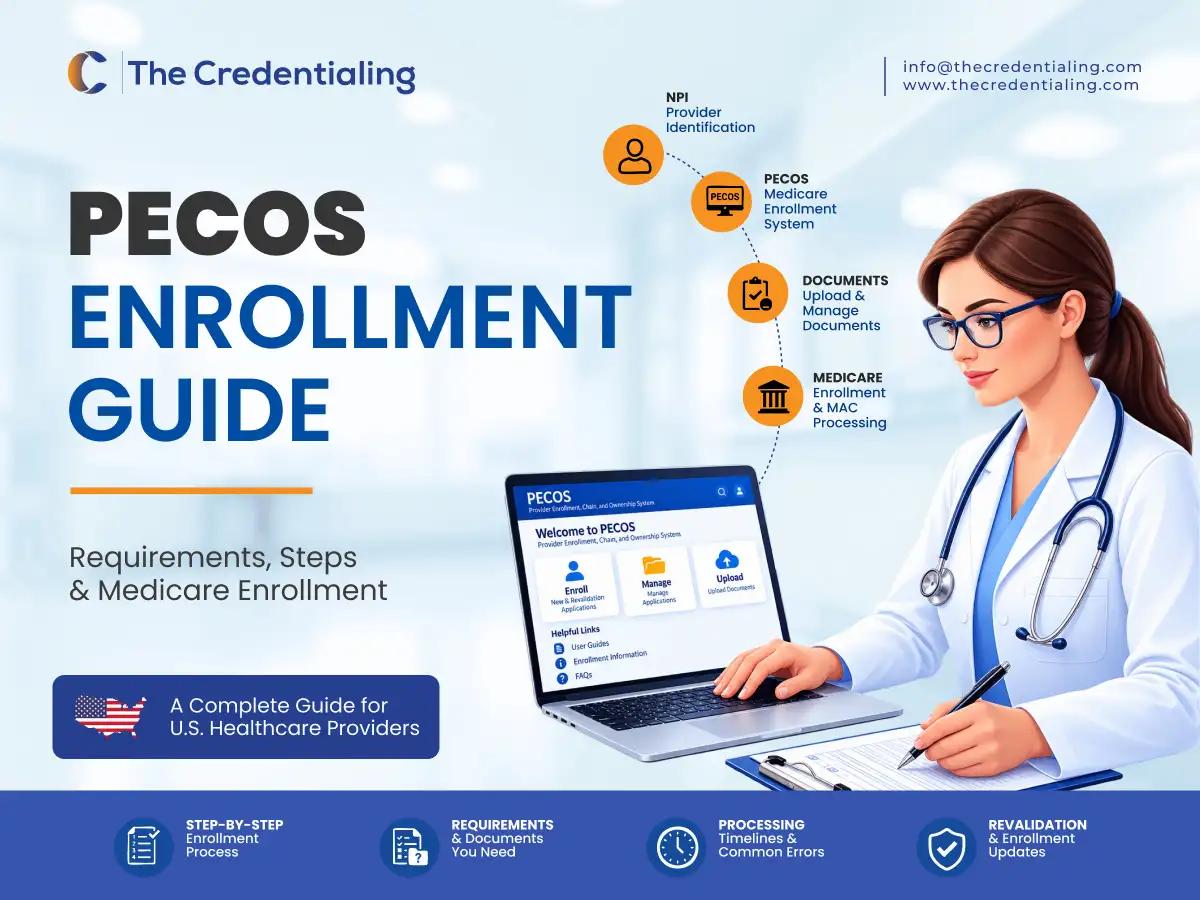
Ultimately, mastering pecos enrollment means moving away from traditional form-filling. A modern pecos enrollment lookup now pulls from real-time federal cross-referencing databases to validate provider data as it is entered, penalizing practices that fail to sync their IRS and NPPES records character-for-character.
Telehealth Credentialing: Multi-State Licensing and Virtual Platform Audits
In 2026, virtual care is no longer governed by temporary pandemic-era waivers. Telehealth credentialing has evolved from a basic "add-on" modifier into an entirely distinct insurance credentialing category. Commercial payers and state Medicaid structures have eliminated blanket virtual care permissions, making sophisticated insurance credentialing services a prerequisite for sustainable remote care.
If you are managing insurance credentialing for therapists, behavioral health groups, or multi-state medical practices, your compliance strategy must integrate these 2026 rules:
-
The Location Rule: Payers now strictly audit the exact physical location of the patient at the time of the virtual visit. It is no longer enough for the provider to be licensed in their home state; if a physician or therapist treats a patient located across state lines, that provider must hold an active, valid license and completed provider enrollment services within that specific encounter state.
-
The 2026 IMLC Expansion: To streamline this multi-state hurdle, the Interstate Medical Licensure Compact (IMLC) has expanded to 40 participating states in 2026. This provides an accelerated, legally compliant pathway for physicians to secure multiple licenses, drastically speeding up the commercial process of how to get credentialed with insurance companies.
-
Platform Verifications: Payers are shifting their scrutiny beyond the practitioner to the virtual infrastructure itself. During initial enrollment and the standard recredentialing process, insurance networks are actively auditing digital health platforms. Providers must verify that their video software utilizes end-to-end encryption compliant with the latest 2026 HIPAA updates, and show documented proof of certified training in virtual care delivery.
How the Credentialing Process Works
The first step to managing everything well and staying compliant is to understand how the credentialing process works. Simply put, it's a planned process with several clear steps that are meant to confirm a provider's entire history in this profession. The process starts with gathering a lot of information, and it goes through several strict checks before the payer makes a decision.
Each step is meant to keep patients safe and protect the healthcare system's integrity.
How Healthcare Organizations Manage Credentialing Data Securely
Medical credentialing involves handling sensitive provider information, including licenses, identification numbers, and professional records. In the United States, healthcare organizations typically store this information in secure credentialing systems or encrypted document management platforms.
Access is limited to authorized personnel such as compliance teams and credentialing specialists. This ensures that provider data remains protected while still being accessible for verification and audits. Maintaining secure and organized records also helps streamline re-credentialing and payer audits.
A Step-by-Step Healthcare Provider Credentialing Process
Organizing your medical credentialing into an exact chronological framework eliminates administrative bottlenecks, prevents immediate payer rejections, and protects your revenue cycle. Follow these five mandatory phases to ensure compliance with 2026 standards.

1. Gather All Necessary Core Documentation:
Collect government-issued IDs, an absolute and unbroken CV timeline (accounting for any gaps greater than 30 days), medical diplomas, state licenses, DEA certificates, and current Malpractice Insurance Certificates.
2. Build and Attest the CAQH ProView Profile:
Input all verified provider data into the Council for Affordable Quality Healthcare (CAQH) ProView database- the universal gold standard portal for commercial insurance. Attest the file and explicitly grant authorization to your targeted commercial payer networks. For federal Medicare enrollment, establish or update the provider's file via the CMS PECOS system.
3. Execute Primary Source Verification (PSV):
Confirm the authenticity of the provider’s qualifications directly with the issuing institutions (e.g., medical schools, state licensing boards). Under tightened NCQA guidelines, this primary source data must be verified within 120 days for Accredited organizations (or 90 days for Certified Credentials Verification Organizations) before a committee decision can be made.
4. Payer Enrollment & Committee Review:
Submit formal enrollment applications through the payers' secure online channels. The completed file is routed to the payer's internal medical credentialing committee for a final review. Per NCQA guidelines, payers must formally notify the practitioner of their decision within 30 calendar days of the committee's ruling.
5. Ongoing Maintenance and 36-Month Re-Credentialing:
Credentialing is a continuous compliance loop. Under NCQA standards, providers must undergo formal re-credentialing every 36 months from their last approval date. Additionally, practices must perform monthly ongoing monitoring of the OIG exclusion list, SAM.gov, and state board sanctions to maintain good standing and prevent sudden out-of-network claim denials.
The Financial Reality of Delays: Because a provider cannot bill insurance companies until they are fully credentialed and enrolled in a network, missing a deadline or letting a file lapse directly translates into deferred revenue or permanent write-offs for the practice.
Digital Credentialing and Automation in Modern Healthcare
Healthcare organizations across the United States are rapidly shifting toward digital credentialing systems. Instead of manual paperwork, providers now submit documentation through secure online platforms that allow faster processing and real-time tracking.
Many practices also use credentialing automation solutions to manage provider data, send renewal reminders, and track compliance requirements. Automation reduces administrative workload and helps ensure that credentialing tasks are completed accurately and on time.
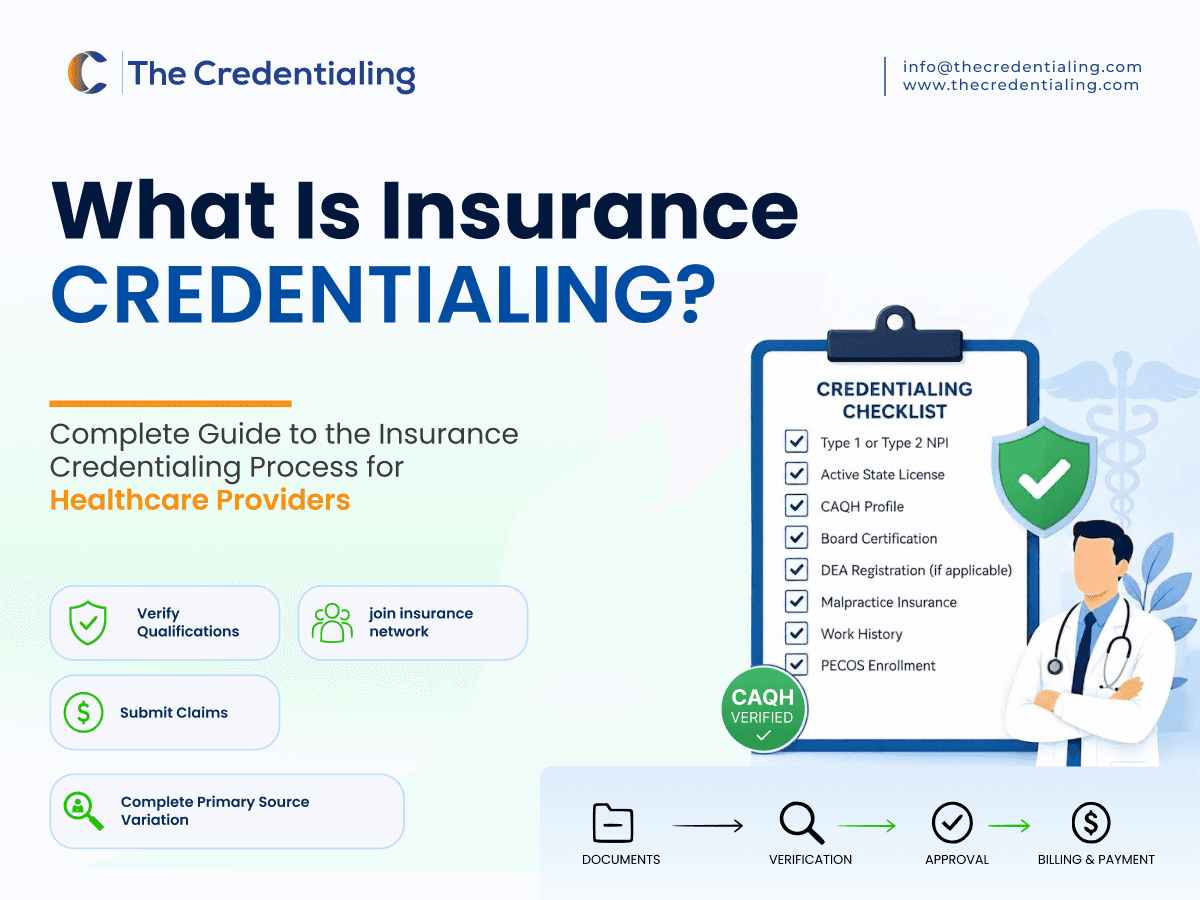
A Complete Medical Credentialing & Compliance Checklist
Use this specialized checklist to organize provider files and execute the mandatory verification checks required to protect your practice from immediate claim rejections and severe regulatory penalties.
1. Mandatory Provider Onboarding Documents
-
Government-Issued Photo ID: Legible color copies of a valid Driver’s License or Passport.
-
Taxpayer Identification: Social Security Number (SSN) and practice Employer Identification Number (EIN).
-
Comprehensive Curriculum Vitae (CV): An unbroken professional history detailing current month/year formats. Any employment gap exceeding 30 calendar days must include a formal, signed written clarification to comply with NCQA audit standards.
-
Medical Education & Training Assets: Copies of Medical School Diplomas alongside all accredited Internship, Residency, and Fellowship Certificates.
-
Active State Medical License(s): Current, unhindered license for every state where the provider delivers or directs care.
-
Controlled Substance Registrations: Valid Federal DEA Certificate and relevant state-specific controlled substance licenses.
-
Board Certifications: Active status verification documentation from the corresponding ABMS or specialized board.
-
Professional Liability Protection: Current Certificate of Insurance (COI) detailing malpractice coverage limits (typically $1M/$3M minimums) with an unbroken retroactive coverage timeline.
-
National Provider Identifiers: Active Type 1 (Individual) NPI number, ensuring all taxonomy codes perfectly mirror the provider's active specialty.
2. Mandatory Federal & State Verification Actions
|
Database / Action |
Compliance Standard |
Regulatory Consequence |
|
HHS-OIG LEIE Screening |
Must check the List of Excluded Individuals and Entities at initial hire and monthly thereafter. |
Failing to catch an excluded provider results in mandatory repayment of federal funds and civil monetary penalties. |
|
SAM.gov Debarment Check |
Screen the System for Award Management database before contracting and maintain monthly batch checks. |
Protects the practice from funding blocks linked to federally debarred, suspended, or sanctioned entities. |
|
NPDB Enrollment |
Transition all providers into the NPDB Unified Query system for continuous year-long tracking. |
Eliminates the exposure windows of static queries; triggers automatic, immediate alerts if an adverse action is reported. |
|
Primary Source Verification |
Validate education, licenses, and board statuses directly with the issuing institutions. |
Mandatory for NCQA compliance. Utilizing automated platform integrations keeps this phase under a 90-day cycle. |
|
Payer Allocation Tracking |
Log all active submissions into CAQH ProView; execute manual follow-ups with commercial insurance networks within 14 days of submission. |
Keeps the credentialing application moving steadily through the payer's medical committee review phase. |
The Cost of Non-Compliance: Skipping monthly OIG and SAM screenings can trigger massive financial liability. Under current federal guidelines, billing for services rendered or directed by an excluded individual can attract Civil Monetary Penalties of over $20,000 per item or service claimed, along with treble (triple) damages under the False Claims Act.
Here is the final, keyword-optimized integration for the remaining sections of your article. These sections are strategically packed with target industry search terms while maintaining standard medical compliance terminology.
How Credentialing Impacts Revenue Cycle Management (RCM)
Medical credentialing is not a separate administrative silo; it is the absolute gateway to your entire revenue cycle. A provider can deliver exceptional clinical care, but if they are not fully credentialed and formally linked to your practice’s tax ID within a payer's network, the practice cannot bill for those services.
To maximize collection rates, smart practices leverage professional provider enrollment services to eliminate operational friction. The real-world financial consequences of administrative delays on your RCM health include:
-
Unappealable Provider Enrollment Denials: When claims are submitted with a rendering provider who is not actively enrolled, insurance clearinghouses will issue hard rejections (often under denial codes indicating "Provider not enrolled/associated with group"). Unlike coding or demographic errors, these denials cannot be fixed by modifying a claim; they represent unrecoverable, permanent revenue leakage. Hiring an in-house credentialing specialist helps secure clean submissions, but outsourcing to full-scale provider enrollment and credentialing services offers a scalable safety net against these errors.
-
Stalled Accounts Receivable (A/R): According to industry data, compliance bottlenecks are a primary driver of expanding A/R days. If a new provider's network activation takes 120 days instead of 60 days, your practice is forced to hold claims or face a wave of denials, completely choking your monthly cash flow.
-
Severe ROI Drag on New Hires: Bringing on a new clinician is a massive capital investment. If that provider sits idle or delivers unbillable care for months while waiting on a sluggish, manual layout, the practice absorbs pure overhead without any incoming reimbursement yield. This makes understanding how to get credentialed with insurance companies efficiently a top priority for growing medical groups.
4 Fatal Compliance Mistakes and How to Avoid Them
Even minor administrative oversights can derail an enrollment cycle. Recognizing these four high-risk errors allows your practice to implement defensive operational protocols.
1. Permitting Providers to See Patients Before Network Activation
-
The Error: Assuming that because an application has been submitted, claims can be held and back-billed retroactively once approved. Most commercial payers do not allow retroactive billing; the effective date is strictly set when the contracting committee signs the final agreement.
-
The Prevention: Enforce a strict policy that new providers cannot treat patients tied to a specific commercial panel until a formal network activation notice- complete with an active billing provider number- is issued by the payer.
2. Missing the 120-Day CAQH Attestation Deadline
-
The Error: Treating CAQH as a "one-and-done" setup. CAQH requires providers to review and formally re-attest their information every 120 days. If this deadline is missed, the profile is automatically deactivated, instantly blocking payers from verifying credentials during routine audits and triggering immediate out-of-network claims drops.
-
The Prevention: Establish a centralized, automated quarterly attestation calendar with system alerts firing 30 days in advance to streamline your long-term recredentialing process.
3. Submitting Incomplete Professional Timelines on CVs
-
The Error: Submitting a standard CV that omits temporary medical leaves, periods of extended travel, or brief employment gaps. Payer verification teams cross-check CV dates meticulously. Any unclarified gap exceeding 30 calendar days results in an immediate application rejection and a complete restart of the processing timeline.
-
The Prevention: Audit all provider CVs before submission. Ensure timelines are written in an unbroken MM/YYYY to MM/YYYY format, and proactively append a signed explanation letter for any chronological gaps. This strict audit protocol is standard practice when establishing an efficient model for insurance credentialing for therapists and behavioral health groups.
4. Relying on Scattered, Disorganized Record-Keeping
-
The Error: Managing sensitive provider certifications across scattered email threads, local desktops, or physical folders. This leads to expired state licenses or DEA certificates being submitted accidentally, causing compliance violations and massive processing delays.
-
The Prevention: Centralize all tracking metadata within a single, secure, cloud-based platform. Partnering with professional insurance credentialing services ensures your active practice data is consistently cross-referenced with live state databases.
Aligning Provider Compliance with Patient Enrollment Calendars
A critical layer of practice management involves syncing your internal medical onboarding with the federal Medicare open enrollment timelines. When a clinical team understands when to enroll in Medicare as participating practitioners, they protect the practice from losing thousands of active beneficiaries during seasonal patient transition windows.
Crucial Patient Timelines to Track
Every year, older adults and eligible individuals look for resources on how to enroll in Medicare or ask their local clinics, "How do I enroll in Medicare safely?" This consumer migration peaks during the annual Medicare open enrollment period (running from October 15 to December 7). This is followed closely by the annual Medicare Advantage open enrollment period (running from January 1 to March 31).
If your internal PECOS enrollment is stuck in an administrative backlog during the peak waves of Medicare open enrollment 2025 or Medicare open enrollment 2026, your newly hired physicians will be legally blocked from treating those incoming patients. To maintain active data integrity, your billing department must regularly leverage a PECOS enrollment lookup to confirm that every practitioner's active billing rights are fully synchronized with federal consumer registration dates.
Conclusion
Maximizing your practice's financial performance in 2026 demands a highly structured, technology-driven approach to medical insurance credentialing. By keeping pace with current CMS enforcement shifts, executing rigorous primary source verifications, and proactively maintaining your CAQH profiles, you can eliminate structural revenue leakage and stabilize your RCM cycle.
When you partner with a dedicated management ecosystem like TheCredentialing, the administrative friction that used to drain your staff's time and choke your cash flow completely disappears. Protect your practice's baseline revenue, accelerate provider onboarding timelines, and keep your organization fully compliant.
Sit Back and Relax! Let The Pros Handle Credentialing For You!
thecredentialing has built a strong portfolio while providing credentialing services to clients over the years. Our service includes helpful features that you won’t find anywhere else.
Schedule Free Demo Today!