NPI Information: The Complete Guide for Healthcare Providers & Administrators (2026)
Learn what NPI information is, why it matters for healthcare providers, and how to find, apply, or update it using the official NPPES registry in the United States.
Schedule Free Demo Today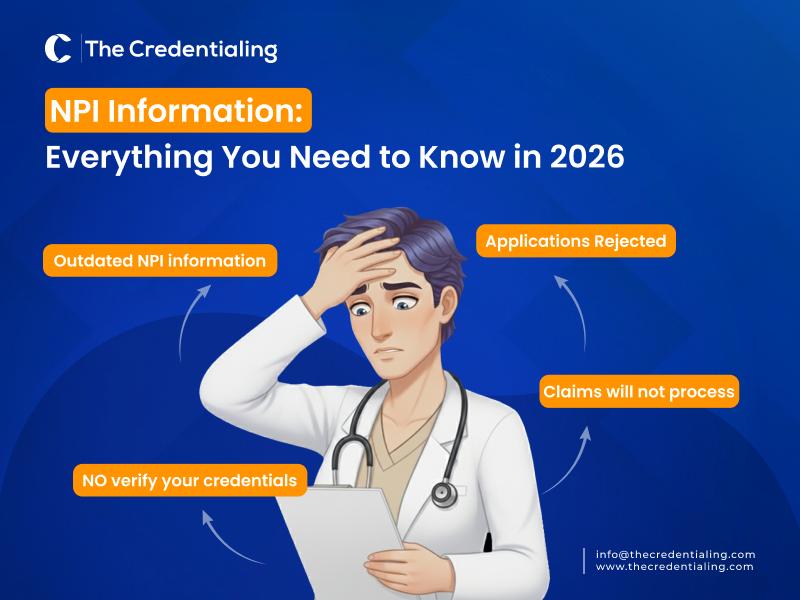
In U.S. healthcare administration, data integrity dictates your revenue cycle. Without an accurate, compliant National Provider Identifier (NPI), your electronic claims will hit hard rejections, provider enrollment applications will stall, and your practice will face immediate credentialing bottlenecks.
An NPI is a unique, 10-digit, intelligence-free identification number mandated by the Health Insurance Portability and Accountability Act (HIPAA). Issued by the Centers for Medicare & Medicaid Services (CMS) via the National Plan and Provider Enumeration System (NPPES), this identifier is permanent and remains tied to a provider throughout their entire professional career, regardless of job changes or relocation.
Key Takeaways
-
State Licensing Is Essential: Without a valid state professional license, practicing medicine can lead to fines, suspension, and career damage. Keeping up with the specific requirements of each state is essential for maintaining legal practice.
-
Update Your NPI Regularly: Your National Provider Identifier (NPI) plays a key role in ensuring smooth billing and insurance claims. Regularly updating your NPI after any state license change prevents delays and issues.
- Stay Organized to Avoid Delays: Common issues like incomplete applications, outdated documents, or incorrect NPI details can delay the licensing process. Using checklists, keeping track of deadlines, and ensuring all documentation is correct can help prevent these administrative hurdles.
Why NPI Accuracy Controls Your Revenue Cycle
Modern insurance payers and government programs rely on automated data-validation algorithms. An NPI does not simply identify a practitioner; it serves as the master key that cross-references multiple regulatory databases:
-
Clearinghouse & Payer Validation: To process HIPAA-compliant standard electronic transactions (such as the 837P or 837I claim formats), the NPI on the claim must perfectly align with the payer's internal registry.
-
PECOS Alignment: For Medicare providers, any discrepancy between your NPPES record and the Provider Enrollment, Chain, and Ownership System (PECOS) will trigger automatic enrollment suspensions or claim denials.
- Directory Accuracy & Compliance: Under current federal transparency rules, insurers actively audit public NPI registries to compile accurate network directories, penalizing practices that leave outdated clinical data on file.
Why Healthcare Providers Need an NPI
Healthcare providers in the United States need an NPI because it is required for most administrative and billing processes within the healthcare system. Insurance companies, government programs, and healthcare networks use the National Provider Identifier to accurately identify providers when processing medical claims.
The NPI became mandatory under federal regulations introduced through the Health Insurance Portability and Accountability Act (HIPAA). The goal was to replace multiple provider identification numbers with one standardized system that works across the entire healthcare industry.
Today, providers typically need an NPI to:
-
Submit insurance claims
-
Enroll with insurance networks
-
Complete provider credentialing
-
Process electronic healthcare transactions
-
Maintain accurate provider identification across healthcare systems
Without a valid NPI, many healthcare providers cannot complete enrollment with insurance payers or receive reimbursements for services.
Understanding NPI Information
You can think of the National Provider Identifier as a Social Security number specifically for healthcare workers rather than general individuals. Before NPIs ever existed, each provider used to have a different identification number provided by every single payer. Naturally, this caused confusion, errors, and billing problems.
The most important and goal-defining NPI information you need to know is that it was essentially made to solve these errors and arising problems by giving every single provider just one 10-digit number that works everywhere. It doesn’t matter which insurance company you use or which state you’re located in; today’s doctor identification number, or to be more specific, NPI, will never change.
Why NPI Information Matters in Practice
Use NPI Information to Verify Provider Legitimacy Before Care
Accurate NPI data is also a core requirement for payer applications and provider enrollment and credentialing services, since insurers use NPI records to verify provider identity and eligibility. You can always use the database to look up your new doctor’s NPI information before you visit them, and confirm if they’re legitimate and properly licensed.
Solve Insurance and Billing Issues Faster
When coverage or billing issues keep coming up, knowing how to access NPI information helps you verify provider details and resolve problems more efficiently.
See Exactly Who You’re Getting Care From
Public NPI information gives rise to a high standard of transparency by showing a provider’s credentials, specialties, and practice locations in one verified place.
Type 1 vs. Type 2 NPIs: Architectural Differences
The Centers for Medicare & Medicaid Services (CMS) classifies healthcare entities into two distinct categories. Misunderstanding which entity type to use on an insurance claim form is one of the most common causes of clearinghouse-level rejections.
Type 1 NPI: Individual Healthcare Providers
A Type 1 NPI is assigned strictly to individual human practitioners who render healthcare services. This includes physicians, dentists, physical therapists, nurse practitioners, and clinical psychologists.
-
The Lifetime Rule: An individual practitioner is legally permitted only one Type 1 NPI for their entire career. It acts as their clinical fingerprint, moving with them across different states, employers, and healthcare systems.
-
Sole Proprietor Exception: If you operate as a sole practitioner but have not formally incorporated your business, you continue to bill using your Type 1 NPI. The addition of an Employer Identification Number (EIN) for tax purposes does not automatically require a Type 2 NPI unless local payer contracts dictate it.
Type 2 NPI: Healthcare Organizations
A Type 2 NPI is issued to organizational entities that furnish healthcare services or supplies. This category encompasses group practices, clinics, hospitals, residential treatment facilities, laboratories, and pharmacies.
-
Corporate Incorporation: If an individual provider decides to incorporate their practice or form a Limited Liability Company (LLC), that corporation becomes a separate legal entity. The corporation must obtain a Type 2 NPI to function as the Billing Provider, while the practitioner uses their Type 1 NPI as the Rendering Provider.
Critical Compliance: CMS Subpart Delegation
For complex healthcare organizations, managing a single Type 2 NPI is rarely sufficient. Under HIPAA guidelines, organizations must designate subparts- components of the entity that function independently or operate at distinct physical locations.
|
Subpart Type |
Entity Structural Requirement |
NPI Assignment Strategy |
|
Acute Care Hospital |
Multi-department facility with separate operating budgets (e.g., inpatient care vs. outpatient laboratory). |
Distinct Type 2 NPIs should be mapped to individual departments to avoid line-item cost-settlement friction. |
|
Multi-State Practice |
A medical group providing services across state lines under varying regional regulations. |
Separate Type 2 NPIs must be assigned to each state-specific corporate entity to satisfy local Medicaid credentialing engines. |
|
Multi-Specialty Clinic |
A single location offering diverse services (e.g., primary care combined with an on-site retail pharmacy). |
The pharmacy requires its own Type 2 NPI and unique National Uniform Claim Committee (NUCC) Taxonomy Code to clear independent pharmacy benefit manager (PBM) filters. |
Operational Warning: Subpart assignment is not arbitrary. If your organizational subparts are not aligned identically across the NPPES registry and the Provider Enrollment, Chain, and Ownership System (PECOS), automated claim engines will flag the subpart NPI as an un-enrolled entity, causing immediate payment suspension.
How to Query the NPPES Registry (Version 2 Data Standards)
The federal government provides direct access to the master provider database through the National Plan and Provider Enumeration System (NPPES). In modern operations, navigating this portal requires an understanding of the current Version 2 (V2) search parameters, which CMS optimized to eliminate character truncation errors and enforce strict database indexing.

Step-by-Step Registry Search Guide
-
Step 1: Access the Official Endpoint: Navigate exclusively to the official public search tool at npiregistry.cms.hhs.gov. Avoid third-party "NPI lookup" mirrors, as they often cache historical, non-compliant data.
-
Step 2: Define Search Parameters:
-
For Individual Providers (Type 1), input the exact legal first name and last name. If the result set is too large, filter by the provider's practicing state or primary taxonomy.
-
For Organizations (Type 2), search using the formal Legal Business Name (LBN) registered with the IRS.
-
Step 3: Analyze the Endpoint Payload: Once you isolate the provider profile, click the hyperlink on the 10-digit NPI to pull the complete data record.
Decoding an NPPES Data Record
To ensure a provider's file is pristine before submitting a claim or credentialing packet, you must audit four key visual zones on the NPPES profile screen:
|
Registry Field |
Technical Significance for Billing |
Operational Risk Factor |
|
NPI Status |
Must explicitly display as Active. |
Suspended or deactivated numbers result in a clearinghouse fatal error. |
|
Provider Taxonomy Code |
The alphanumeric 10-character code managing specialty (e.g., 207Q00000X for Family Medicine). |
Must perfectly match the cross-walk code on your insurance contract, or the claim will reject for "provider specialty mismatch." |
|
Primary Practice Address |
The physical location where clinical services are rendered. |
Must feature a valid 9-digit ZIP code (ZIP+4). Basic 5-digit ZIP codes fail automated commercial payer validation tools. |
|
Mailing Address |
The designated contact address for administrative correspondence. |
This is completely separate from the practice location. Using this address in the billing loop triggers an address mismatch denial. |
Step-by-Step: How to Apply for an NPI
Applying for a National Provider Identifier is completely free, but the application must follow a strict legal sequence. Any mismatched data submitted during this phase will flag the file for manual reviewer intervention, stretching the approval timeline from a few hours to several weeks.
Phase 1: Establish Your I&A Credentials
Before touching the NPI application, you must create a digital identity through the CMS Identity & Access (I&A) Management System.
-
The Account Lockout Rule: This account acts as your legal signature. If your organization's credentialing specialist or an outside billing service is completing the form for you, they must use the I&A portal to establish an official Surrogate Relationship. Never share your personal I&A passwords.
Phase 2: Complete the NPPES Application
1. Select Your Provider Type:
Choose Individual (Type 1) if you are a treating practitioner, or Organization (Type 2) if you are registering an incorporated group practice, clinic, or subpart.
2. Input Legal Identity Metrics:
Provide your legal name and Social Security Number (SSN) for Type 1, or your official Legal Business Name (LBN) and Employer Identification Number (EIN) for Type 2. This data must exactly mirror your IRS documentation.
3. Map Your NUCC Taxonomy Codes:
Select your specific clinical specialty from the National Uniform Claim Committee (NUCC) code set. Do not use generic classifications; choose the exact sub-specialty code that aligns with your medical diplomas or board certifications.
4. Enter State License Details:
Input your active state professional license number and the issuing state board. The NPPES system runs an automated check against state licensing registries to verify your license status in real time.
5. Define Public vs. Protected Addresses:
Enter your physical primary practice location and mailing address. Ensure the physical location contains a valid, deliverable 9-digit ZIP code (ZIP+4) to prevent future payer routing bugs.
Phase 3: Processing and Enumeration
Once submitted, the NPPES system cross-references the data with state boards and federal records. Online applications are usually processed, and a 10-digit NPI is issued within 2 to 5 business days. A physical paper application (Form CMS-10114) is still accepted but extends processing timelines to approximately 4 to 6 weeks.
Technical Anatomy of an NPI Record
An NPI is not a random sequence; it is a 10-digit, intelligence-free numeric identifier. The first digit is restricted to a 1 or a 2 to align with international numbering standards, while the remaining digits are sequentially issued by CMS regardless of whether you are an individual or an organization. Luhn checksum validator used by clearinghouse engines to instantly spot typing errors before a claim leaves your billing software.
Compliant Data Payload Breakdown
The public registry serves as a transparent master directory. However, to comply with federal privacy laws, CMS draws a sharp line between public operational business data and protected personal information.
|
Public Registry Data (Visible to All) |
Non-Public Data (Strictly Protected) |
|
NPI Number (e.g., 1487693215) |
Social Security Number (SSN) |
|
Provider Legal Name & Credentials (MD, DO, DDS) |
Date of Birth (DOB) |
|
Primary Practice Physical Address (with ZIP+4) |
Personal Home Address & Home Phone |
|
Active Taxonomy Codes & Descriptions |
Financial Account / Direct Deposit Details |
|
State License Numbers (Issuing Board & Status) |
Internal Tax Documents & IRS Correspondence |
The Freedom of Information Act (FOIA) Reality
Under HIPAA regulations, a provider's primary practice location address is legally considered public business data. Critical Warning for Remote Providers: If you are an independent telemedicine provider, a behavioral health specialist, or a medical typist working from home, your home address will become public record if you list it as your primary practice location during application.
To safeguard your personal privacy, you must use a verified commercial business address or a dedicated physical office space as your practice location before submitting your file to NPPES.
The CMS 30-Day Update Rule & Maintenance Protocols
Maintaining an accurate NPPES registry file isn't just an administrative best practice- it is a federal regulatory mandate under HIPAA. CMS strictly requires providers to report any change to their core NPI data elements within 30 days of the change taking effect.
Critical Triggers for Mandatory NPI Updates
-
Demographic & Legal Alterations: Any modification to a provider’s legal name due to marriage, divorce, or corporate restructuring.
-
Practice Relocation & Directory Alignment: Changing, adding, or deleting physical practice locations. Leaving an old address active creates "ghost locations" that trigger commercial insurance directory penalties and immediate claim rejections.
-
Clinical Scope Changes: Moving into a new specialty or adding an updated NUCC Taxonomy Code to reflect newly acquired medical or billing capabilities.
-
State Licensure Syncing: Renewing or adding professional licenses across different states.
Credentialing Impact: During insurance network enrollment and credentialing re-verification, automated systems continuously pull data from your NPI record. A single discrepancy between your NPI profile, your PECOS record, and your CAQH profile will stall credentialing applications for months, stopping you from seeing paneled patients.
Common NPI Management Errors & Mitigation Strategies
To ensure a smooth revenue cycle and prevent clean claims from being snagged by clearinghouse or payer-side electronic edits, review these critical friction points:
|
Operational Oversight |
Downstream Revenue Cycle Impact |
Professional Mitigation Strategy |
|
Confusing NPI with Taxonomy or License Numbers |
The electronic 837P or 837I claim transaction drops entirely at the clearinghouse level, failing to reach the payer. |
Use the 10-digit NPI exclusively in the Billing/Rendering fields; place taxonomy and license numbers in their designated reference qualifiers. |
|
Failing to Account for I&A Account Dormancy |
Administrators find themselves locked out of the NPPES portal when trying to execute urgent updates, missing the 30-day window. |
CMS multi-factor authentication (MFA) credentials require routine log-ins. Perform a semi-annual audit of your I&A surrogate user permissions. |
|
Assuming Every Payer accepts a Type 1 NPI for Corporations |
Claims filed under a personal Type 1 NPI for services legally rendered under an LLC or S-Corp are rejected for provider structure mismatches. |
Secure a Type 2 NPI for your incorporated business entity and structure your billing software to pass the Type 2 as Billing and Type 1 as Rendering. |
|
Omitting the ZIP+4 Post Office Code Extension |
Modern commercial payer validation engines flag the practice location as an unverified address, triggering an automatic line-item denial. |
Always use the standard USPS address lookup tool to find and input your exact 9-digit ZIP code within the NPPES registry. |
Conclusion: Protecting the Healthcare Revenue Cycle
An accurate, continuously maintained NPI profile is the foundation of a healthy healthcare revenue cycle. It is far more than a basic digital footprint; it is a critical regulatory data asset that dictates whether electronic claims process smoothly or face costly clearinghouse drops.
By understanding the structural variations between Type 1 and Type 2 identifiers, establishing clear subpart frameworks, and enforcing strict data alignment across NPPES, PECOS, and CAQH registries, medical practices can effectively eliminate directory penalties, reduce administrative drag, and avoid immediate compliance bottlenecks.
Frequently Asked Questions (FAQs)
What is NPI information?
Operational and demographic data points securely linked to a 10-digit National Provider Identifier within the NPPES database, including legal names, clinical specialty classifications (taxonomy codes), state licensures, and verified physical operating locations.
Who needs an NPI?
Any HIPAA-covered healthcare provider, individual clinician (Type 1), or organizational health entity (Type 2) that executes standard electronic billing transactions, transmits health information, or enrolls in commercial and government insurance networks.
Difference between applying and updating an NPI?
Applying is the initial setup through the I&A system to get a first-time 10-digit NPI. Updating is changing an active profile within 30 days of an operational shift (like a new address or taxonomy code) to maintain data integrity and prevent claim rejections.
How do I find a provider’s NPI?
By executing a search through the official federal registry endpoint at npiregistry.cms.hhs.gov using current Version 2 (V2) database filters, which allow queries by individual practitioner name, corporate Legal Business Name (LBN), geography, or specific taxonomy group.
Is NPI information public?
Yes. Core business details are public under FOIA to promote industry transparency. However, sensitive data- like SSNs, dates of birth, and home details (unless listed as the primary business address)- remain strictly confidential and protected.
What is the NPI registry used for?
A central federal clearinghouse database managed by CMS that allows insurance payers, billing clearinghouses, and consumers to cross-reference a healthcare provider’s administrative footprint, confirm clinical credentials, and validate enrollment eligibility.
How long does it take to get an NPI?
Digital applications submitted cleanly through the online NPPES portal are typically processed and enumerated within 2 to 5 business days. Legacy paper applications (Form CMS-10114) require manual data entry and extend the processing window to 4 to 6 weeks.
Can a provider have multiple NPIs?
No. Under CMS guidelines, an individual human practitioner is strictly limited to one Type 1 NPI for their entire professional lifetime. Conversely, corporate healthcare organizations are permitted to secure multiple Type 2 NPIs to properly separate distinct clinical subparts, unique geographic locations, or independent business subsidiaries.
Sit Back and Relax! Let The Pros Handle Credentialing For You!
thecredentialing has built a strong portfolio while providing credentialing services to clients over the years. Our service includes helpful features that you won’t find anywhere else.
Schedule Free Demo Today!