Provider Credentialing Checklist: Essential Documents and Requirements for Healthcare Providers
Use our complete provider credentialing checklist to organize required documents, meet credentialing requirements, avoid delays, and streamline provider enrollment in 2026.
Schedule Free Demo Today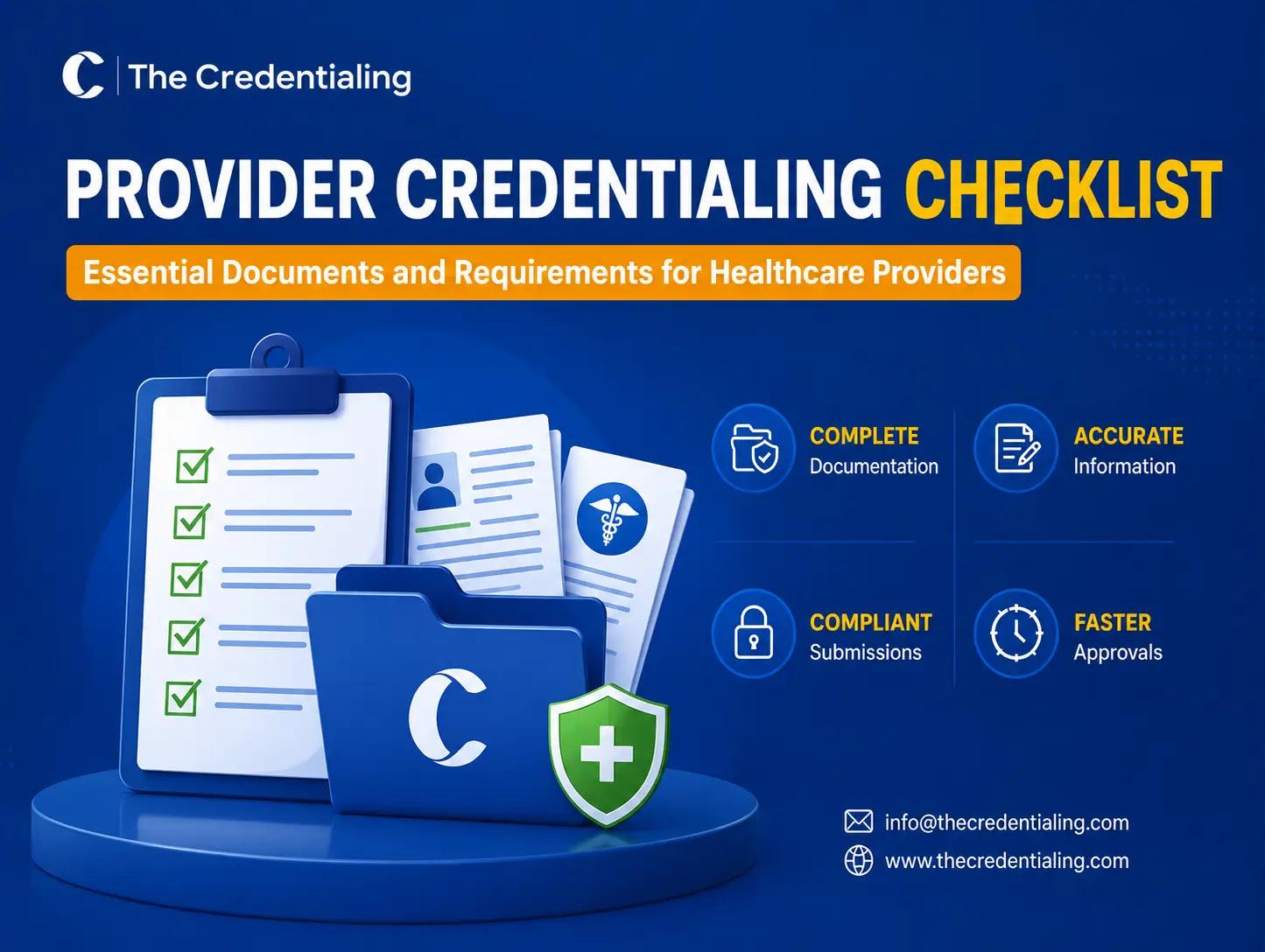
Provider Credentialing Checklist: Essential Documents and Requirements for Healthcare Providers
Before patient care and reimbursement are authorized, all healthcare facilities, like practices, clinics, medical centres, and hospitals, along with payers, rely on credentialing to verify whether providers meet professional and legal requirements.
A thorough healthcare provider credentialing checklist ensures that all required documents are accurately verified and submitted.
In this guide, we will explain the true purpose of a provider credentialing checklist, outline the credentialing documents requested during the process of verification, and provide separate checklists for doctors and nurses. We will also include a practical credentialing checklist template and will guide you on maintaining the records of credentialing.
What Is a Provider Credentialing Checklist?
A provider credentialing checklist is a structured record that includes several things, such as documents, licenses, certifications, and professional information. During the credentialing process, this structured record is required and used to verify a provider’s qualifications.
Actually, a credentialing checklist serves as a reference throughout the credentialing process by identifying every document that must be verified or submitted before a provider is approved to practice his profession in a healthcare network or his area.
Additional documentation may be requested sometimes because payer requirements vary. But the core requirements remain consistent across commercial insurance companies, Medicare, Medicaid, hospitals, and healthcare organizations.
Required records can be more effectively monitored, expiration dates can be tracked, and missing documentation can also be identified before application submission by using a standardized checklist, which actually helps in maintaining consistency within practices.
Why Is a Provider Credentialing Checklist Important?
To confirm that healthcare providers meet professional standards, the process of medical credentialing becomes quite a necessity. Without a properly structured checklist, important documents can be overlooked and may cause confusion, resulting in incomplete applications and long processing times.
In many cases, applications are returned because supporting records are missing, expired, or inconsistent with previously submitted information.
A credentialing checklist supports the process by helping providers:
-
Organize required credentialing documents
-
Monitor license and certification expiration dates
-
Prepare complete payer enrollment applications
-
Reduce administrative errors
-
Maintain compliance with credentialing requirements
-
Simplify future recredentialing
Who Needs a Provider Credentialing Checklist?
Almost every medical practitioner needs a provider credentialing checklist for the confirmation of their qualifications and educational documents prior to enrollment, before delivering patient care, or insurance enrollment. There are different requirements for a credentialing process that depend on the specialty, state legislation, and payer policies, but an organized set of documentation can save you time and make the process smoother.
Healthcare professionals who often require a provider credentialing checklist include:
- Physicians (MDs and DOs)
- Nurse Practitioners (NPs)
- Physician Assistants (PAs)
- Behavioral Health Providers
- Psychologists and Licensed Therapists:
- Dental Specialists and Dentists
- Physical and Occupational Therapists
- Home Health Providers
- Durable Medical Equipment (DME) Suppliers:
- Telehealth Providers
- Group Medical Practices
- Hospitals and Healthcare Organizations
For any newly licensed provider, an experienced practitioner entering a new practice, or a health care organization onboarding several providers, it is important to have a consistent checklist to ensure that all necessary documentation is complete, accurate, and readily available.
Complete Provider Credentialing Checklist
Although requirements differ among payers and healthcare organizations, the following documents are requested in most credentialing applications.
|
Credentialing Requirement |
Commonly Required |
|
State professional license |
✓ |
|
National Provider Identifier (NPI) |
✓ |
|
DEA registration (when applicable) |
✓ |
|
CAQH profile |
✓ |
|
Curriculum vitae (CV) |
✓ |
|
Medical school diploma |
✓ |
|
Residency certificate |
✓ |
|
Fellowship certificate (if applicable) |
✓ |
|
Board certification |
✓ |
|
Professional liability insurance |
✓ |
|
Government-issued identification |
✓ |
|
Employment history |
✓ |
|
Professional references |
✓ |
|
Hospital privileges (if applicable) |
✓ |
|
Medicare enrollment |
When required |
|
Medicaid enrollment |
When required |
|
Background check |
Frequently required |
|
Sanctions disclosure |
✓ |
|
Continuing education records |
Some organizations |
The checklist should be reviewed before every application is submitted. Expired licenses, outdated insurance certificates, and incomplete work histories are among the most common reasons applications require correction.
How Does the Provider Credentialing Process Work?
The steps involved in credentialing are roughly the same, although they may vary among insurance companies and healthcare organizations. A provider goes through multiple steps of approval to participate in a healthcare network.
The typical provider credentialing process includes:
-
Gather all needed credentialing materials.
-
Fill out the provider's CAQH profile (if applicable).
-
Submit the credentialing application to the healthcare organization/payer.
-
Perform primary source verification of licenses, education, certifications, and professional history.
-
Full background checks and screening for sanctions.
-
Check to see that the application is correct and complete.
-
Be credentialed as needed by a credentialing committee.
-
Full participation in the payer system and network participation.
This can take different amounts of time depending on the payer, healthcare organization, specialty, and the fullness of the paperwork submitted. Having good records all year long can help minimize processing delays.
Credentialing Documents Explained
Each document included in the credentialing process serves a specific verification purpose. Understanding these can make document preparation simple and reduce unnecessary delays.
State Professional License
An active and unrestricted state license is considered an important credentialing document. Whether the provider has met the legal requirements established by the state licensing board, the licensure must confirm that the license remains valid throughout the process of credentialing and should be renewed before its expiration date.
National Provider Identifier (NPI)
The National Provider Identifier is a unique identification number assigned to healthcare providers. It is used throughout the healthcare system for billing, claims processing, and provider identification.
Credentialing applications typically require the provider's Type 1 NPI. Healthcare organizations may also provide a Type 2 NPI for organizational billing purposes.
DEA Registration
A Drug Enforcement Administration registration is required only for providers who prescribe controlled substances. The registration must correspond with the provider's practice information and remain active throughout participation with the payer.
When controlled substances are not prescribed, this document is generally not requested.
CAQH Profile
The Council for Affordable Quality Healthcare maintains a centralized provider database that is widely used by commercial insurance companies. Rather than requesting identical information from every provider, many payers retrieve credentialing information directly from an authorized CAQH profile.
For this reason, the profile should be kept complete and regularly attested. Information stored within the profile should remain consistent with every credentialing application submitted to insurance companies.
Curriculum Vitae
A current curriculum vitae provides a chronological summary of the provider's education, training, employment history, certifications, and professional experience.
Most credentialing organizations expect employment history to be presented without unexplained gaps. If periods of unemployment have occurred, explanations may be requested during the process of credentialing review.
Education and Training Records
To confirm that the provider has completed the necessary academic studies and clinical training required for professional practice, educational documents, along with all the relevant qualifications, are verified.
Supporting provider documentation may include:
-
Medical school diploma
-
Residency completion certificate
-
Fellowship certificate
-
Internship records, when requested
-
Graduate degree documentation for advanced practice providers
Primary source verification is commonly performed before credentials are approved.
Board Certification
Board certification demonstrates that specialty-specific standards have been satisfied after completion of postgraduate training. Although board certification is not mandatory for every provider, it is requested by many hospitals, employers, and insurance networks.
When certification has been renewed, current documentation should also be included within the credentialing file.
Professional Liability Insurance
During payer enrollment and hospital credentialing, evidence of professional liability insurance is requested. Documentation usually includes a certificate of insurance containing the limits of policy, coverage dates, and the insurance carrier.
An updated certificate may be requested if coverage expires during the process of credentialing or before approval is granted.
Employment History
Professional work history allows credentialing organizations to verify several things, such as previous employment, clinical experience, and practice locations.
Employment information generally includes:
-
Employer name
-
Practice address
-
Position held
-
Employment dates
-
Reason for leaving, when requested
Because discrepancies often require additional verification, consistency between the curriculum vitae, CAQH profile, and the application of credentialing is important.
Professional References
Peer references are requested frequently to evaluate competence and performance. References are usually expected from providers who have directly observed the applicant's clinical practice within recent years.
The number of references required varies among medical facilities, although two or three professional references are often requested.
Hospital Privileges
Hospital privileges verify whether a provider has been authorized to perform clinical services within a medical facility. This requirement is generally applicable to specialists whose scope of practice includes inpatient care or hospital-based procedures. Providers who practice exclusively in outpatient settings may not be required to submit hospital privilege documentation.
What Is Primary Source Verification (PSV)?
Primary source verification, or PSV, is easily one of the most critical steps in the provider credentialing process. It is how we re-confirm that all the submitted information is completely accurate, current, and legitimate.
Instead of relying only on documents submitted by the provider, Credentialing teams don't just cross their fingers and accept a provider's paperwork; they go right to the source to verify every qualification. This process gives enormous benefits such as keeping your compliance tight, your patients safe, and your practice's reputation completely airtight.
Typical primary source verification (PSV) elements are:
-
A state-professional license verification system.
-
A system to verify professional licensure at the state level.
-
National Provider Identifier (NPI) confirmation is required.
-
Verification of DEA registration (if applicable),
-
The verification of medical school education.
-
The verification of residency and fellowship training.
-
Board certification verification
-
Hospital privilege confirmation
-
Professional liability insurance verification
-
When necessary, verification of Medicare and Medicaid enrollment.
-
National sanctions and exclusion screening.
Primary source verification is performed by most hospitals, insurance companies, and health care organizations before authorizing credentialing applications. If there are discrepancies, further documentation and clarification may be required prior to proceeding with the review process.
Physician Credentialing Checklist
A physician credentialing checklist generally contains additional documentation because hospital appointments, specialty verification, and procedural privileges are often included within the review process.
Most physician credentialing applications require:
-
Active state medical license verification
-
National Provider Identifier
-
DEA registration, when applicable
-
Complete CAQH profile
-
Medical school diploma
-
Residency certificate
-
Fellowship documentation, if completed
-
Current board certification
-
Professional liability insurance
-
Employment history
-
Professional references
-
Government-issued identification
-
Hospital privileges, when applicable
-
Medicare and Medicaid enrollment information, when required
Before submission, each document should be reviewed to confirm that names, addresses, license numbers, and information about practice remain consistent across every record.
Nurse Practitioner Credentialing Checklist
The nurse practitioner credentialing checklist contains many of the same documents required for physicians, although additional requirements may depend on state regulations and the provider's scope of practice. Credentialing is completed to verify education, licensure, certification, and prescribing authority before participation in a payer network is approved.
A typical nurse practitioner credentialing file includes:
-
Active Registered Nurse (RN) license
-
Advanced Practice Registered Nurse (APRN) license, where applicable
-
National Provider Identifier (NPI)
-
National certification
-
Graduate nursing degree
-
DEA registration, if controlled substances are prescribed
-
Professional liability insurance
-
Current CAQH profile
-
Employment history
-
Professional references
-
Collaborative or supervisory agreement, where required by state law
Although many credentialing requirements are standardized, state practice laws should always be reviewed before an application is submitted.
NH Credentialing Requirements
The term NH credentialing is commonly used to describe the credentialing process followed by healthcare providers practicing in New Hampshire. While the basic requirements are identical to those in other states, payer policies and state regulations may require additional documentation.
Healthcare providers applying for credentialing are generally expected to maintain:
-
An active New Hampshire professional license
-
National Provider Identifier
-
DEA registration, when applicable
-
Current professional liability insurance
-
Education and training records
-
Board certification, if applicable
-
CAQH profile
-
Medicare or Medicaid enrollment, when required
-
Complete employment history
Based on specialty, facility requirements, or participation agreements, insurance companies and healthcare facilities may request additional information. For that reason, payer guidelines should always be reviewed before documentation is submitted.
Provider Credentialing vs. Insurance Credentialing
Although the terms are often used interchangeably, provider credentialing and insurance credentialing serve different purposes within healthcare administration.
|
Provider Credentialing |
Insurance Credentialing |
|
Verifies professional qualifications |
Enrolls providers with insurance companies |
|
Reviews education, training, and experience |
Establishes participation in payer networks |
|
Confirms licenses and certifications |
Enables reimbursement for covered services |
|
Includes primary source verification |
Includes payer enrollment requirements |
|
Required by hospitals and healthcare organizations |
Required by commercial insurers, Medicare, and Medicaid |
Provider credentialing ensures that a healthcare professional is qualified and licensed, and insurance credentialing enables healthcare providers to enter into payer networks and collect reimbursement for their services. For many practitioners, early provider credentialing is necessary before they can get their insurance enrollment.
Provider Credentialing Checklist Template
A standardised provider credentialing checklist template helps organise documents, monitor expiration dates, and identify missing information before an application is submitted.
|
Credentialing Item |
Status |
Expiration or Review Date |
|
State license |
☐ |
__________ |
|
NPI |
☐ |
N/A |
|
DEA registration |
☐ |
__________ |
|
CAQH profile updated |
☐ |
__________ |
|
Board certification |
☐ |
__________ |
|
Professional liability insurance |
☐ |
__________ |
|
Curriculum vitae updated |
☐ |
__________ |
|
Medical education records |
☐ |
Permanent |
|
Residency or fellowship records |
☐ |
Permanent |
|
Employment history reviewed |
☐ |
__________ |
|
Professional references |
☐ |
__________ |
|
Medicare enrollment |
☐ |
__________ |
|
Medicaid enrollment |
☐ |
__________ |
|
Hospital privileges |
☐ |
__________ |
The template should be reviewed regularly instead of only during initial credentialing. Ongoing maintenance allows expired documents to be replaced promptly and reduces preparation time during recredentialing.
How Long Does Provider Credentialing Take?
The time required to complete provider credentialing varies because it depends on the healthcare organization, insurance company, as well as specialty, and whether all the required documentation is submitted accurately.
Typical credentialing timelines include:
|
Credentialing Type |
Estimated Time |
|
Commercial Insurance Credentialing |
60–120 days |
|
Medicare Enrollment |
45–90 days |
|
Medicaid Enrollment |
Varies by state |
|
Hospital Credentialing |
90–180 days |
|
Recredentialing |
Typically shorter than initial credentialing |
Processing times may be longer if applications are incomplete, licenses have expired, or documents are missing or inconsistent with the information on the CAQH profile. To minimize delays, you must prepare early documentation and keep your records up-to-date.
How Much Does Provider Credentialing Cost?
The cost of provider credentialing is not static. It highly fluctuates due to several factors, such as the doctor’s specialty, total insurance networks involved, the complexity of the application, and whether the credentialing process is outsourced to a credentialing team or is managed in-house.
Healthcare organizations may incur costs related to:
-
Administrative staff responsible for credentialing
-
Credentialing software and document management systems
-
Provider enrollment with multiple insurance companies
-
Ongoing monitoring and recredentialing activities
-
Outsourced credentialing and payer enrollment services
Although credentialing requires an investment of time and resources, maintaining organized documentation and standardized credentialing processes can help reduce administrative expenses, minimize application delays, and support faster participation in insurance networks.
Best Practices Of Credentialing Checklist for Physicians:
The effectiveness of a credentialing checklist is improved when records are maintained throughout the year rather than assembled immediately before submission.
Commonly, the following practices are recommended:
-
Maintain digital copies of all documents.
-
Checking license and certification expiration dates.
-
Regularly updating the curriculum vitae (CV).
-
The CAQH profile must be kept attested and complete.
-
Consistent names, addresses, and license numbers.
-
Stored Malpractice insurance certificates with policy information.
By managing records consistently, you can significantly reduce administrative burden and speed up the application processing times.
Common Credentialing Mistakes

Most credentialing processes are delayed because of incomplete documentation rather than eligibility concerns. But to be clear, many of these avoidable delays can be prevented by continuously reviewing every document before submission.
Common mistakes include:
Expired Licenses or Certifications
Applications may remain pending until renewed licenses or certifications are received.
Incomplete Employment History
When gaps in employment history are not explained, organizations of credentialing often request additional documentation before continuing the review process.
Outdated CAQH Information
The information submitted is compared to the provider's CAQH profile by insurance companies. The variations in records can lead to clarifications being requested.
Incorrect Practice Information
The name of the provider, address, phone number, and tax identification number should be the same in all applications.
Missing Supporting Documents
Applications are sometimes incomplete because they lack certificates of professional liability insurance, board certification, or educational records.
The provider credentialing checklist can be reviewed again before submission, and many of these avoidable delays can be avoided.
Provider Recredentialing Checklist
Credentialing is not a one-time process. It is a non-stop process that you repeat about every three years. Most healthcare organizations, hospitals, and insurance companies require providers to complete recredentialing at regular intervals to confirm that professional qualifications remain current.
A provider recredentialing checklist typically includes:
-
Active professional license verification
-
Updated DEA registration, when applicable
-
Current board certification
-
Professional liability insurance certificate
-
Updated curriculum vitae (CV)
-
Current CAQH profile attestation
-
Recent employment history
-
Updated professional references
-
Hospital privilege verification, when applicable
-
Medicare and Medicaid enrollment updates, when required
Throughout the year, maintaining these records helps in simplifying future recredentialing and considerably reduces the likelihood of several interruptions that you see in payer participation or reimbursement.
How Often Should Credentialing Documents Be Updated?

Records of credentials should be kept ongoing and not be updated when recredentialing is underway. Information regarding changes in professional qualifications or regarding professional practice should be documented as soon as possible.
Changes are usually necessitated after changes to the following:
-
State licensure
-
DEA registration
-
Board certification
-
Practice location
-
Professional liability insurance
-
Employment
-
Hospital privileges
-
Contact information
There are some insurance companies that mandate recredentialing every three years; some may have different intervals for individual payer policies.
How Healthcare Organizations Manage Credentialing Documents
Through standardized processes, healthcare organizations sometimes manage provider credentialing documents that help in maintaining compliance, improving efficiency, and reducing several types of administrative risk. Rather than collecting documents only during credentialing or recredentialing, many organizations maintain centralized credentialing records throughout the year.
Common credentialing management practices include:
-
Maintaining secure digital copies of credentialing documents
-
Monitoring license, certification, and insurance expiration dates
-
Regularly updating provider information in CAQH
-
Reviewing employment history and professional qualifications
-
Tracking recredentialing deadlines
-
Maintaining documentation required by hospitals, commercial insurers, Medicare, and Medicaid
-
Using credentialing software to improve document management and workflow efficiency
Consistently managing credentialing records helps medical organizations respond more quickly to credentialing requests, maintain regulatory compliance, and reduce delays during the process of provider enrollment and recredentialing.
Conclusion
A well-organized provider credentialing checklist serves as a practical reference throughout the credentialing process. By maintaining complete credentialing documents, monitoring expiration dates, and reviewing records before submission, healthcare providers can improve application accuracy and reduce administrative delays.
Whether a physician credentialing checklist, a nurse practitioner credentialing checklist, or a general credentialing checklist template is being used, the same objective applies: accurate verification of professional qualifications. Consistent documentation practices also support recredentialing, payer enrollment, hospital appointments, and ongoing regulatory compliance, making organized credentialing records an essential part of healthcare administration.
Frequently Asked Questions
What is included in a provider credentialing checklist?
Standard things that should be on a provider credentialing checklist include professional licenses, NPI, DEA registration, CAQH profile, education records, board certification, malpractice insurance, employment history, professional references, and more that are needed for the provider information to be verified.
What documents are required for physician credentialing?
Typical physician credentialing programs call for a Medical License, Medical Practice Identification Number, Drug Enforcement Administration enrollment, medical education history, residency proof, board certification, malpractice insurance, employment history, along with hospital privileges, and references from medical colleagues.
Is a physician credentialing checklist different from a nurse practitioner credentialing checklist?
Yes. Both require many of the same credentialing documents, but nurse practitioners may also be required to submit advanced practice licensure, national certification, and collaborative practice agreements where state law applies.
Why is a provider credentialing checklist template useful?
A credentialing checklist template helps organize required documents, monitor renewal dates, identify missing records, and simplify both initial credentialing and future recredentialing.
What are the most common reasons credentialing applications are delayed?
Applicants have their applications delayed because of their outdated licenses, incomplete employment history, outdated CAQH information, and provider details that don't match between the applicant's application and the CAQH form.
What documents are required for healthcare credentialing?
Healthcare organizations typically require a completed application, an active state license, DEA registration (if applicable), NPI, board certifications, malpractice insurance, work history, education records, government-issued identification, and any additional medical credentialing documents requested by the payer or facility.
What is a provider credentialing checklist?
A provider credentialing checklist is a structured list of all required records, licenses, certifications, and supporting information that helps providers submit complete applications, meet provider credentialing requirements, and reduce delays during the process of healthcare provider verification.
What documents are needed for physician credentialing?
Common physician credentialing documents include a valid medical license, medical school diploma, residency and fellowship certificates, board certification, DEA registration, malpractice insurance, NPI, CV, employment history, and any additional records required by specific insurers or hospitals.
What should be included in a credentialing checklist?
A healthcare credentialing checklist should include all provider enrollment documentation, license renewal dates, education and training records, professional references, malpractice coverage, employment history, board certifications, CAQH profile status, and other insurance credentialing requirements requested by payers.
What are the provider enrollment requirements before applying to insurance networks?
Provider enrollment requirements generally include maintaining an active professional license, obtaining an NPI, completing CAQH where applicable, securing malpractice insurance, gathering supporting documentation, and ensuring all information is accurate before submitting enrollment applications.
What are the provider credentialing requirements in the USA?
Provider credentialing requirements in the United States vary by payer and healthcare organization, but most follow a standard medical credentialing checklist in the USA that includes identity verification, license validation, education and training review, work history, malpractice coverage, sanctions screening, and primary source credential verification before approval.
Sit Back and Relax! Let The Pros Handle Credentialing For You!
thecredentialing has built a strong portfolio while providing credentialing services to clients over the years. Our service includes helpful features that you won’t find anywhere else.
Schedule Free Demo Today!