Medicaid Provider Enrollment: Requirements, Application Process & Status Guide
Learn how Medicaid provider enrollment works in the U.S., including requirements, documents, application steps, status checks, state differences, and common delays.
Schedule Free Demo Today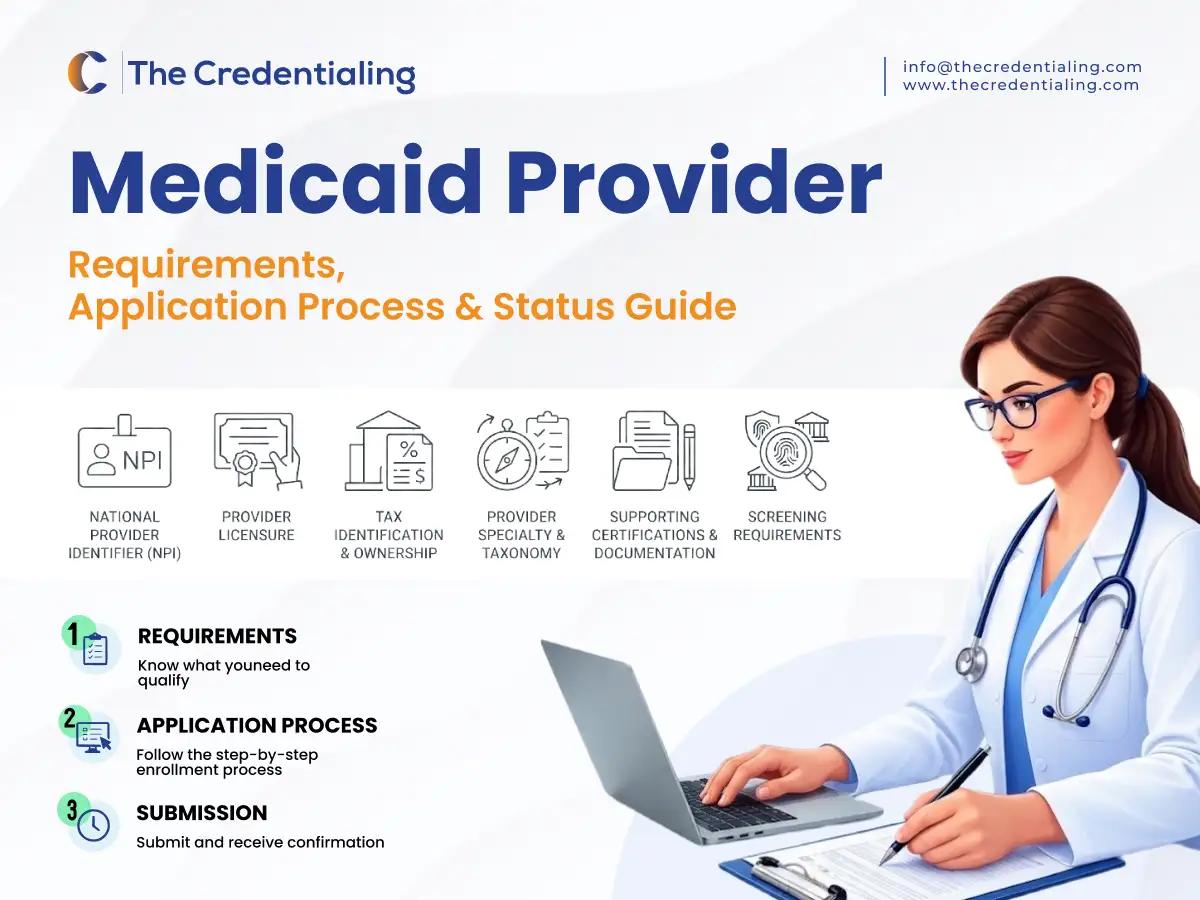
Medicaid Provider Enrollment: What U.S. Healthcare Providers Need to Know
Medicaid provider enrollment is the process healthcare providers complete to participate in a state's Medicaid program and become eligible to provide covered services under that program. Unlike Medicare, Medicaid is administered by individual states, so the enrollment process, application requirements, provider categories, portals, screening procedures, and documentation can vary depending on where a provider wants to participate.
For healthcare providers operating in the United States, understanding these differences is important before submitting an application. A complete enrollment application generally requires accurate provider information, identification details, licenses and certifications where applicable, ownership information, and other documentation required by the state Medicaid agency.
Federal Medicaid rules establish important provider screening and enrollment requirements, but states administer their own Medicaid programs and determine many program-specific enrollment procedures.
Quick Answer:
Medicaid provider enrollment is state-specific. If you want to participate in Medicaid in more than one state, you generally need to follow each state's Medicaid provider enrollment requirements rather than relying on a single nationwide enrollment application.
What Is Medicaid Provider Enrollment?
Medicaid provider enrollment registers a healthcare provider with a state's Medicaid program so the provider can participate according to that program's rules.
The enrollment process helps the Medicaid agency establish that a provider meets applicable participation requirements and allows the state to conduct required screening and verification.
Federal requirements under 42 CFR Part 455, Subpart E establish Medicaid provider screening and enrollment standards. Depending on the provider category and applicable risk level, screening can include activities such as database checks, site visits, and fingerprint-based criminal background checks.
The exact process, however, is not identical nationwide.
For example, a provider enrolling with New York Medicaid follows New York's enrollment process and portal rather than a universal federal Medicaid enrollment portal. New York's official enrollment guidance includes obtaining an NPI when required and submitting an enrollment application through its provider enrollment system.
Medicaid Provider Enrollment vs. Medicaid Credentialing
These terms are related but should not automatically be treated as the same process.
Provider enrollment generally concerns registering and screening a provider for participation in the Medicaid program.
Credentialing focuses on verifying qualifications and other information required for participation in a managed care network or other healthcare network.
In some Medicaid managed-care arrangements, credentialing may be performed by the state Medicaid agency, a managed care organization, or another delegated entity. The relationship between enrollment and credentialing can therefore vary by state and health plan.
Who Needs to Enroll With Medicaid?
Healthcare providers and organizations that want to participate in a state Medicaid program generally need to meet that state's provider enrollment requirements.
The exact provider types eligible for Medicaid participation can vary because states have flexibility in determining covered provider types and applicable qualifications, subject to federal requirements.
Depending on the state and Medicaid program, enrollment may apply to providers such as:
-
Physicians
-
Nurse practitioners
-
Physician assistants
-
Behavioral health providers
-
Dentists
-
Physical therapists
-
Occupational therapists
-
Speech-language pathologists
-
Home health providers
-
Durable medical equipment providers
-
Laboratories
-
Pharmacies
-
Clinics
-
Group practices
-
Other eligible healthcare organizations
Eligibility and enrollment requirements should always be confirmed with the specific state Medicaid agency because provider categories and participation requirements are not identical across all states.
Medicaid Provider Enrollment Requirements
There is no single checklist that applies identically to every Medicaid provider in every state.
However, providers should be prepared to provide accurate information and supporting documentation commonly associated with Medicaid enrollment.
Depending on the provider type and state, requirements may include:
National Provider Identifier (NPI)
Providers generally need an applicable NPI for Medicaid enrollment and claims-related activities. States may have specific rules regarding individual and organizational NPIs.
The NPI should match the provider information used throughout the enrollment application.
Provider Licensure
A current state license or other applicable authorization may be required based on the provider's profession and the services being enrolled.
Providers should verify that license information is accurate and current before submitting an application.
Tax Identification Information
The provider or organization may need to provide applicable tax identification information and related ownership or billing details.
Ownership and Control Information
Medicaid enrollment may require information about owners, controlling interests, managing employees, or other individuals associated with the provider organization.
Federal Medicaid screening rules include requirements concerning ownership and controlling interests.
Provider Specialty and Taxonomy Information
Providers may need to identify their provider type, specialty, taxonomy, practice locations, and services they intend to provide through the Medicaid program.
Supporting Certifications and Documentation
Depending on the provider category, state, and program, additional documentation may be required.
This can include professional certifications, accreditation information, liability insurance, facility documentation, or other state-specific records.
Screening Requirements
Certain providers may be subject to additional screening based on the Medicaid provider screening framework and applicable risk category.
Federal requirements can include site visits, fingerprint-based background checks, and federal database checks depending on the applicable circumstances.
Documents Needed for Medicaid Enrollment

The exact document list varies by state, provider type, and enrollment category, so providers should use the official state Medicaid checklist as the final authority.
Commonly requested information or documentation may include:
|
Information or Document |
Why It May Be Required |
|
NPI |
Identifies the individual or organization |
|
State license |
Verifies professional authorization |
|
Tax identification information |
Establishes tax and billing identity |
|
May support tax and payer enrollment requirements |
|
|
Practice address |
Establishes service and enrollment locations |
|
Ownership information |
Supports required screening and disclosure |
|
Provider specialty information |
Identifies the services/provider category |
|
Liability insurance information |
May be required for applicable providers |
|
Accreditation or certification |
May apply to specific provider types |
|
Supporting enrollment forms |
Required by the state or provider category |
|
Banking/EFT information |
May be required for electronic payments |
Important: Do not assume every provider needs every document listed above. Medicaid requirements can vary significantly by state and provider type.
How to Apply for Medicaid Provider Enrollment

Although each state has its own process, the enrollment journey generally follows several stages.
Step 1: Identify the Correct State Medicaid Program
Determine which state's Medicaid program you need to enroll with.
If you plan to provide services to Medicaid beneficiaries in multiple states, review the enrollment requirements for each state separately. CMS's Medicaid Provider Enrollment Compendium specifically explains that Medicaid and CHIP programs are administered by individual states and advises providers to locate the enrollment instructions for each state where they seek to provide services.
Step 2: Confirm Provider Eligibility
Review the state's requirements for your provider type.
Check:
-
Provider category
-
Licensure requirements
-
NPI requirements
-
Practice location requirements
-
Ownership requirements
-
Certification or accreditation requirements
-
Screening requirements
Step 3: Prepare Provider Information
Make sure information is consistent across your:
-
NPI record
-
State license
-
Tax records
-
CAQH profile, where applicable
-
Practice records
-
Payer applications
-
Medicaid enrollment application
Data mismatches can create unnecessary questions or delays during enrollment.
Step 4: Gather Required Documents
Prepare the documents required by the state and provider category before beginning the application.
Do not submit an application simply because the basic information is available. Review the complete state checklist first.
Step 5: Submit the Medicaid Enrollment Application
Submit the application through the enrollment method designated by the state Medicaid agency.
Some states use online provider enrollment portals, while others may have additional forms, processes, or enrollment requirements depending on the provider category.
Step 6: Complete Required Screening
The state may perform applicable provider screening and verification.
Federal Medicaid rules establish screening requirements based on provider risk categories, with applicable procedures that can include database checks, site visits, and fingerprint-based background checks.
Step 7: Respond to Requests for Additional Information
If the Medicaid agency identifies missing information or needs clarification, respond promptly.
An application that is technically submitted but incomplete is not the same as an application that is ready for final approval.
Step 8: Monitor the Application
Keep track of:
-
Application status
-
Requests for information
-
Screening requirements
-
Effective dates
-
Enrollment identifiers
-
Revalidation or renewal obligations
Maintain copies of the submitted application and supporting documents for your records.
Medicaid Enrollment vs. Credentialing
One of the most common sources of confusion for healthcare practices is treating Medicaid enrollment and credentialing as interchangeable.
They are connected, but they can serve different purposes.
|
Medicaid Provider Enrollment |
Credentialing |
|
Registers/screens the provider for Medicaid participation |
Verifies qualifications and participation criteria |
|
Administered through the applicable Medicaid program |
May involve a Medicaid managed care organization or delegated credentialing entity |
|
Can involve state-specific screening |
Can involve professional qualification verification |
|
Supports participation in the Medicaid program |
Supports network participation when applicable |
|
Requirements vary by state and provider category |
Requirements can vary by health plan and network |
For Medicaid managed care, the distinction can become especially important. Some states use centralized credentialing approaches, while others may require providers to work with individual managed care plans.
Completing Medicaid enrollment does not automatically mean a provider is credentialed with every Medicaid managed care organization in a state.
Medicaid Enrollment by State
Medicaid provider enrollment is state-specific.
This is one of the most important differences between Medicaid and Medicare enrollment.
There is no single nationwide Medicaid provider enrollment application that automatically enrolls a provider in every state.
If a provider wants to participate in multiple state Medicaid programs, the provider generally needs to follow each applicable state's enrollment requirements.
For example:
-
A provider enrolling with New York Medicaid must follow New York's provider enrollment requirements.
-
A provider enrolling with Texas Medicaid must follow Texas Medicaid requirements.
-
A provider enrolling with California Medicaid/Medi-Cal must follow California's requirements.
-
A provider enrolling with Florida Medicaid must follow Florida's requirements.
The exact application process, provider categories, documentation, screening, portals, and managed-care requirements can differ.
What Should Providers Do Before Enrolling in Another State?
Before submitting another application:
-
Identify the state's Medicaid agency.
-
Confirm that your provider type is eligible.
-
Review the state's current enrollment requirements.
-
Confirm NPI and licensing information.
-
Review ownership and tax information.
-
Identify any state-specific screening requirements.
-
Determine whether managed care plans require additional credentialing.
-
Save copies of all submitted documentation.
This state-by-state approach is more reliable than assuming that completing enrollment in one state automatically transfers to another.
How to Check Medicaid Provider Enrollment Status
Because Medicaid is administered by individual states, there is no single nationwide provider enrollment status portal for all Medicaid programs.
Instead, providers should use the enrollment system or provider portal designated by the relevant state Medicaid agency.
Depending on the state, you may need information such as:
-
Provider NPI
-
Application ID
-
Provider number
-
Tax identification information
-
Login credentials
-
Other identifying information
A provider's status may indicate that an application is:
-
Submitted
-
Under review
-
Pending additional information
-
Approved
-
Denied
-
Active
-
Terminated
-
Due for revalidation or another required action
The exact terminology and available status information depend on the state.
What If Your Application Is Still Pending?
Do not immediately submit a duplicate application.
First:
-
Review the application's current status.
-
Check for requests for additional documentation.
-
Confirm that contact information is current.
-
Verify that the submitted information matches your official records.
-
Contact the appropriate state Medicaid enrollment support channel if clarification is needed.
-
Document all follow-up activity.
If the state requests additional information, respond within the required timeframe.
Common Medicaid Provider Enrollment Problems
Even when a provider meets the basic eligibility requirements, enrollment can be delayed by incomplete or inconsistent information.
1. NPI Information Does Not Match
Differences between the NPI record and the Medicaid application can create verification problems.
Review:
-
Legal name
-
Entity type
-
Practice address
-
Taxonomy
-
Organization information
2. Expired License or Credential
An outdated license or certification can prevent the application from moving forward.
Check expiration dates before submitting the application.
3. Missing Ownership Information
Organizations may need to provide ownership and controlling-interest information.
Incomplete disclosures can create additional review requirements.
4. Incorrect Tax Information
Tax ID, legal entity name, and billing information should be consistent.
5. Incomplete Application
A submitted application is not necessarily a complete application.
Missing fields, documents, signatures, or supporting information can result in additional requests.
6. Failure to Monitor the Application
Enrollment does not end when the application is submitted.
Providers need to monitor communications and respond to requests from the Medicaid agency.
7. Assuming Medicaid Credentialing Is the Same as Enrollment
A provider may complete state Medicaid enrollment and still have additional credentialing or contracting requirements with Medicaid managed care plans.
The process depends on the state and plan structure.
How Long Does Medicaid Provider Enrollment Take?
There is no single nationwide Medicaid enrollment timeline that applies to every provider.
The timeframe can depend on:
-
State Medicaid agency
-
Provider type
-
Application completeness
-
Screening level
-
Required documentation
-
Ownership disclosures
-
Site visits, when applicable
-
Fingerprint or background-check requirements, when applicable
-
Additional information requests
-
State-specific processing procedures
-
Managed care credentialing or contracting requirements
For this reason, providers should avoid relying on a generic national processing-time estimate.
The best source for a current processing estimate is the applicable state Medicaid agency.
How Can Providers Reduce Avoidable Delays?
You cannot control every part of a state Medicaid review, but you can reduce preventable problems by:
-
Verifying NPI information before applying
-
Confirming licenses are current
-
Preparing required documents in advance
-
Reviewing the application for completeness
-
Using consistent legal and practice information
-
Responding quickly to requests
-
Tracking application activity
-
Monitoring renewal and revalidation requirements
A clean application does not guarantee approval or a specific processing time, but it can reduce avoidable administrative issues.
Medicare vs. Medicaid Provider Enrollment
Medicare and Medicaid are both government healthcare programs, but their provider enrollment systems are different.
|
Medicare |
Medicaid |
|
Federal program |
Joint federal-state program |
|
Provider enrollment is administered through Medicare |
Provider enrollment is administered by individual state Medicaid programs |
|
PECOS is used for Medicare enrollment |
States use their own Medicaid enrollment systems/processes |
|
Federal Medicare requirements apply |
Federal requirements apply alongside state-specific Medicaid requirements |
|
Enrollment requirements are generally standardized nationally |
Requirements can vary by state and provider type |
A provider participating in both programs may need to complete both Medicare and Medicaid enrollment.
Completing Medicare enrollment does not automatically enroll a provider in a state's Medicaid program.
Likewise, Medicaid enrollment in one state does not automatically enroll the provider in another state's Medicaid program.
How Professional Enrollment Support Helps
Medicaid enrollment can become difficult when a practice is managing multiple providers, locations, states, or payer requirements at the same time.
Professional provider enrollment support can help organize the process by:
-
Reviewing provider information before submission
-
Preparing enrollment documentation
-
Identifying missing information
-
Coordinating application submissions
-
Monitoring application progress
-
Managing follow-up requests
-
Supporting multi-state enrollment workflows
-
Coordinating related credentialing and payer enrollment tasks
For organizations participating with Medicare, Medicaid, and commercial payers, centralized enrollment management can also help reduce repetitive administrative work.
TheCredentialing provides provider enrollment and credentialing support for healthcare providers and organizations across the United States, including multi-state Medicaid enrollment, Medicare enrollment, and commercial payer enrollment.
Need Help With Medicaid Provider Enrollment?
If your practice is managing Medicaid enrollment across multiple states or coordinating Medicaid with Medicare and commercial payer enrollment, TheCredentialing can help manage the administrative process.
Explore U.S. Provider Enrollment Services →
Medicaid Provider Enrollment Checklist
Before submitting a Medicaid enrollment application, review this basic checklist:
-
Confirm the correct state Medicaid program.
-
Confirm your provider type is eligible.
-
Verify your NPI information.
-
Confirm applicable state licenses are current.
-
Prepare tax and legal entity information.
-
Review ownership and controlling-interest information.
-
Gather required supporting documents.
-
Review state-specific screening requirements.
-
Complete the correct Medicaid enrollment application.
-
Review the application for missing information.
-
Submit through the state's designated enrollment process.
-
Monitor application status.
-
Respond to requests for additional information.
-
Save application and submission records.
-
Track future revalidation or renewal requirements.
Frequently Asked Questions About Medicaid Provider Enrollment
What is Medicaid provider enrollment?
Medicaid provider enrollment is the process of registering and screening an eligible healthcare provider with a state's Medicaid program so the provider can participate according to applicable program requirements.
Is Medicaid provider enrollment the same in every state?
No. Medicaid is administered by individual states, so enrollment procedures, provider requirements, portals, documentation, and screening processes can vary by state.
Can I enroll in Medicaid in more than one state?
Yes, when you are eligible to participate in multiple state Medicaid programs. However, you generally need to follow the enrollment requirements of each state where you want to participate.
Do I need an NPI for Medicaid enrollment?
An NPI is an important provider identifier and is required in many Medicaid enrollment situations. The exact requirements can vary by provider type and state.
Is Medicaid credentialing the same as Medicaid enrollment?
No. They can overlap, but enrollment and credentialing can serve different purposes. Managed care credentialing may involve a Medicaid managed care organization or another credentialing entity, depending on the state and plan.
How do I check my Medicaid provider enrollment status?
Use the provider enrollment portal or status-checking process provided by the state Medicaid agency where you submitted your application. There is no single nationwide Medicaid provider enrollment status portal.
How long does Medicaid provider enrollment take?
Processing time varies by state, provider type, application completeness, screening requirements, and other factors. Providers should check the applicable state Medicaid agency for current processing information.
What causes Medicaid enrollment applications to be delayed?
Common issues include incomplete applications, inconsistent provider information, missing documentation, expired licenses, ownership disclosures, screening requirements, and failure to respond to additional information requests.
Does Medicare enrollment automatically enroll me in Medicaid?
No. Medicare and Medicaid are separate programs with different enrollment processes. A provider participating in both generally needs to complete the applicable enrollment requirements for each program.
Can a credentialing company help with Medicaid enrollment?
Yes. A professional provider enrollment and credentialing company can assist with application preparation, documentation review, submission, follow-up, status tracking, and multi-state enrollment workflows, depending on the services provided.
Final Takeaway
Medicaid provider enrollment is not a one-size-fits-all process.
For U.S. healthcare providers, the most important starting point is identifying the state Medicaid program, provider category, and applicable enrollment requirements before submitting an application. Federal Medicaid rules establish important screening and enrollment standards, while states administer their programs and determine many of the operational requirements providers must follow.
If you are enrolling in multiple states or managing Medicaid alongside Medicare and commercial payer enrollment, maintaining accurate provider data and a consistent enrollment workflow becomes even more important.
Need help managing provider enrollment across Medicaid, Medicare, and commercial payers? Explore TheCredentialing's U.S. provider enrollment and credentialing services.
Official Sources
Sit Back and Relax! Let The Pros Handle Credentialing For You!
thecredentialing has built a strong portfolio while providing credentialing services to clients over the years. Our service includes helpful features that you won’t find anywhere else.
Schedule Free Demo Today!