What Documents Are Required for Credentialing? A Complete Provider Checklist
Learn which documents are needed for U.S. provider credentialing, including licenses, NPI, CAQH, malpractice insurance, CV, and group practice records.
Schedule Free Demo Today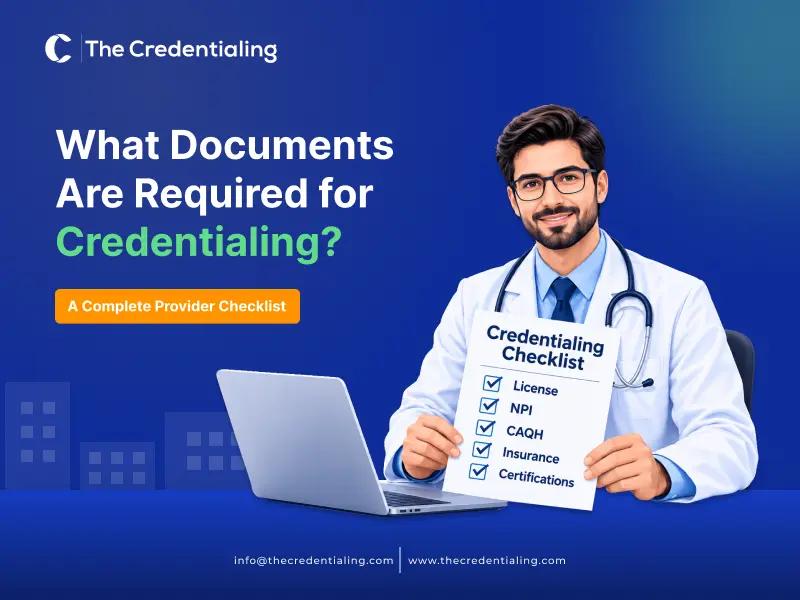
Healthcare provider credentialing requires more than submitting a medical license and completing an application. Insurance companies and healthcare organizations may need to verify your education, training, professional qualifications, work history, malpractice coverage, and practice information before considering you for participation in their networks.
If you are a physician, nurse practitioner, physician assistant, mental health professional, or practice administrator preparing for insurance credentialing in the United States, gathering the right documents before applying can help you avoid preventable errors and requests for missing information.
So, what documents are required for credentialing?
The exact requirements depend on your provider type, specialty, state, insurance payer, and whether you are applying as an individual practitioner, joining a group practice, or enrolling a healthcare organization. However, most provider credentialing workflows involve a common set of professional, administrative, and supporting records.
This guide covers the essential documents to prepare, additional requirements for group practices, CAQH documentation, common mistakes, and a practical checklist to help you organize your application.
Quick Answer: What Documents Are Required for Credentialing?
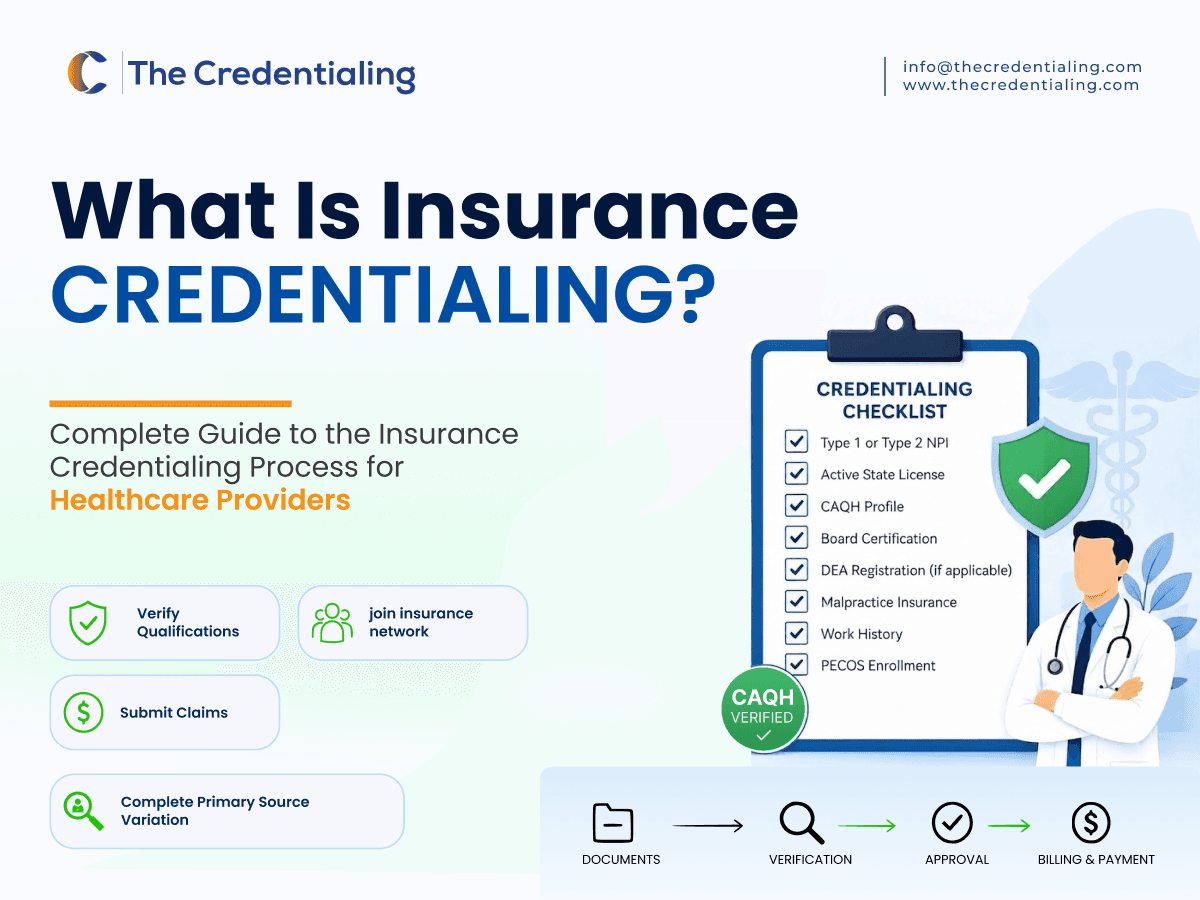
For U.S. healthcare provider credentialing, commonly requested documents and information include:
-
Current state professional license or licenses
-
National Provider Identifier (NPI)
-
Completed and attested CAQH Provider Data Portal profile, when applicable
-
Curriculum vitae (CV) with complete professional work history
-
Medical, professional, or other applicable education and training records
-
Board certification or specialty certification, when applicable
-
DEA registration and state controlled-substance registration, when applicable
-
Professional liability or malpractice insurance documentation
-
Hospital affiliations and clinical privileges, when applicable
-
Previous employment and practice history
-
Professional references, when requested
-
Medicare or Medicaid enrollment information, when applicable
-
Completed payer-specific credentialing application and required authorizations
-
IRS Form W-9 and tax identification information for applicable enrollment workflows
-
Group practice, ownership, and facility documentation, when applicable
This is a general preparation checklist, not a universal list of mandatory uploads. Some payers verify credentials directly through primary sources, while others request supporting documents or additional forms. Always confirm the requirements for your specific application.

1. Professional License and State Licensure Records
A current professional license is one of the most important components of a healthcare credentialing application.
Insurance payers generally need to establish that a practitioner is appropriately licensed to provide the services associated with the application. The required license depends on the provider's profession, state, and scope of practice.
Prepare the following, as applicable:
-
Current medical license for physicians
-
Registered nurse or advanced practice registered nurse license for applicable nursing professionals
-
Nurse practitioner authorization or certification required by the relevant state
-
Physician assistant license
-
Professional counselor, psychologist, clinical social worker, or therapist license
-
Additional state licenses for providers practicing in multiple states
Check that each license is active and that the name, license number, issuing state, and expiration date match the information entered in the credentialing application.
Important: Having a license in one state does not automatically satisfy the licensure requirements for practicing in another state. Check the licensing rules and payer requirements relevant to each practice location.
2. National Provider Identifier (NPI)
The National Provider Identifier is a standard identification number used in U.S. healthcare administrative transactions.
Providers should have the appropriate NPI information available before beginning credentialing and enrollment.
There are two common NPI types:
-
Type 1 NPI: Identifies an individual healthcare provider.
-
Type 2 NPI: Identifies an eligible organization, such as a group practice or healthcare organization.
Depending on your application, prepare your individual NPI, organizational NPI, or both.
Also verify that your NPI information is consistent with the information you submit to the payer, including your name or organization name, provider taxonomy, practice address, and other relevant details.
An NPI identifies a provider or organization; it does not, by itself, establish insurance network participation or replace payer enrollment requirements.
3. CAQH Provider Data Portal Profile and Supporting Documents
Many commercial health plans use CAQH to access provider information during credentialing. The CAQH Provider Data Portal allows participating organizations to retrieve information that providers maintain and authorize them to access.
Before starting an application, check whether the payer uses CAQH and whether your profile is complete, current, and appropriately authorized.
Information and documents to prepare may include:
-
Professional licenses
-
Education and training history
-
Board certification information, when applicable
-
DEA registration, when applicable
-
Professional liability insurance information
-
Practice locations and contact details
-
Hospital affiliations, where relevant
-
Employment and professional history
-
Other information or documents requested by the payer
Review your profile for outdated information, expired documentation, incomplete work history, and inconsistencies between your records and the payer application.
You may also need to complete the required attestation and authorize the appropriate health plan to access your information.
Completing a CAQH profile does not automatically complete credentialing with every insurer. Individual payers may still require separate applications, additional documentation, or other enrollment steps.
For a detailed explanation, read our CAQH credentialing guide.
4. Curriculum Vitae (CV) and Complete Work History
Your CV helps the credentialing organization review your professional background, employment history, education, training, and qualifications.
Prepare an updated CV that includes, as applicable:
-
Medical or professional education
-
Residency, internship, fellowship, or other relevant training
-
Previous and current employment
-
Practice locations
-
Professional positions and relevant appointments
-
Specialty qualifications
-
Relevant professional activities
Pay particular attention to employment dates and gaps in work history.
If your application requires a continuous work history, make sure the dates are complete and explain any periods that cannot be accounted for according to the payer's instructions.
A CV that lists only your current employer and education may not provide enough detail for the credentialing review.
Before submitting it, compare the information against your CAQH profile and payer application. Inconsistent dates, missing employers, and unexplained gaps can lead to requests for clarification.
5. Education, Training, and Board Certification Records
Credentialing organizations may verify the education and training required for your profession and specialty.
Depending on the provider type, prepare relevant records such as:
-
Medical, nursing, or other professional degree information
-
Medical school or professional education details
-
Residency and fellowship information
-
Internship or postgraduate training records
-
Board certification certificates or verification details
-
Specialty certifications, where applicable
-
Additional qualifications requested by the payer
Not every payer requires a copy of every diploma or training certificate. Some qualifications may be verified directly with the issuing institution or through another accepted verification process.
Check the specific application instructions before collecting or uploading additional records.
If you hold multiple certifications, confirm that the information you submit reflects your current qualifications and any applicable expiration dates.
6. DEA Registration and State Controlled-Substance Licenses
Some healthcare providers require Drug Enforcement Administration (DEA) registration or state controlled-substance authorization for their professional activities.
Where applicable, prepare:
-
Current DEA registration details or certificate
-
State controlled-substance registration
-
Relevant prescribing authorization or documentation requested by the payer
These requirements depend on the provider's profession, prescribing authority, state, and scope of practice.
For example, a provider who does not prescribe controlled substances may not need the same documentation as a practitioner whose role includes prescribing them.
Do not assume that DEA registration is mandatory for every provider. Confirm whether it applies to your role and whether the payer requests a copy, registration details, or another form of verification.
7. Professional Liability or Malpractice Insurance
Professional liability insurance documentation is commonly requested during provider credentialing.
Payers may use it to verify coverage information and determine whether the provider meets their applicable insurance requirements.
Prepare your current malpractice insurance declarations page or face sheet, where requested.
Review the document for:
-
Insured provider name
-
Insurance carrier
-
Policy number
-
Policy effective and expiration dates
-
Applicable coverage limits
-
Other information required by the payer
Make sure the provider is correctly identified as an insured party. For clinicians working within a group practice, confirm whether the existing policy covers the individual provider and the relevant practice arrangement.
Coverage limits and documentation requirements can differ between payers, specialties, and provider types. Do not assume that one policy satisfies every insurance network's requirements.
If your policy is approaching expiration, confirm what updated documentation the payer needs and when it must be provided.
8. Hospital Affiliations and Clinical Privileges
Some credentialing applications request information about hospital affiliations, admitting privileges, or clinical privileges.
Prepare the relevant information if it applies to your role, such as:
-
Current hospital affiliations
-
Hospital names and locations
-
Clinical privileges or privilege status, where requested
-
Relevant affiliation dates
-
Additional documentation required by the payer
These requirements vary by specialty, payer, and practice arrangement.
For example, a practitioner who provides outpatient services may have different affiliation requirements from a physician whose work involves hospital-based care.
Do not assume that every insurance payer requires hospital privileges or that the absence of a hospital affiliation automatically prevents credentialing. Follow the applicable payer's instructions and provide any required explanation or alternative documentation.
9. Professional References and Other Verification Information
Some applications request professional references or additional information to support credential verification.
Depending on the payer and provider type, you may need to prepare:
-
Professional reference names and contact information
-
Previous employer details
-
Training program information
-
Verification information for relevant qualifications
-
Explanations or supporting records for specific credentialing questions
The exact requirements vary. A professional reference list is not necessarily a mandatory document for every insurance credentialing application.
Use accurate, current contact details and ensure that any references you provide meet the payer's stated requirements.
10. Medicare, Medicaid, and Other Enrollment Information
If you are applying to participate in Medicare, Medicaid, or a related managed care network, you may need information beyond the standard professional credentialing documents.
Depending on the enrollment pathway, prepare applicable information such as:
-
Individual or organizational NPI
-
Tax identification information
-
Practice and service locations
-
Existing Medicare enrollment details
-
Existing Medicaid enrollment details
-
Ownership and managing-control information, when applicable
-
Supporting licenses and certifications
-
Program-specific forms and disclosures
Medicare enrollment requirements depend on the provider type and enrollment action. Many Medicare enrollment workflows use PECOS, the Provider Enrollment, Chain, and Ownership System.
Medicaid requirements vary by state and program. Managed care plans may also have separate credentialing or network participation requirements.
Do not treat commercial insurance credentialing, Medicare enrollment, and state Medicaid enrollment as interchangeable processes. Confirm the documentation required for each application.
11. IRS Form W-9 and Tax Identification Information
Tax and business information is especially important when enrolling a provider under a group practice or organization.
Depending on the payer and enrollment workflow, prepare:
-
Completed IRS Form W-9
-
Employer Identification Number (EIN), when applicable
-
Relevant tax identification information
-
Legal business name and tax classification
-
Corresponding practice or organization details
The legal name and tax information should be consistent with the applicable IRS records and payer application.
For group practices, pay attention to the relationship between the billing entity, tax identification number, organizational NPI, and individual practitioners.
An individual provider's credentialing file and the group's enrollment file may require different information. Confirm whether the payer is credentialing the practitioner, enrolling the organization, or processing both.
12. Practice Address, Contact Information, and Location Records
Accurate practice information helps payers associate the provider with the correct service location and administrative records.
Prepare the information requested for each relevant location, including:
-
Physical practice address
-
Mailing address, if different
-
Office telephone number and fax number, where applicable
-
Practice contact or administrator details
-
Specialty and service information
-
Individual and organizational NPI details, as applicable
-
Location-specific information required by the payer
Check suite numbers, ZIP codes, telephone numbers, and legal business names carefully.
If you practice at multiple locations, do not assume that one address or one enrollment record automatically covers every location. Follow the payer's location and participation requirements.
13. Additional Documents for Group Practices and Healthcare Organizations
Group practices and healthcare organizations may need to provide both individual practitioner information and organization-level documentation.
In addition to the applicable clinician records, prepare the following where requested:
-
Organizational NPI
-
IRS Form W-9 and tax identification information
-
Legal business or organization details
-
Ownership and managing-control disclosures
-
Practice location information
-
Provider rosters
-
Group-to-provider affiliation information
-
Applicable state or facility licenses
-
Accreditation or certification records, when required
-
Organizational insurance documentation, where applicable
-
Banking information for separate EFT enrollment, when requested
-
Payer-specific group enrollment forms and agreements

Requirements depend on the organization's structure and the payer's enrollment process. For example, a physician group, behavioral health organization, laboratory, and home health agency may have different licensing and supporting-document requirements.
A group practice should also check that each individual provider is correctly associated with the intended organization, tax identification number, and service location where required.
For practices enrolling multiple providers, maintaining a separate, organized file for each clinician alongside a central organization file can make document tracking and updates easier.
14. Documents That May Be Needed for Re-Credentialing
Re-credentialing is not always the same as initial credentialing.When a payer reviews an existing provider, it may use information already on file and request updated records rather than require the entire original document set again.
Depending on the payer, prepare or review:
-
Current professional licenses
-
Updated malpractice insurance documentation
-
Renewed DEA or controlled-substance registration, when applicable
-
Updated board certification information
-
Revised work or practice history, where relevant
-
Current practice locations and contact details
-
Updated CAQH information and attestation, when applicable
-
Required re-credentialing forms and disclosures
Check expiration dates and confirm which documents the payer needs for the specific re-credentialing cycle.
If your practice has changed locations, added clinicians, changed ownership, or updated its tax information, determine whether separate enrollment maintenance or notification steps are also necessary.
Complete Provider Credentialing Document Checklist
Use this checklist to organize your records before starting an application.
Individual provider documents
-
Current professional license or licenses
-
Individual NPI information
-
Completed and attested CAQH profile, when applicable
-
Updated CV and work history
-
Education and training information
-
Board or specialty certification records, when applicable
-
DEA and state controlled-substance registration, when applicable
-
Current malpractice insurance documentation
-
Hospital affiliation or privilege information, when applicable
-
Professional references, if requested
-
Medicare or Medicaid enrollment details, when applicable
-
Completed payer application and required authorizations
Group practice or organization documents
-
Organizational NPI, when applicable
-
IRS Form W-9 and relevant tax identification information
-
Legal business and ownership information, when requested
-
Practice and service location details
-
Provider roster and group affiliations
-
Applicable facility or organization licenses
-
Required accreditation or certification records
-
Organization-level insurance documentation, where applicable
-
EFT or banking enrollment information, if required for a separate process
-
Payer-specific group enrollment forms and agreements
This checklist is a starting point. Cross-check it against the current instructions for every payer and enrollment pathway before submitting your application.
Common Document Mistakes That Can Delay Credentialing
Even when a provider has all the main documents, inconsistent or incomplete information can create additional work.
Expired licenses or insurance documents
Check expiration dates before submitting your application. If a document is due for renewal, follow the applicable payer's instructions for providing updated records.
Inconsistent provider information
Compare the provider's name, license details, NPI, practice address, and other relevant information across the application, CAQH profile, and supporting documents.
Differences that appear minor, such as a missing suite number or outdated business name, may require clarification.
Incomplete employment history
Review the payer's work-history requirements and make sure all required periods are accounted for. Explain gaps when requested rather than leaving required fields incomplete.
Missing or outdated CAQH information
A profile may contain old practice addresses, expired documents, incomplete sections, or outdated professional information.
Review the current profile and the payer's access requirements before submitting a new application.
Missing group or organization details
Individual practitioners joining a group may need additional information about the billing organization, tax identification number, service locations, or group affiliations.
Confirm which entity is being enrolled and which documents belong to the individual versus the organization.
Uploading documents without checking the instructions
Payers may specify file formats, signatures, naming conventions, or other submission requirements. Follow the current instructions and make sure each document is legible.
Avoid sending sensitive personal or financial information through unapproved channels.
How to Prepare Your Documents Before Applying
A simple preparation process can make credentialing administration easier.
Step 1: Identify the payer and enrollment pathway. Determine which insurance plan or organization you are applying to and whether you are submitting an individual, group, facility, Medicare, or Medicaid enrollment application.
Step 2: Obtain the current requirements. Review the payer's official checklist and determine which documents are mandatory, conditional, or subject to direct verification.
Step 3: Organize the records. Keep individual provider documents separate from group practice and organization records. Label files clearly so that the correct information can be located when needed.
Step 4: Check accuracy and expiration dates. Compare names, license numbers, addresses, tax details, and dates across the application and supporting records.
Step 5: Complete the required profiles and forms. Update the CAQH Provider Data Portal where applicable and complete the payer's application and authorizations.
Step 6: Submit and monitor the application. Follow the payer's submission instructions, retain confirmation details, and respond to requests for additional information.
Step 7: Track renewals and maintenance. Maintain a record of expiring licenses, insurance policies, certifications, and other documents that may need updating.
How TheCredentialing Can Help With Provider Credentialing
Preparing credentialing documents can become complicated when a practice is enrolling several providers, working with multiple insurance payers, or managing different practice locations.
TheCredentialing supports healthcare providers and group practices with provider credentialing and enrollment, CAQH profile services, and related enrollment and maintenance workflows.
Depending on your requirements, support may include:
-
Organizing provider information and supporting documentation
-
Assisting with CAQH profile management
-
Coordinating payer-specific credentialing and enrollment applications
-
Supporting group practice and provider affiliation workflows
-
Monitoring application progress and helping address requests for additional information
-
Assisting with ongoing credentialing maintenance and re-credentialing
The exact scope depends on your provider type, payer requirements, and service arrangement.
If you are preparing for initial credentialing, adding providers to an existing practice, or managing multiple insurance applications, visit our provider credentialing and enrollment services page to learn more.
Need help organizing your credentialing requirements? Contact TheCredentialing to discuss your provider type, practice structure, and target insurance networks.
Frequently Asked Questions
What documents are required for medical credentialing?
Commonly requested records include a professional license, NPI information, CV, education and training details, malpractice insurance documentation, and applicable certifications. Depending on the payer, you may also need CAQH information, DEA registration, work history, hospital affiliations, and additional application forms.
Is CAQH required for every insurance credentialing application?
No. Many commercial health plans use CAQH, but requirements vary by payer and enrollment pathway. Some organizations use other application processes or request additional information outside the CAQH profile. Confirm the requirements of each insurance plan.
Do nurse practitioners need different credentialing documents from physicians?
Some core requirements overlap, including professional licensure, NPI information, education and training, and work history. Nurse practitioners may also need applicable certification, state authorization, and other documentation depending on their state, specialty, prescribing authority, and payer requirements.
Do mental health providers need malpractice insurance for credentialing?
A payer may request professional liability insurance documentation as part of its credentialing requirements. The exact requirements depend on the provider's license, specialty, payer, and practice arrangement. Check the current instructions for the relevant insurance network.
Do group practices need a W-9 for provider credentialing?
A W-9 is commonly requested in applicable group or organizational enrollment workflows. Whether it is required for a specific application depends on the payer and the entity being enrolled. The practice should confirm its tax information and legal business details before submission.
Can I use the same documents for every insurance payer?
Some core documents can be used across multiple applications if they remain current and meet each payer's requirements. However, individual plans may request additional forms, disclosures, authorizations, or information. Review each payer's instructions rather than assuming one document package is sufficient for every network.
What happens if a credentialing document is missing?
The payer may request additional information, place the application on hold, or be unable to complete the review until the required information is supplied. The outcome depends on the payer's process and the nature of the missing item. Respond promptly and follow the payer's instructions.
How often should credentialing documents be updated?
Update documents when information changes or a license, certification, insurance policy, or other credential is renewed or expires. CAQH attestation and profile-maintenance requirements should be checked in the current portal guidance. Payers may also have separate re-credentialing and notification schedules.
Is provider credentialing the same as provider enrollment?
No. Credentialing focuses on verifying a provider's qualifications and professional information. Enrollment involves the administrative steps required to participate in a particular payer program or network. The processes are related, but completing one does not necessarily mean the other is complete.
Final Checklist Before You Submit
Before sending your application, confirm that you have identified the correct payer, gathered the required individual and organization documents, checked all relevant expiration dates, updated applicable CAQH information, and completed the required forms and authorizations.
Most importantly, use the payer's current instructions as the final authority on which records are required for your specific application.
If you need assistance coordinating provider documentation, CAQH information, or payer enrollment, TheCredentialing can help you review your credentialing needs and determine the next steps.
Sit Back and Relax! Let The Pros Handle Credentialing For You!
thecredentialing has built a strong portfolio while providing credentialing services to clients over the years. Our service includes helpful features that you won’t find anywhere else.
Schedule Free Demo Today!