Nurse Practitioner Taxonomy Code: Complete Guide to NPI Codes by Specialty
Find the correct nurse practitioner taxonomy code for FNP, PMHNP, and other NP specialties. Learn about NPI registration, NPPES updates, and credentialing.
Schedule Free Demo Today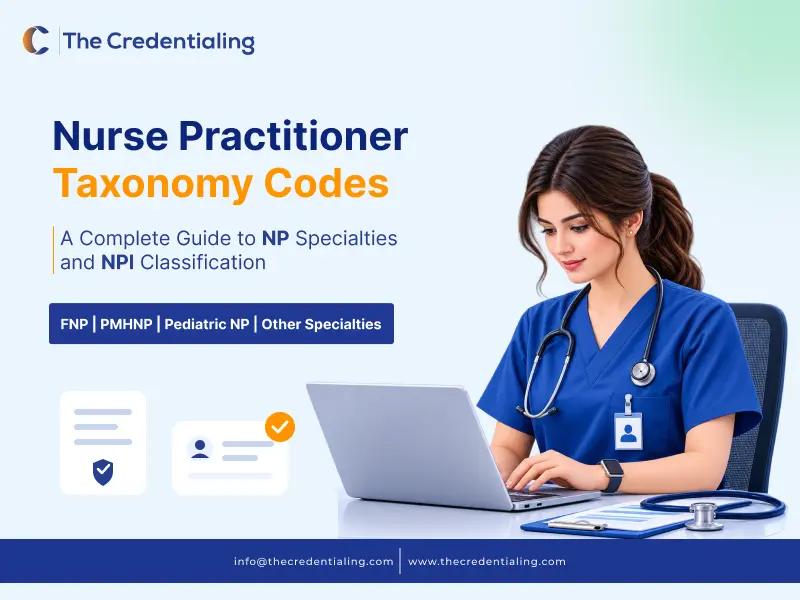
A nurse practitioner taxonomy code identifies a healthcare provider's professional classification and specialty in the United States. These 10-character codes are used in National Provider Identifier (NPI) applications and help identify healthcare providers in administrative, enrollment, and claims-related processes.The general nurse practitioner taxonomy code is 363L00000X. However, nurse practitioners working in specific specialties may use a more specific code, such as 363LF0000X for Family Nurse Practitioners (FNPs) or 363LP0808X for Psychiatric/Mental Health Nurse Practitioners (PMHNPs).Choosing an appropriate taxonomy code is an important part of maintaining accurate NPI information. It can also help support consistent provider information during Medicare, Medicaid, and commercial insurance enrollment.This guide explains nurse practitioner taxonomy codes by specialty, how to find the correct code, how to update taxonomy information through NPPES, and what healthcare providers should understand about taxonomy codes during credentialing and payer enrollment.
What Is a Nurse Practitioner Taxonomy Code?
A nurse practitioner taxonomy code is a 10-character alphanumeric identifier that describes a provider's healthcare classification and specialization.The National Uniform Claim Committee (NUCC) maintains the Healthcare Provider Taxonomy Code Set. It organizes healthcare providers into categories based on their professional type and specialty.
For nurse practitioners, the taxonomy hierarchy includes three levels:
-
Provider grouping: Physician Assistants & Advanced Practice Nursing Providers.
-
Classification: Nurse Practitioner.
-
Specialization: The provider's specific area of practice, such as Family, Pediatrics, or Psychiatric/Mental Health.
For example, 363LF0000X identifies a Family Nurse Practitioner. It belongs to the broader Nurse Practitioner classification, which is represented by 363L00000X.Taxonomy codes help distinguish providers who may have different professional specialties even when they share the same general provider classification.

What Does a Nurse Practitioner Taxonomy Code Identify?
A taxonomy code helps identify:
-
The provider's professional classification.
-
The provider's area of specialization.
-
The type of healthcare services associated with the provider's professional category.
-
Provider information used in NPI and healthcare administration processes.
A taxonomy code does not replace a state license, board certification, professional qualification, or payer credentialing decision.
What Is the General Nurse Practitioner Taxonomy Code?
The general nurse practitioner taxonomy code is 363L00000X.
This code identifies the Nurse Practitioner classification within the Physician Assistants & Advanced Practice Nursing Providers grouping.
It is the parent classification for multiple nurse practitioner specialties.
For example:
|
Taxonomy code |
Classification or specialty |
|
363L00000X |
Nurse Practitioner |
|
363LF0000X |
Family Nurse Practitioner |
|
363LP0808X |
Psychiatric/Mental Health Nurse Practitioner |
|
363LP0200X |
Pediatric Nurse Practitioner |
|
363LA2200X |
Adult Health Nurse Practitioner |
The general code and specialty-specific codes should not be treated as interchangeable in every situation. Providers should select the taxonomy that most accurately reflects their professional classification and specialization.
Nurse Practitioner Taxonomy Codes by Specialty
Different nurse practitioner specialties have different taxonomy codes. The following table provides a reference to commonly used NP classifications and specializations.
Nurse Practitioner Taxonomy Code Comparison Table
|
Nurse practitioner specialty |
Taxonomy code |
|
General Nurse Practitioner |
363L00000X |
|
Acute Care Nurse Practitioner |
363LA2100X |
|
Adult Health Nurse Practitioner |
363LA2200X |
|
Critical Care Medicine Nurse Practitioner |
363LC0200X |
|
Community Health Nurse Practitioner |
363LC1500X |
|
Family Nurse Practitioner |
363LF0000X |
|
Gerontology Nurse Practitioner |
363LG0600X |
|
Neonatal Nurse Practitioner |
363LN0000X |
|
Critical Care Neonatal Nurse Practitioner |
363LN0005X |
|
Pediatric Nurse Practitioner |
363LP0200X |
|
Critical Care Pediatric Nurse Practitioner |
363LP0222X |
|
Psychiatric/Mental Health Nurse Practitioner |
363LP0808X |
|
Perinatal Nurse Practitioner |
363LP1700X |
|
Primary Care Nurse Practitioner |
363LP2300X |
|
School Nurse Practitioner |
363LS0200X |
|
Women's Health Nurse Practitioner |
363LW0102X |
|
Obstetrics & Gynecology Nurse Practitioner |
363LX0001X |
|
Occupational Health Nurse Practitioner |
363LX0106X |

Important: This table is a reference, not an instruction to select a particular code based only on a job title. Review the current NUCC taxonomy code set and your professional qualifications before making a selection.
Family Nurse Practitioner Taxonomy Code – 363LF0000X
The Family Nurse Practitioner taxonomy code is 363LF0000X.This code identifies providers classified as Family Nurse Practitioners.
Family Nurse Practitioners provide healthcare services across different age groups and may work in primary care practices, family medicine clinics, community health centers, and other healthcare settings.
Common searches associated with this classification include:
-
363LF0000X taxonomy code
-
Taxonomy code for family nurse practitioner
-
Taxonomy for family nurse practitioner
-
Family nurse practitioner taxonomy
-
Family nurse practitioner NPI taxonomy
When reviewing an NPI application, an FNP should verify that the selected taxonomy accurately reflects their professional classification and specialization.
Psychiatric Mental Health Nurse Practitioner Taxonomy Code – 363LP0808X
The Psychiatric/Mental Health Nurse Practitioner taxonomy code is 363LP0808X.It identifies nurse practitioners specializing in psychiatric and mental health services.Psychiatric Mental Health Nurse Practitioners may work in outpatient mental health clinics, behavioral health organizations, hospitals, psychiatric practices, and other healthcare settings.
Common keyword variations include:
-
PMHNP taxonomy code
-
Psychiatric nurse practitioner taxonomy code
-
Psychiatric mental health nurse practitioner taxonomy
-
363LP0808X taxonomy code
-
Taxonomy 363LP0808X
A PMHNP should verify that the selected taxonomy corresponds with their actual professional classification and specialization.
Pediatric Nurse Practitioner Taxonomy Code – 363LP0200X
The Pediatric Nurse Practitioner taxonomy code is 363LP0200X.This specialization identifies nurse practitioners whose professional practice focuses on pediatric healthcare.Pediatric Nurse Practitioners may provide healthcare services in pediatric clinics, hospitals, primary care practices, and other healthcare organizations.
The relevant keyword variations include:
-
363LP0200X taxonomy code
-
Taxonomy 363LP0200X
-
Pediatric nurse practitioner taxonomy code
Providers should confirm that their professional qualifications and specialty align with the selected taxonomy.
Adult Health Nurse Practitioner Taxonomy Code – 363LA2200X
The Adult Health Nurse Practitioner taxonomy code is 363LA2200X.This classification identifies nurse practitioners specializing in adult healthcare.Adult Health Nurse Practitioners may work in outpatient practices, specialty clinics, hospitals, and other healthcare environments.
Gerontology Nurse Practitioner Taxonomy Code – 363LG0600X
The Gerontology Nurse Practitioner taxonomy code is 363LG0600X.It identifies nurse practitioners specializing in healthcare for older adults.This classification may be relevant to providers working in geriatric care practices, long-term care environments, and other settings focused on older adult populations.
Acute Care Nurse Practitioner Taxonomy Code – 363LA2100X
The Acute Care Nurse Practitioner taxonomy code is 363LA2100X.It identifies nurse practitioners specializing in acute care.These providers may work in hospital-based settings and other environments where acute health conditions are assessed and managed.
Primary Care Nurse Practitioner Taxonomy Code – 363LP2300X
The Primary Care Nurse Practitioner taxonomy code is 363LP2300X.This classification identifies nurse practitioners specializing in primary care.Primary Care Nurse Practitioners may work in family medicine practices, community health clinics, and outpatient healthcare organizations.
Women's Health Nurse Practitioner Taxonomy Code – 363LW0102X
The Women's Health Nurse Practitioner taxonomy code is 363LW0102X.It identifies nurse practitioners specializing in women's health.Providers in this specialty may work in women's health clinics, outpatient practices, and other healthcare settings providing services related to women's health.
Obstetrics & Gynecology Nurse Practitioner Taxonomy Code – 363LX0001X
The Obstetrics & Gynecology Nurse Practitioner taxonomy code is 363LX0001X.This code identifies the Obstetrics & Gynecology specialization within the Nurse Practitioner classification.It is important to distinguish this NP specialty code from taxonomy codes used by physicians specializing in obstetrics and gynecology. They are different provider classifications.
Other Nurse Practitioner Specialties
Additional taxonomy codes cover specialties such as neonatal care, perinatal care, community health, school nursing, and occupational health.Providers should consult the current NUCC taxonomy code set rather than assuming that a specialty not listed in this guide has no dedicated classification.
What Is the APRN Taxonomy Code?
APRN stands for Advanced Practice Registered Nurse.It is a broader professional designation that includes different advanced nursing roles. Nurse Practitioners are one type of APRN, but not every APRN is a Nurse Practitioner.
Advanced nursing roles may include:
-
Nurse Practitioners (NPs)
-
Clinical Nurse Specialists (CNSs)
-
Certified Registered Nurse Anesthetists (CRNAs)
-
Certified Nurse-Midwives (CNMs)
Because APRN covers multiple professional roles, there is no single universal APRN taxonomy code that applies to every advanced practice nurse.For example, a Family Nurse Practitioner and a Certified Registered Nurse Anesthetist belong to different taxonomy classifications.The appropriate taxonomy code should reflect the provider's actual professional role and specialization.
Is an APRN Taxonomy Code the Same as an NP Taxonomy Code?
No. Nurse Practitioner is one classification within the broader advanced practice nursing profession.An APRN's taxonomy depends on their specific professional classification. Providers should not select an NP taxonomy simply because they hold an APRN designation.
How to Find Your Nurse Practitioner Taxonomy Code
Nurse practitioners can use official healthcare administration resources to identify and verify their taxonomy codes.The two important resources are the NUCC taxonomy code set and the National Plan & Provider Enumeration System (NPPES).
1. Search the Official NUCC Taxonomy Code Set
The NUCC maintains the Healthcare Provider Taxonomy Code Set.
To identify an appropriate code:
-
Open the official NUCC website.
-
Locate the current Healthcare Provider Taxonomy Code Set.
-
Search for your professional classification or specialization.
-
Review the corresponding code and description.
-
Confirm that the classification reflects your professional role.
Official resource: https://www.nucc.org/
2. Check Your Information Through NPPES
NPPES is the federal system used to apply for and maintain National Provider Identifier information.Providers can use the NPI Registry to look up publicly available NPI information.
To check an existing record:
-
Open the CMS NPI Registry.
-
Search using your NPI number or provider details.
-
Open the relevant provider record.
-
Review the listed taxonomy information.
-
Check which taxonomy is marked as primary.
Official resource: https://npiregistry.cms.hhs.gov/
3. Verify Your Provider Classification
Before selecting a taxonomy code, compare the code description with your actual professional classification and specialty.Do not choose a code only because it appears in a job posting, payer directory, or another provider's NPI record.Two providers working in similar clinical environments may have different professional classifications.
4. Confirm Your Primary Taxonomy Selection
CMS allows providers to select more than one taxonomy code when applying for an NPI, but one code must be designated as primary.The primary selection should accurately represent the provider's principal professional classification or specialization.
How to Add or Update a Nurse Practitioner Taxonomy Code in NPPES
Nurse practitioners can review and maintain their NPI information through NPPES.If your professional classification or specialization has changed, or your existing taxonomy information needs correction, review your NPI record and follow the applicable NPPES update process.
The general process includes:
Step 1: Access Your NPPES Account
Visit the official NPPES website and sign in using the applicable account credentials.
Official website: https://nppes.cms.hhs.gov/
Step 2: Locate Your NPI Record
Open the relevant provider record and review the information currently associated with your NPI.
Step 3: Review Existing Taxonomy Codes
Check your listed taxonomy codes and identify the primary taxonomy selection.Confirm that the descriptions match your professional classification and specialty.
Step 4: Add or Update Taxonomy Information
Follow the available NPPES instructions to add, revise, or correct taxonomy information as applicable.
Make sure the information accurately reflects your provider type and specialization.
Step 5: Review and Submit Your Changes
Review the complete application or update before submitting it.Keep a record of the submitted information and verify the public NPI record after the update has been processed.
Note: NPPES interface options and submission requirements may change. Follow the current CMS instructions rather than relying on outdated screenshots or third-party tutorials.
Primary vs. Secondary Nurse Practitioner Taxonomy Code
A provider may have more than one taxonomy code associated with an NPI record.However, one taxonomy must be designated as primary.
What Is a Primary Taxonomy Code?
The primary taxonomy code identifies the provider's designated primary professional classification or specialization in the NPI record.CMS requires providers to identify one primary code when multiple taxonomy codes are selected.
What Is a Secondary Taxonomy Code?
A secondary taxonomy code identifies an additional professional classification or specialization associated with the provider.It may be relevant when a provider has multiple applicable professional classifications.
Can a Nurse Practitioner Have Multiple Taxonomy Codes?
Yes. CMS allows providers to select multiple taxonomy codes when applying for an NPI, provided the selected classifications accurately reflect the provider's professional information.The provider must identify one as primary.Having multiple taxonomy codes does not automatically mean that a provider is eligible to bill every payer or provide every service associated with those classifications.Payer enrollment, licensing, certification, and participation requirements still apply.
Does a Nurse Practitioner Taxonomy Code Affect Insurance Credentialing and Billing?
Taxonomy information is an important part of provider identification and healthcare administration.
During provider enrollment and insurance credentialing, accurate NPI and taxonomy information can help maintain consistency across provider records.
However, a taxonomy code alone does not establish credentialing approval, network participation, or reimbursement eligibility.
1. NPI Registration and Provider Identification
Nurse practitioners use an NPI to identify themselves in covered healthcare administrative transactions.The taxonomy code included in the NPI record describes their professional classification and specialization.
2. Medicare Provider Enrollment
Nurse practitioners seeking to enroll in Medicare must meet the applicable enrollment requirements.CMS explains that providers need an NPI and appropriate taxonomy information as part of the enrollment process.The relevant requirements depend on the provider type and applicable Medicare enrollment rules.
3. Medicaid Provider Enrollment
Medicaid enrollment requirements vary by state.Nurse practitioners should review the applicable state Medicaid program's provider enrollment instructions and confirm that their NPI and taxonomy information are consistent with the requested provider classification.
4. Commercial Insurance Payer Enrollment
Commercial insurance companies may request NPI and taxonomy information during provider enrollment and credentialing.Providers should review each payer's enrollment instructions because requirements can vary by insurer, specialty, provider type, and participation arrangement.
5. Healthcare Claims and Billing Information
Taxonomy information may be relevant to healthcare claims and provider identification.Depending on the payer and transaction requirements, the appropriate taxonomy code may need to be included in the applicable claim information.Incorrect or inconsistent provider information can create administrative issues and may require correction.For this reason, providers and billing teams should review NPI, taxonomy, and payer enrollment information for consistency.
Common Nurse Practitioner Taxonomy Code Mistakes
Incorrect taxonomy selection can create avoidable administrative problems.Here are some common mistakes providers should avoid.
Selecting a General Code Without Reviewing Specialty Information
Some providers may select 363L00000X without checking whether a more specific specialty code accurately describes their professional classification.Review the NUCC hierarchy before choosing a code.
Confusing an NPI Number With a Taxonomy Code
An NPI is a 10-digit numerical identifier assigned to a healthcare provider.A taxonomy code is a separate 10-character alphanumeric identifier describing the provider's classification and specialization.They serve different purposes.
Confusing Professional Credentials With Taxonomy Codes
Credentials such as FNP-C, FNP-BC, PMHNP-BC, and DNP are not interchangeable with taxonomy codes.A professional credential or academic degree does not automatically determine the correct taxonomy selection.
Selecting a Code Based Only on the Workplace
Working in a hospital, behavioral health clinic, or primary care practice does not automatically determine a provider's taxonomy classification.The code should reflect the provider's professional classification and specialization, not simply the location where they work.
Not Reviewing NPI Information After an Update
Providers should review their NPI information after making changes to their professional or practice details.Maintaining accurate records can help reduce inconsistencies during payer enrollment and other administrative processes.
Assuming Every Payer Uses the Same Requirements
Medicare, Medicaid, and commercial insurers may have different enrollment and documentation requirements.Providers should verify the applicable instructions instead of assuming that one payer's requirements apply to every insurer.
Frequently Asked Questions About Nurse Practitioner Taxonomy Codes
What is the taxonomy code for a nurse practitioner?
The general nurse practitioner taxonomy code is 363L00000X. Nurse practitioners may use more specific taxonomy codes depending on their professional specialization, such as 363LF0000X for Family Nurse Practitioners or 363LP0808X for Psychiatric/Mental Health Nurse Practitioners.
What is the taxonomy code for a Family Nurse Practitioner?
The Family Nurse Practitioner taxonomy code is 363LF0000X. It identifies the Family specialization within the Nurse Practitioner classification.
What is the PMHNP taxonomy code?
The Psychiatric/Mental Health Nurse Practitioner taxonomy code is 363LP0808X. It identifies nurse practitioners specializing in psychiatric and mental health services.
What is taxonomy code 363L00000X?
363L00000X is the general Nurse Practitioner classification under the Physician Assistants & Advanced Practice Nursing Providers grouping.
What is taxonomy code 363LF0000X?
363LF0000X identifies a Family Nurse Practitioner within the Nurse Practitioner classification.
What is taxonomy code 363LP0808X?
363LP0808X identifies the Psychiatric/Mental Health Nurse Practitioner specialization.
What is taxonomy code 363LP0200X?
363LP0200X identifies the Pediatric Nurse Practitioner specialization.
Can a nurse practitioner have more than one taxonomy code?
Yes. CMS allows providers to select multiple taxonomy codes when applying for an NPI. However, one code must be identified as primary.
Is a taxonomy code the same as an NPI number?
No. An NPI is a unique 10-digit numerical identifier assigned to a healthcare provider. A taxonomy code is a 10-character code that identifies the provider's classification and specialization.
How do I change my nurse practitioner taxonomy code?
Nurse practitioners can review and update their taxonomy information through the NPPES system by following the applicable CMS instructions. Providers should verify the updated information after submitting changes.
Does Medicare require a nurse practitioner taxonomy code?
CMS requires appropriate taxonomy information as part of the NPI process used for Medicare enrollment. Nurse practitioners must also meet the applicable Medicare enrollment requirements.
What is the difference between an APRN and a nurse practitioner taxonomy code?
APRN is a broader professional designation that includes different advanced nursing roles. Nurse Practitioner is one specific classification within advanced practice nursing. The applicable taxonomy depends on the provider's professional role and specialization.
What is the registered nurse taxonomy code?
The general Registered Nurse taxonomy code is 163W00000X. This is different from the Nurse Practitioner classification, which uses 363L00000X and its specialty-specific codes.
Is 282N00000X a nurse practitioner taxonomy code?
No. 282N00000X identifies a General Acute Care Hospital classification. It is a facility taxonomy code, not a Nurse Practitioner taxonomy code.
What is the OB/GYN nurse practitioner taxonomy code?
The Obstetrics & Gynecology Nurse Practitioner taxonomy code is 363LX0001X. This code should not be confused with physician taxonomy classifications for obstetrics and gynecology.
Conclusion
Choosing an appropriate nurse practitioner taxonomy code is an important part of maintaining accurate NPI information and supporting healthcare administrative processes.The general Nurse Practitioner classification is 363L00000X, while specialties such as Family Nurse Practitioner, Psychiatric/Mental Health Nurse Practitioner, and Pediatric Nurse Practitioner have their own taxonomy codes.Before submitting an NPI application or updating an existing record, verify the code through the current NUCC taxonomy code set and review the applicable CMS and NPPES instructions.Accurate provider information also matters during insurance credentialing and payer enrollment. If you need assistance managing provider credentialing or insurance enrollment requirements, TheCredentialing provides credentialing and enrollment support for healthcare providers and practices.
Authoritative links
Include these official references in the relevant sections:
-
CMS – Find Your Taxonomy Code definition, primary selection and Medicare enrollment.
-
NUCC official website official taxonomy code set.
-
CMS NPI Registry public provider record lookup.
-
NPPES NPI application and maintenance.
-
HL7 NUCC Provider Code Reference taxonomy code descriptions and hierarchy.
The CMS source confirms that multiple taxonomy codes may be selected, but one must be identified as primary.
Sit Back and Relax! Let The Pros Handle Credentialing For You!
thecredentialing has built a strong portfolio while providing credentialing services to clients over the years. Our service includes helpful features that you won’t find anywhere else.
Schedule Free Demo Today!