What Is a CVO in Healthcare Credentialing?
Learn what CVO credentialing means, what a Credentials Verification Organization verifies, how primary source verification works, and how CVOs relate to provider enrollment.
Schedule Free Demo Today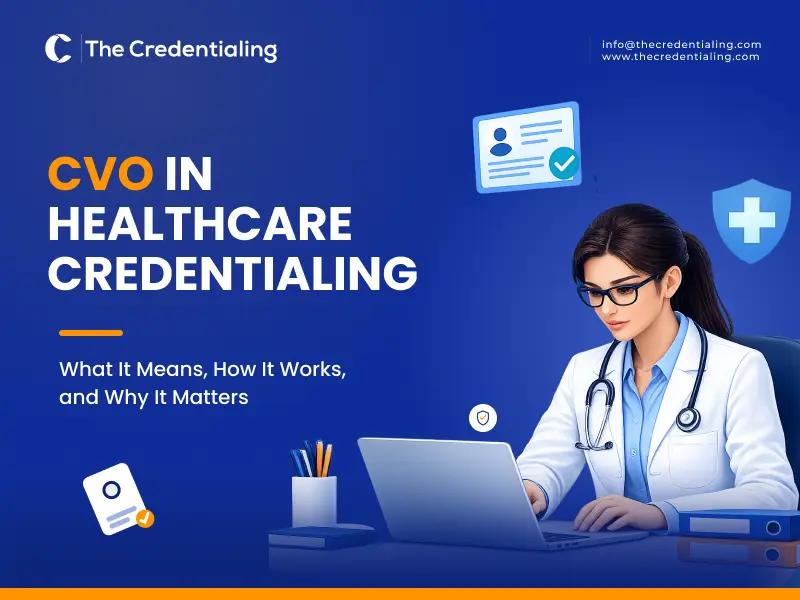
A CVO in healthcare credentialing stands for a Credentials Verification Organization. It is an organization that verifies healthcare practitioners' professional qualifications, licenses, education, training, work history, and other credentials on behalf of hospitals, health plans, medical groups, and other healthcare organizations.CVOs perform primary source verification (PSV) and document their findings to help healthcare organizations evaluate provider qualifications during the credentialing process. They generally verify the information rather than make the final decision about whether a provider should be approved or accepted into an insurance network.For healthcare providers and practice administrators in the United States, understanding CVO credentialing can help clarify why an organization requests additional documents, verifies professional records, or contacts a provider during credentialing and insurance enrollment.
What Does CVO Stand for in Healthcare?
CVO stands for Credentials Verification Organization.A Credentials Verification Organization verifies information about healthcare practitioners through original issuing organizations, recognized verification sources, or authorized agents of those sources.
For example, a CVO may:
-
Verify a physician's medical license through the relevant state licensing board.
-
Confirm medical education with the issuing institution.
-
Check board certification with the appropriate specialty board.
-
Review professional work history.
-
Verify applicable DEA or state CDS registrations.
-
Check relevant malpractice claims history and sanctions information.
The purpose is to provide healthcare organizations with documented verification results that can support their credentialing decisions.
A CVO can operate as:
-
An external organization: An independent company providing verification services to hospitals, health plans, medical groups, or other healthcare clients.
-
An internal department: A verification unit operating within a hospital system, health plan, or another healthcare organization.
CVO services are used by organizations that need to verify practitioner qualifications as part of their provider credentialing responsibilities.
What Is a Credentials Verification Organization (CVO)?
A Credentials Verification Organization is responsible for checking the accuracy of professional information submitted by healthcare practitioners.
Its primary function is to verify credentials and document the results for the organization requesting the service.
A CVO may work with:
-
Hospitals and health systems.
-
Health insurance companies and health plans.
-
Medical groups and physician organizations.
-
Behavioral and mental health organizations.
-
Healthcare staffing organizations.
-
Other organizations responsible for practitioner credentialing.
A CVO generally focuses on verification activities. The hospital, health plan, or authorized credentialing committee that requested the verification is responsible for reviewing the information and making the applicable credentialing decision.
According to the National Committee for Quality Assurance (NCQA), CVO certification evaluates organizations that perform practitioner credential verification and the processes they use to protect credentialing information and improve service quality.
What Does a CVO Do in Provider Credentialing?
CVO provider credentialing involves verifying different aspects of a healthcare practitioner's professional background.The exact verification activities depend on the provider's profession, the client's policies, and the applicable credentialing standards.
1. Primary Source Verification (PSV)
Primary Source Verification is the process of confirming a practitioner's reported qualifications with the original issuing organization or an appropriately recognized verification source.For example, instead of relying only on a copy of a physician's medical license, a CVO may verify the license through the relevant state medical board.
PSV may cover:
-
Professional licenses.
-
Medical education.
-
Residency and fellowship training.
-
Board certification.
-
DEA or state CDS registration, when applicable.
-
Other credentials required by the requesting organization.
The purpose is to ensure that the information in a provider's credentialing file is supported by an appropriate verification source.
2. Medical License Verification
A CVO may verify whether a healthcare practitioner's professional license is valid and review relevant licensing information.
This can include:
-
License status.
-
License expiration date.
-
License restrictions or conditions.
-
Disciplinary actions.
-
Applicable licensing board sanctions.
License verification is particularly relevant for providers who practice or hold licenses in multiple states.
3. Education and Training Verification
A CVO may verify a practitioner's educational qualifications and professional training.
Depending on the provider's profession, this can include:
-
Medical school education.
-
Professional school education.
-
Graduate medical education.
-
Residency training.
-
Fellowship training.
-
Other relevant professional education.
These checks help confirm that the practitioner has completed the education and training reported in the credentialing application.
4. Board Certification Verification
Board certification verification confirms whether a healthcare practitioner holds the specialty certification reported in their application.
For physicians, this may involve checking the relevant medical specialty board.
Verification may include certification status, specialty information, and applicable expiration or maintenance details.
5. DEA and State CDS Registration Verification
For providers whose professional responsibilities involve controlled substances, verification may include:
-
Drug Enforcement Administration (DEA) registration.
-
Applicable state Controlled Dangerous Substances (CDS) registration.
Not every healthcare practitioner requires DEA or state CDS registration. These checks depend on the provider's role and the requirements of the requesting organization.
6. Work History Verification
A CVO may review a provider's professional employment history and identify gaps or inconsistencies that require clarification.
This may include:
-
Previous healthcare organizations.
-
Employment dates.
-
Professional experience.
-
Explanations for relevant work history gaps.
Providers may be asked to provide additional information when the submitted application and professional records do not match.
7. Malpractice Claims History Verification
Malpractice claims history may be reviewed as part of the credential verification process.
Depending on the client's requirements, this can involve reviewing professional liability claims information, relevant settlements, and applicable reporting sources.The National Practitioner Data Bank (NPDB) is one of the sources used in certain healthcare credentialing and professional review activities. Its use depends on the organization's eligibility and applicable reporting and querying requirements.
Official reference: National Practitioner Data Bank.
8. Sanctions and Exclusion Verification
CVOs may check applicable state and federal sanctions or exclusion information.
Examples include:
-
State licensing board disciplinary actions.
-
Medicare and Medicaid sanctions.
-
Applicable federal exclusion information.
-
Other relevant professional disciplinary records.
For example, healthcare organizations may use the HHS Office of Inspector General (OIG) exclusion information when checking whether a practitioner appears on the federal exclusion list.

CVO Provider Credentialing Requirements
CVO provider credentialing requirements refer to the information, documents, and verification activities needed to evaluate a healthcare practitioner's professional qualifications.Requirements are not identical for every provider. They may vary according to the practitioner's profession, specialty, license type, healthcare organization, payer, and applicable credentialing standards.
Common verification categories include:
|
Verification category |
Information reviewed |
|
Professional license |
License status, expiration, restrictions, and disciplinary information |
|
Education |
Medical or professional education |
|
Training |
Residency, fellowship, and other relevant training |
|
Board certification |
Specialty certification status |
|
DEA/CDS registration |
Applicable controlled-substance registration |
|
Work history |
Employment and professional history |
|
Malpractice history |
Relevant professional liability claims information |
|
Sanctions |
Applicable state and federal sanctions or exclusions |
|
Practitioner application |
Submitted professional information and attestations |
Documents Providers May Be Asked to Submit
Depending on the organization and the provider's professional role, supporting documents may include:
-
Current professional license or licenses.
-
Updated curriculum vitae (CV).
-
Education and training information.
-
Board certification information.
-
DEA registration, when applicable.
-
State CDS registration, when applicable.
-
Professional liability insurance documentation.
-
Employment history.
-
Practice location information.
-
Hospital affiliation details, when applicable.
-
Completed credentialing applications and signed attestations.
This is a general list, not a universal checklist. Providers should follow the specific instructions provided by the hospital, health plan, CVO, or credentialing organization requesting the information.
For a more detailed document checklist, read our guide to Documents Required for Provider Credentialing.
How Does the CVO Credentialing Process Work?
The CVO credentialing process generally follows a structured workflow to collect provider information, verify professional credentials, document findings, and report results to the requesting organization.Although individual workflows differ, the process commonly includes these six stages.
Step 1: Provider Information Collection
The process begins when the requesting healthcare organization submits provider information and supporting documents to the CVO.This may include professional licenses, education details, work history, board certification information, and other required records.
Step 2: Application and Document Review
The CVO reviews the submitted information for completeness and identifies missing documents, inconsistencies, or details that require clarification.The provider or practice administrator may be contacted to provide additional information.
Step 3: Primary Source Verification
The CVO verifies the provider's credentials through appropriate original or recognized verification sources.This may involve checking state licensing boards, educational institutions, specialty certification organizations, and other relevant authorities.
Step 4: Verification Documentation
The verification findings are documented in the provider's credentialing file.
Records may include:
-
Verification source.
-
Date of verification.
-
Information confirmed.
-
Verification result.
-
Any discrepancies identified.
Step 5: Verification Results and Reporting
The CVO organizes the verification findings and provides the required documentation or report to its client.If information is incomplete or discrepancies remain unresolved, additional clarification may be required.
Step 6: Credentialing Review and Decision
The responsible healthcare organization, health plan, or authorized credentialing committee reviews the verified information and makes the applicable credentialing decision.A completed CVO verification does not automatically mean that a provider has been approved, contracted, or enrolled with an insurance company.

How Long Does CVO Verification Take?
There is no single turnaround time that applies to every CVO verification. The actual time depends on the completeness of the provider's file, the type of credentials being checked, the response time of verification sources, and the requesting organization's procedures.It is also important to distinguish between the time a CVO takes to complete a verification and the time limits used in credentialing standards to determine whether verification information is considered current.
NCQA Credentialing Verification Timeframes
NCQA's September 2025 guide to credentialing programs publishes different verification timeframes for different credential elements under Credentialing Accreditation and Credentialing Certification.
The following table summarizes the timeframes published in that guide:
|
Credential element |
Credentialing Accreditation |
Credentialing Certification |
|
License to practice |
180 days |
90 days |
|
Board certification |
120 days |
90 days |
|
Work history |
180 days |
120 days |
|
Malpractice history |
120 days |
90 days |
|
State licensing sanctions |
120 days |
90 days |
|
Medicare/Medicaid sanctions |
120 days |
90 days |
|
Credentialing application attestation |
180 days |
120 days |
|
Medicare/Medicaid exclusions |
120 days |
90 days |
Important: These are NCQA's published verification timeframes, not a promise that a CVO will finish an entire provider file within those periods. The applicable program, credential element, current standards, and client requirements should always be checked before applying a timeframe to an individual case.
Official reference: NCQA Credentialing Accreditation and Certification Guide (September 2025).
What Should Providers Do When a CVO Contacts Them?
A CVO may contact a healthcare provider or practice administrator to confirm information, request documents, or clarify details in a credentialing file.Providers can prepare for these requests by following a few practical steps.
1. Respond to Verification Requests
Read the request carefully and identify which documents or information are required.If the deadline is unclear, ask the requesting organization when the information is needed.
2. Review Professional License Information
Check that the professional license information submitted in the application is accurate and current.If you hold licenses in multiple states, make sure the relevant details are consistent.
3. Keep Your CV Updated
Review your curriculum vitae and make sure employment dates, practice history, education, and other professional details are accurate.If an explanation is required for a work history gap, prepare the information requested by the credentialing organization.
4. Keep DEA and CDS Information Current
If your professional responsibilities require DEA or state CDS registration, review the applicable registration details and provide updated information when requested.
5. Maintain Consistent Provider Information
Check that your name, professional details, practice locations, employment dates, and other information are consistent across your application, supporting documents, and CAQH profile.
6. Review and Sign Attestations
Complete required application fields and sign and date attestations according to the requesting organization's instructions.
7. Keep Your CAQH Profile Updated
When applicable, maintain accurate provider information and supporting documents in CAQH ProView.You can read our CAQH Credentialing Guide for more information about managing your CAQH profile.
Common Reasons for CVO Verification Delays
CVO verification may require additional follow-up when submitted information is incomplete, inconsistent, or difficult to confirm.
Some situations that can contribute to delays include:
|
Potential issue |
What providers can do |
|
Expired or soon-to-expire license |
Review license status and provide updated information when available |
|
Unexplained work history gap |
Prepare the explanation requested by the credentialing organization |
|
Name or date mismatch |
Check that submitted information is consistent across records |
|
Missing supporting documents |
Review the document request and submit the required items |
|
Delayed response from a verification source |
Ask the requesting organization whether additional information is needed |
|
Missing or outdated attestation |
Complete the required attestation according to the organization's instructions |
|
Incomplete malpractice information |
Provide the documentation requested by the credentialing organization |
Providers should avoid assuming that every delay is caused by the CVO or by the provider. Verification may depend on several parties, including issuing institutions, licensing boards, previous employers, and the requesting organization.
CVO vs. Healthcare Credentialing Company
A CVO and a healthcare credentialing company may perform related activities, but their responsibilities are not necessarily the same.A CVO primarily focuses on verifying practitioner credentials. A healthcare credentialing company may provide broader administrative support, including application preparation, CAQH profile management, insurance payer enrollment, and recredentialing assistance.
|
Comparison |
CVO |
Healthcare credentialing company |
|
Main focus |
Credential verification |
Broader credentialing and enrollment support |
|
Typical clients |
Hospitals, health plans, and medical groups |
Healthcare providers and medical practices |
|
Primary source verification |
Core function |
May provide it directly or through a partner |
|
Application preparation |
Depends on service scope |
May be included |
|
CAQH profile management |
Not necessarily included |
May be included |
|
Payer enrollment |
Not usually the core CVO function |
May be included |
|
Follow-up with payers |
Depends on contract |
May be included |
|
Recredentialing support |
May support verification and monitoring |
May support administrative coordination |
Some healthcare credentialing companies also provide CVO services. The actual difference depends on the organization's scope of work and contractual responsibilities.For an independent provider or medical practice trying to join insurance networks, broader credentialing and payer enrollment support may be more relevant than hiring a CVO directly.
CVO vs. Delegated Credentialing vs. CAQH ProView
CVO services, delegated credentialing, and CAQH ProView are related to provider credentialing, but they describe different functions.
|
Term |
What it means |
Main purpose |
|
CVO |
Credentials Verification Organization |
Verifies practitioner credentials |
|
Delegated credentialing |
An arrangement in which defined credentialing responsibilities are delegated under an agreement |
Assigns credentialing responsibilities |
|
CAQH ProView |
An online provider data profile |
Allows providers to maintain and share professional information with participating organizations |
CVO vs. Delegated Credentialing
A CVO performs credential verification activities for a healthcare organization or client.Delegated credentialing refers to an arrangement in which a health plan assigns defined credentialing responsibilities to another organization under an applicable agreement.For example, a health plan may delegate certain credentialing functions to a medical group that meets its requirements. That medical group may use an internal team or an external CVO to perform verification activities.The delegation agreement defines the responsibilities and oversight requirements.
CVO vs. CAQH ProView
CAQH ProView is an online platform where healthcare providers maintain and share professional information with participating health plans and other authorized organizations.A CVO performs verification activities to confirm information through appropriate sources.A completed CAQH profile does not replace primary source verification and does not automatically establish insurance network participation.For more information about CAQH, read our CAQH Credentialing Guide.
NCQA CVO Certification vs. URAC CVO Accreditation
NCQA and URAC are two organizations with programs that evaluate credentials verification operations.Healthcare organizations may consider certification or accreditation status when evaluating CVO service providers. However, the programs have different standards and evaluation frameworks.
NCQA CVO Certification
The National Committee for Quality Assurance (NCQA) offers a Credentials Verification Organization certification program.According to NCQA, its CVO program evaluates organizations that verify practitioner credentials through primary sources, recognized sources, or contracted agents of primary sources.
Its focus areas include:
-
Internal quality improvement.
-
Protection of credentialing information.
-
Verification of practitioner credentials.
-
Applicable verification processes and documentation.
NCQA's certification options cover credential elements such as professional licenses, DEA or CDS registration, education and training, board certification, work history, malpractice claims history, sanctions, and practitioner application processing.
Official reference: NCQA CVO Certification.
NCQA Credentialing Accreditation
NCQA Credentialing Accreditation evaluates organizations that provide broader credentialing services.The scope includes credential verification as well as additional responsibilities such as credentialing committee review, recredentialing, and applicable ongoing monitoring.This is different from a verification-focused CVO function. Verifying provider information and making the final credentialing decision are separate activities.
Official reference: NCQA Credentialing Programs.
URAC CVO Accreditation
URAC offers a separate Credentials Verification Organization Accreditation program.
Its framework evaluates areas such as:
-
Organizational structure.
-
Policies and procedures.
-
Regulatory compliance.
-
Information management.
-
Quality management.
-
Staffing and oversight.
-
Credential verification processes.
-
Data integrity.
-
Communication and reporting.
URAC's published program information describes 40 core standards covering organizational and operational areas, along with additional standards addressing credential verification and related processes.
Official reference: URAC Credentials Verification Organization Accreditation.
NCQA vs. URAC: Key Differences
|
Comparison |
NCQA CVO Certification |
URAC CVO Accreditation |
|
Program type |
Certification |
Accreditation |
|
Main focus |
Credential verification operations |
Verification operations and organizational controls |
|
Evaluation areas |
Verification, information protection, quality improvement |
Organizational structure, policies, compliance, verification, data integrity, and communications |
|
Published framework |
NCQA CVO standards and certification options |
URAC CVO accreditation standards |
Organizations should review the current standards and verify a vendor's actual certification or accreditation status before relying on its claims.
How to Choose a CVO for Healthcare Credentialing
Hospitals, health plans, medical groups, and other organizations evaluating CVO vendors should review more than pricing.The following factors can help with the evaluation.
1. Certification or Accreditation Status
Ask whether the CVO holds NCQA CVO Certification or URAC CVO Accreditation.Verify the organization's current status through the relevant program directory rather than relying only on a website claim.
2. Scope of Verification Services
Confirm which credential elements the CVO verifies.These may include professional licenses, DEA or CDS registration, education, training, board certification, work history, malpractice claims history, and sanctions.
3. Primary Source Verification Methods
Ask which sources the CVO uses and how it documents verification results.The organization should be able to explain how its verification methods align with the applicable standards and client requirements.
4. Verification Reporting
Review sample reports to understand whether they identify the source, date, result, and any discrepancies for each verification activity.
5. Data Security and Confidentiality
Ask about information security, access controls, confidentiality procedures, and how credentialing information is protected.
6. Ongoing Monitoring
Check whether ongoing monitoring is included in the service agreement and identify exactly which credentials or records are monitored.
7. Technology and Integrations
Review whether the CVO's systems can work with your existing credentialing software and internal workflows.
8. Service Scope and Pricing
Understand whether pricing is based on individual provider files, verification elements, subscriptions, or additional services.Confirm which services are included and whether additional fees apply to re-verification, follow-up, or other activities.
How Does CVO Verification Relate to Provider Enrollment?
CVO verification is one component that may support the wider healthcare provider credentialing and insurance enrollment process.Although these activities are connected, they are not interchangeable.
Provider credentialing involves reviewing and verifying a practitioner's professional qualifications.
Provider enrollment involves completing the requirements to participate in a particular insurance network or government healthcare program.
For example, a healthcare provider seeking participation with a commercial health plan may need to:
-
Maintain accurate professional information.
-
Complete applicable payer-specific applications.
-
Maintain an updated CAQH profile when required.
-
Provide supporting documents.
-
Satisfy the health plan's credentialing requirements.
-
Complete any additional contracting or enrollment steps.
A health plan may use its own internal CVO or an external CVO to perform credential verification as part of its credentialing process.
Providers and practice administrators should understand that:
-
CVO verification does not automatically complete insurance enrollment.
-
A completed CAQH profile does not automatically establish network participation.
-
Each health plan may have separate application and documentation requirements.
-
Final credentialing and network participation decisions remain with the responsible organization.
TheCredentialing supports healthcare providers and medical practices with provider credentialing, CAQH profile management, insurance payer enrollment, and related credentialing administration.
Frequently Asked Questions About CVOs in Healthcare
1. What does CVO stand for in healthcare?
CVO stands for Credentials Verification Organization. It is an organization that verifies healthcare practitioners' professional qualifications, licenses, education, training, and other credentials for healthcare organizations and health plans.
2. What is CVO credentialing?
CVO credentialing refers to the credential verification activities performed by a Credentials Verification Organization. These activities may include primary source verification, medical license checks, education and training verification, board certification checks, work history reviews, and applicable sanctions checks.
3. What does a CVO verify for healthcare providers?
A CVO may verify professional licenses, medical education, residency and fellowship training, board certification, DEA or CDS registration, work history, malpractice claims history, and applicable sanctions.
4. What are CVO provider credentialing requirements?
Requirements depend on the provider's profession, specialty, license type, and the requesting organization's policies. Common verification areas include professional licenses, education, training, board certification, work history, malpractice history, and applicable sanctions.
5. Does a CVO approve or deny healthcare providers?
A CVO generally verifies credentials and reports its findings to the requesting organization. The responsible hospital, health plan, or authorized credentialing committee reviews the information and makes the applicable credentialing decision.
6. What is the difference between a CVO and a credentialing company?
A CVO primarily performs credential verification. A healthcare credentialing company may provide broader administrative services, including application preparation, CAQH profile management, payer enrollment, and recredentialing support. Some companies provide both types of services.
7. What is NCQA CVO Certification?
NCQA CVO Certification evaluates organizations that provide practitioner credential verification services. Its evaluation areas include credential verification, protection of credentialing information, and internal quality improvement.
8. What is the difference between NCQA and URAC CVO programs?
NCQA offers CVO Certification, while URAC offers Credentials Verification Organization Accreditation. Both evaluate credential verification operations, but they use different standards and evaluation frameworks.
9. Can CVO provider credentialing be completed online?
Many CVOs and healthcare organizations use online systems to collect provider information, receive supporting documents, manage verification workflows, and communicate results. Available features vary by organization.
10. Is CVO the same as delegated credentialing?
No. A CVO performs credential verification activities, while delegated credentialing is an arrangement in which an organization receives defined credentialing responsibilities under an agreement.
11. Does a CVO complete insurance enrollment?
Not necessarily. CVO verification may support a health plan's credentialing process, but insurance enrollment can require separate payer applications, CAQH information where applicable, contracting steps, and the health plan's decision.
12. How long does CVO verification take?
There is no single turnaround time for every CVO. It depends on the provider's file, the credentials being verified, source response times, and the requesting organization's procedures. NCQA also publishes different verification timeframes for individual credential elements under its credentialing programs.
Get Support With Healthcare Provider Credentialing and Payer Enrollment
Healthcare provider credentialing involves several administrative responsibilities, including professional documentation, CAQH profile management, insurance applications, and payer-specific enrollment requirements.Managing these requirements can become challenging for independent healthcare providers and growing medical practices, particularly when working with multiple insurance companies.
TheCredentialing supports healthcare providers and medical practices with:
-
Provider credentialing support.
-
CAQH profile management.
-
Insurance payer enrollment.
-
Credentialing documentation and related administrative support.
Whether you are preparing provider documentation, maintaining your CAQH profile, or coordinating insurance enrollment, our team can help you manage the applicable administrative requirements.
Explore TheCredentialing's healthcare provider credentialing services to learn more about the support available for your practice.
Sit Back and Relax! Let The Pros Handle Credentialing For You!
thecredentialing has built a strong portfolio while providing credentialing services to clients over the years. Our service includes helpful features that you won’t find anywhere else.
Schedule Free Demo Today!