What Is Insurance Credentialing? Complete Guide to the Insurance Credentialing Process for Healthcare Providers
Learn what insurance credentialing is, requirements, process steps, timelines, CAQH, provider enrollment, and how US healthcare providers can avoid delays.
Schedule Free Demo Today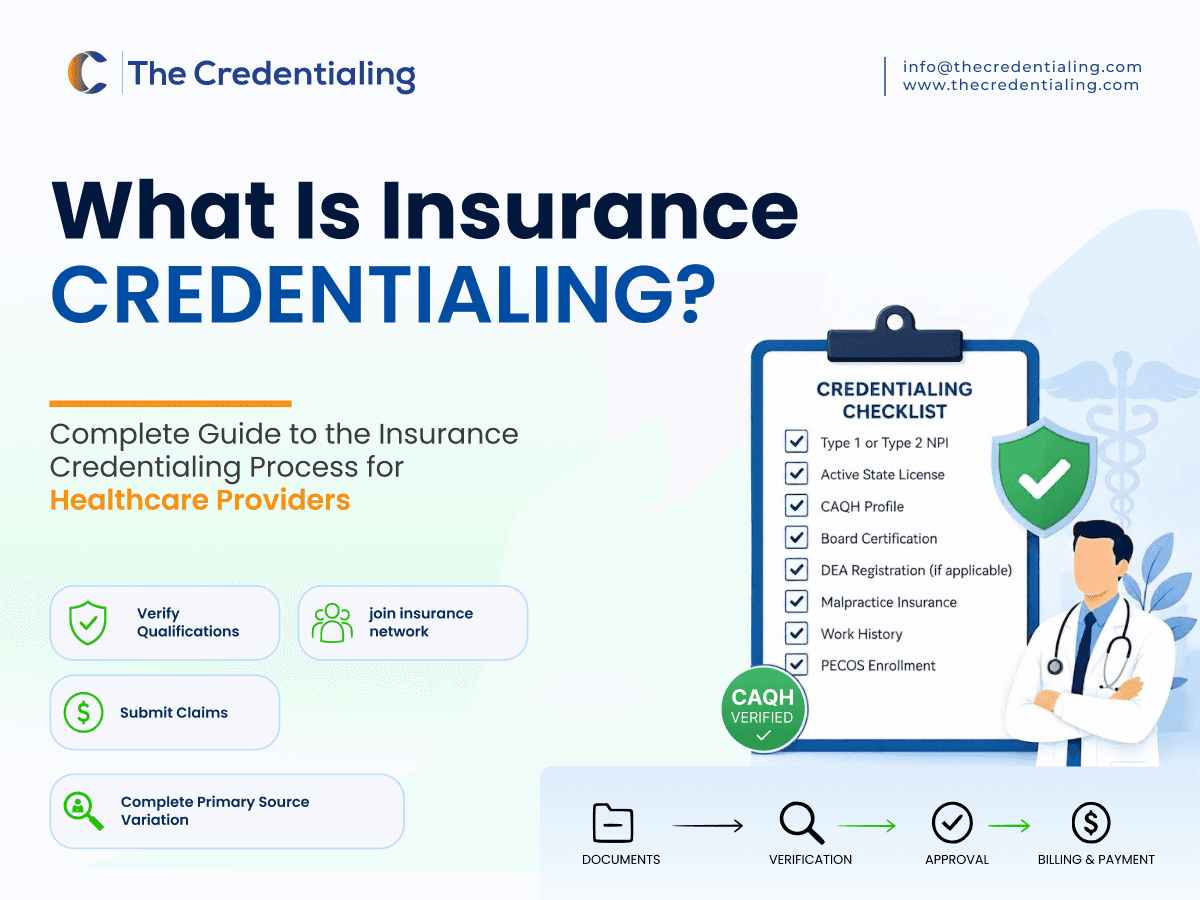
Introduction
Insurance credentialing is the process health plans use to verify a provider’s qualifications, checking state licenses, board certifications, medical education, malpractice history, and DEA registration before allowing them onto a provider panel.
For physicians, mid-levels, dentists, and behavioral health specialists, in-network reimbursement is impossible without it. Payers require this step to vet provider quality and manage liability, but for a practice, it is strictly a gatekeeper for cash flow.
Whether you are opening a new location, onboarding a provider, or launching a telehealth service, credentialing delays directly freeze revenue. Until payer approval goes through, you are looking at unbillable visits, write-offs, or out-of-network claim denials.
At TheCredentialing, we handle the administrative side of payer enrollment (managing CAQH profiles, tracking commercial credentialing applications, and submitting Medicare or Medicaid enrollments) so your providers can start seeing patients and billing without the typical back-and-forth delays.
What Is Insurance Credentialing?
Insurance credentialing is the verification process performed by health insurance companies to confirm that healthcare providers meet professional, regulatory, and quality standards before joining an insurance network.
During credentialing, payers verify information such as:
- Medical licenses
- Education and training
- Residency and fellowship history
- Board certifications
- Work experience
- Malpractice insurance
- Professional references
- Sanctions and disciplinary history
Once approved, the provider becomes eligible to participate in the insurance network and receive reimbursement for covered patient services.
Why Insurance Credentialing Matters for Healthcare Practices
Insurance credentialing matters because it determines whether healthcare providers can participate with insurance networks and receive payment for covered patient services.
If you run a medical clinic, your entire cash flow depends on getting this process right. When you open a new private practice or hire a new nurse practitioner, you must pass payer vetting before you can bill for your services.
Without proper credentialing, even highly qualified providers may face challenges such as:
-
Insurance claim denials
-
Delayed reimbursement
-
Out-of-network payment limitations
-
Patient access problems
-
Revenue loss
-
Provider onboarding delays
For healthcare organizations, credentialing is not just an administrative requirement. It is a critical part of revenue cycle management and practice operations.
Getting approved takes time, organization, and insider knowledge of how insurance networks operate. You have to deal with rigid bureaucratic requirements, track multiple expiration dates, and follow up with payers every week.
1. Enables Insurance Reimbursement
Healthcare providers depend on insurance reimbursement to maintain financial stability. When a provider completes medical insurance credentialing, insurance companies verify their qualifications and approve their participation in the payer network.
Without approval:
-
Claims may not process correctly
-
Insurance companies may deny payments
-
Patients may face unexpected out-of-pocket expenses
A successful credentialing process allows providers to bill insurance companies according to established payer agreements.
2. Builds Patient Trust and Accessibility
Patients often search insurance directories to find healthcare providers covered by their insurance plans. Health insurance credentialing allows providers to appear in payer directories, helping patients identify:
-
In-network doctors
-
Covered specialists
-
Approved healthcare facilities
Being listed as an in-network provider can improve patient acquisition and increase appointment opportunities.
3. Protects Healthcare Quality Standards
Insurance companies use credentialing to confirm that providers meet professional and regulatory requirements. During verification, payers review:
-
Education credentials
-
Medical licenses
-
Training history
-
Certifications
-
Professional background
This process helps maintain healthcare quality and patient safety standards throughout insurance networks. Health plans do not hand out billing agreements to just anyone with a medical degree. Insurers need proof that you know how to practice medicine safely and ethically within your specialty.
4. Supports Practice Growth
Growing healthcare practices frequently add new physicians, nurse practitioners, and specialists. However, a provider cannot immediately generate insurance revenue after joining a practice.
The provider must complete:
-
Insurance credentialing
-
Payer approval
-
Network activation
When you open a new private practice or add a new provider, starting the process early helps practices avoid unnecessary delays when onboarding new providers. We wrote this guide to show you exactly how insurance credentialing works from start to finish. You will learn why health plans take months to process applications, how to avoid common paperwork traps, and how to build a reliable workflow that keeps your practice revenue secure.
Core Fundamentals of Insurance Credentialing
Health plans do not hand out billing agreements to just anyone with a medical degree. Insurers need proof that you know how to practice medicine safely and ethically within your specialty. When you apply for in-network status, the insurance carrier acts as a gatekeeper. They dig through your past employment records, check your educational transcripts, and look for any past malpractice lawsuits or disciplinary actions.
Why Insurance Companies Require Provider Vetting
The insurance company is at a huge legal and financial risk if they let an unqualified or suspended doctor be part of their team. Patients have a cause of action against a payer for negligent selection if a practitioner is incompetent and added to their network.
Health plans can't risk criminal and civil penalties or even lawsuits- they conduct extensive background checks on each clinician. This investigation also assists insurance companies in creating provider directories.
Patients use these directories to find local, in-network doctors. Once a payer approves your application, they add your name, clinic location, and specialty to their public list so patients can actually find and book you.
CAQH Credentialing: Why CAQH ProView Is Important in Insurance Credentialing
A major part of the insurance credentialing process is maintaining an accurate and complete CAQH credentialing profile. The Council for Affordable Quality Healthcare (CAQH) provides CAQH ProView, a secure online platform widely used by healthcare providers and insurance companies to collect and verify provider information.
Many commercial insurance payers use CAQH data when reviewing provider applications for network participation.
A complete CAQH profile helps simplify:
-
Provider insurance credentialing
-
Medical insurance credentialing applications
-
Insurance payer verification
-
Provider enrollment processes
Information Required in a CAQH Profile
Healthcare providers should maintain accurate information in the following areas:
Personal Information
Includes:
-
Provider name
-
Contact details
-
Practice locations
-
Professional identifiers
Education and Training History
Includes:
-
Medical school information
-
Residency programs
-
Fellowship training
-
Graduation dates
Professional Licenses
Providers must maintain:
-
Active state licenses
-
License expiration dates
-
License numbers
Work History
Healthcare providers should include complete employment history with:
-
Employer names
-
Start dates
-
End dates
-
Explanations for gaps
Malpractice Insurance Information
Providers must maintain updated:
-
Insurance carrier details
-
Coverage limits
-
Policy expiration dates
CAQH Re-Attestation Requirements
Providers must regularly review and confirm their CAQH information through the CAQH Provider Data Portal. Failure to update CAQH can create problems such as:
-
Credentialing delays
-
Application suspension
-
Network participation issues
Healthcare practices should create internal reminders to review CAQH information regularly and ensure provider records remain accurate.
Medicare and Medicaid Credentialing Requirements
Government healthcare programs have additional enrollment requirements compared with commercial insurance plans. Providers who want to treat Medicare and Medicaid patients must complete specific enrollment processes before receiving reimbursement.
Medicare Credentialing Through PECOS
Medicare providers must complete enrollment through the Centers for Medicare & Medicaid Services (CMS) Provider Enrollment, Chain, and Ownership System (PECOS).
PECOS allows providers to:
-
Submit Medicare enrollment applications
-
Update provider information
-
Manage enrollment records
-
Maintain compliance with CMS requirements
Common Medicare enrollment requirements include:
-
NPI number
-
Tax identification information
-
Medical licenses
-
Practice locations
-
Ownership details
-
Specialty information
Incorrect information submitted through PECOS can delay Medicare approval.
Medicaid Credentialing
Medicaid credentialing requirements vary by state because each state manages its own Medicaid program.
Providers may need to complete:
-
State-specific applications
-
Provider agreements
-
Background checks
-
License verification
-
Enrollment documentation
Healthcare organizations serving Medicaid patients should understand their state-specific requirements before beginning the enrollment process.
Primary Source Verification (PSV) in Insurance Credentialing
Primary Source Verification (PSV) is one of the most important stages of the credentialing process. During PSV, insurance companies verify provider information directly from the original source instead of relying only on documents submitted by the provider. The purpose of PSV is to confirm that provider credentials are accurate and legitimate.
What Information Is Verified During PSV?
Insurance companies typically verify:
Medical Education
Verification includes:
-
Medical school completion
-
Graduation dates
-
Degree information
Residency and Fellowship Training
Payers confirm:
-
Training completion
-
Specialty qualifications
-
Program details
State Medical Licenses
Insurance companies verify:
-
Active license status
-
Restrictions
-
Expiration dates
Board Certifications
Verification confirms:
-
Specialty certification
-
Certification status
-
Expiration information
Work History
Payers review:
-
Previous employers
-
Practice history
-
Employment gaps
Government Exclusion Screening
Credentialing teams review databases including:
-
OIG Exclusion List
-
SAM.gov exclusions
-
Other compliance databases
This ensures providers are eligible to participate in healthcare programs.
Key Organizations Involved in Insurance Credentialing

There are several major healthcare bodies that determine how health plans actively screen medical professionals:
NCQA: This organization develops nationally recognized credentialing standards that accredited health plans follow when verifying healthcare providers.
Primary Source Verification (PSV): This mandatory verification standard requires insurers to validate your education, residency, licenses, board certifications, and work history directly from the original issuing sources rather than relying on copies submitted by the provider.
Council for Affordable Quality Healthcare (CAQH): This non-profit alliance runs CAQH ProView, a secure online database where you store your professional documents. Instead of sending paper applications to twenty different insurers, you upload your profile once to CAQH, and participating payers download your data directly.
OIG Exclusion List & SAM.gov: Federal investigators run regular checks on these two fraud registries. Health plans check these lists to make sure the government has not banned you from treating Medicare or Medicaid patients due to healthcare fraud or abuse.
Key Distinctions and Healthcare Terminology
Healthcare administrators use confusing industry jargon that often trips up new clinic owners. People swap words like credentialing, privileging, contracting, and enrollment as if they mean the exact same thing. They do not.
Each term describes a completely different operational phase of getting a doctor ready to bill patients and insurers.
|
Term |
Primary Definition |
Managing Entity |
Key Outcome |
|
Insurance Credentialing |
Verifying your clinical qualifications, training, and license history |
Health Plans / Commercial Payers |
Verified eligibility to join a payer network |
|
Hospital Privileging |
Granting a doctor permission to perform specific medical procedures |
Hospital Medical Staff Office |
Authority to treat patients inside a hospital |
|
Provider Contracting |
Negotiating legal agreements, fee schedules, and reimbursement rules |
Payer Contracting Department |
A signed legal contract and agreed-upon payment rates |
|
Provider Enrollment |
Linking a verified doctor's NPI to a clinic's Tax ID for claim billing |
Payer Enrollment Department |
Active billing setup in the payer's claims processing system |
Credentialing vs. Privileging
The main difference between credentialing and privileging is that credentialing properly verifies your background history for a health plan, while privileging decides what treatments you are allowed to physically perform inside a hospital or surgical center.
For example, an insurer verifies that you hold a valid surgical license. The hospital privileging committee decides whether you have the specific surgical skills to operate their robotic surgery equipment.
Privileging looks at facility-level competency, whereas credentialing looks at network qualification.
Credentialing vs. Contracting
You must pass background credentialing before you can negotiate a provider contract. Credentialing answers a simple question: "Is this doctor qualified to treat our members?"
Once the insurer answers yes, you move into the contracting phase. During contracting, you sign the actual legal document that locks in your fee schedules, outlines your billing rules, and defines your relationship with the insurer.
Provider Enrollment vs. Medical Credentialing
Medical credentialing covers the investigative background check. Provider enrollment covers the administrative setup.
Once an insurer approves your professional background, their enrollment team links your National Provider Identifier (NPI) to your clinic's Tax Identification Number (TIN). If you skip enrollment- such as failing to submit your Medicare forms through CMS PECOS- the payer's billing system will reject your claims even if you passed background vetting.
Delegated Credentialing Agreements
Large medical groups and health systems often sign delegated credentialing agreements with insurance companies. Under this setup, the insurance carrier allows the medical group to handle primary source verification in-house.
Instead of waiting for the health plan to check diplomas and licenses, the clinic's internal staff does the background work and sends the verified file to the insurer. This arrangement reduces onboarding times and helps growing clinics get new doctors billing faster.
Step-by-Step Insurance Credentialing Application & Workflow
Getting through insurance credentialing requires careful tracking and attention to detail. If you leave a single date blank on an application or forget to explain a gap in your employment history, an insurer will reject your file and send you back to the starting line.

Step 1: NPI Registration, Licensing, and Documentation
Before you submit your application to any health plan, you must gather your fundamental practice documents:
National Provider Identifier (NPI): Apply for an Individual Type 1 NPI through the NPPES registry. If you own a group practice or clinic incorporated as a business, you must also obtain an Organizational Type 2 NPI.
State Medical License: Secure an active, unrestricted medical license from the state medical board in every state where you plan to see patients.
DEA Registration: Apply for the federal DEA registration and state-level controlled drug permits if your clinical scope includes prescribing these specific medications, such as narcotic drugs.
Malpractice Attestation: Get a proper Certificate of Insurance showing the information of active liability coverage that must meet the minimum dollar amounts set by the state or the carrier.
Want to avoid credentialing delays? Get all your paperwork together before you start applying to payers. Pull your NPI, state licenses, DEA registration, malpractice coverage, CAQH profile, education records, board certs, and work history into one easy-to-access folder. Having everything on hand keeps the process moving and prevents frustrating rejections.
Take a look at our Insurance Credentialing Checklist to make sure you don't miss a thing.
Step 2: CAQH Profile Setup and PECOS Enrollment
Most commercial health insurance carriers rely on the CAQH ProView system to review your background data. Building a complete, accurate profile sets the foundation for your enrollment success:
-
Fill out every section of your CAQH account. Must have your degrees, school history, residency training, certifications, work history, and current clinic locations.
-
Format your CV cleanly using month and year dates (e.g., "06/2018 – 07/2021") for every school and job you list. Payers will reject your CV immediately if you list years without specific months.
-
Re-attest your CAQH profile every 120 days. You must log into the system and confirm your data is correct three times a year. If you forget to re-attest, insurers will freeze your pending applications and drop you from their networks.
-
Submit your Medicare enrollment applications through the online CMS PECOS portal. Assign your correct provider taxonomy codes, so Medicare knows your exact medical specialty.
Step 3: Primary Source Verification (PSV) and Background Vetting
The insurance company or a credentialing verification organization begins the process of primary source verification once your application is submitted. Insurers do not trust simple photocopies of your professional documentation; instead, they verify every written thing on your resume from the source.
During this phase, investigators directly contact:
-
Your medical school, residency programs, and fellowship directors to confirm your graduation dates and completion certificates.
-
Specialty medical boards to verify your board certification status.
-
Previous employers and hospital administrators to verify your clinical work history and check for past disciplinary actions.
-
The OIG and SAM.gov databases confirm whether you have no federal sanctions, Medicare exclusions, or license suspensions.
If your CV shows any gap in work history longer than 30 days, the investigator will stop the verification process and demand a written, signed explanation describing what you did during that time off.
Did you know most credentialing applications get held up over simple oversights, not missing qualifications? Payers constantly return applications due to preventable errors like incomplete CAQH profiles, expired malpractice coverage, missing documents, or unexplained gaps on a resume. Don't let an administrative glitch slow down your approval.
Check out what to watch out for in our guide on Common Insurance Credentialing Mistakes.
Step 4: Credentialing Committee Review and Network Participation
After the vetting team finishes confirming your records, they bundle your file and send it to the health plan's internal credentialing committee. This committee of licensed physicians meets once or twice a month to vote on new provider applications.
When the committee votes to approve your application, the payer's contracting team sends you a participating provider agreement. You must sign and return this contract immediately. Once the insurer processes your signature, they assign you an official network effective date and add your clinic to their billing system.
Timelines, Delays, and Financial Impact
Delays in credentialing can destroy a practice's financial health. When you hire a new physician, you start paying their salary immediately. If that doctor cannot bill insurance companies for three or four months, your clinic loses thousands of dollars every week.
Credentialing Turnaround Time (TAT) Expectations
Under normal circumstances, insurance credentialing takes between 90 and 180 days per health plan. Commercial insurance companies like Aetna, Cigna, and UnitedHealthcare usually process complete applications within 60 to 120 days.
Government programs take much longer. Medicare and Medicaid applications routinely take 90 to 150 days to clear, depending on regional application volumes and state backlogs. If you make a minor mistake on your application, the payer will bump your file to the back of the queue, pushing your wait time past the six-month mark.
Financial Risk Analysis: The Cost of Enrollment Delays
When an uncredentialed doctor treats insured patients, your billing department faces an impossible situation. If you submit the claim to the insurance company, the payer will deny it outright or process it at a significantly lower out-of-network reimbursement rate.
Real-World Revenue Loss Calculation:
Take a standard primary care physician who treats 18 patients a day. If your average reimbursement per visit is $130, that doctor generates $2,340 in gross billings every working day. If a health plan delays your credentialing approval by just 120 working days, your clinic loses $280,800 in uncollectible claims and stalled cash flow from that single provider.
To stop these cash flow bleeds and track payer processing speeds, successful clinic owners often hire specialized revenue cycle management services to run their provider onboarding workflows proactively.
Everyone talks about the revenue you lose while waiting on enrollment, but what about the actual cost of getting credentialed? Between staff time, network scope, provider type, and whether you outsource or handle it in-house, administrative expenses add up fast.
Want a realistic picture of what to budget for? Take a look at our complete breakdown of insurance credentialing costs.
Can You Bill Insurance Before Credentialing Is Complete?
No, you cannot bill insurance before receiving formal approval. Many clinic owners try to cheat the system by billing an uncredentialed doctor's patient visits under the NPI of an older, established physician in the practice.
This practice is illegal. Submitting claims under another doctor's NPI to bypass enrollment delays violates federal billing rules and constitutes healthcare fraud. While Medicare allows valid "incident-to" billing under very strict direct-supervision rules, you can never use incident-to billing just to hide an uncredentialed doctor from an insurance company.
However, some health plans grant retroactive billing effective dates. If an insurer approves your contract with a retroactive effective date tied to your original application date, you can hold your claims and submit them all at once after your approval comes through. You must verify these retroactive billing policies with each individual payer before you schedule patients.
Specialty Focus and Practice Structure Considerations
There are different credentialing obstacles for different medical specialties and practice models. The approach to application needs to be personalised in accordance with the clinical specialty and business model of the applicant.
Mental Health and Behavioral Health Insurance Credentialing
Mental health therapists, psychologists, Licensed Clinical Social Workers (LCSWs), and Licensed Professional Counselors (LPCs) face heavy resistance from insurance companies. Health plans frequently declare "closed panels" in behavioral health.
When a payer closes its panel, they refuse to accept new mental health provider applications because they claim they already have enough therapists in that zip code.
When a panel is closed, you have to prove your practice fills a gap in their network. If they turn you down, file an appeal highlighting niche or high-demand specialties like pediatric behavioral health, addiction medicine, eating disorder care, or bilingual counseling. If you can show their members are underserved in those specific areas, payers are much more likely to grant a network exception.
Nurse Practitioners and Allied Health Enrollment
NPs, PAs, and Certified Registered Nurse Anesthetists (CRNAs) must have to deal with state scope of practice issues when enrolling.
In "full practice authority" states, insurers credential nurse practitioners independently, allowing them to bill under their own Type 1 NPIs. In states that restrict nurse practitioners, insurers require you to submit a formal collaborative practice agreement signed by a supervising physician before they approve your credentialing application.
Solo Practice vs. Multi-Specialty Group Credentialing
Your business structure determines how you handle your insurance mechanism:
Solo Practice Credentialing: When you start a solo practice, you will have to build your billing identity from scratch. Link your NPI Type 1 to your clinic's Tax Identification Number. Negotiate individual fee schedules and sign fresh contracts with every single health plan.
Group Practice Credentialing: When you join an existing multi-specialty group practice, the paperwork moves much faster. The clinic already holds active Type 2 Organizational NPI contracts with the major health plans. Your enrollment team simply links your individual Type 1 NPI to the group's established Tax ID, allowing you to plug directly into their existing fee schedules.
Telehealth Credentialing Standards Across State Lines
Virtual care practices face complex multi-state regulations. If you run a telehealth clinic that treats patients across state borders, you cannot rely on your home state medical license alone. You must obtain an active medical license and complete separate insurance credentialing applications in every single state where your patients physically sit at the exact moment you treat them via video chat.
Credentialing Management: In-House, Software, or CVO Outsourcing?

Managing provider applications requires dozens of hours of manual follow-up every month. As your clinic grows, you must decide how to handle this administrative workload efficiently. Healthcare leaders generally choose between three management models:
Evaluating In-House vs. Credentialing Verification Organizations (CVOs)
In-House Credentialing Staff
You hire a full-time staff member to handle the entire workflow, submitting primary source documents, sitting on hold with payer reps, and updating CAQH profiles. You get full control over your files and immediate answers when you ask for an update.
The downside? You are taking on additional payroll and benefits costs. Worse, if that coordinator quits, all your institutional knowledge walks out the door with them, leaving your credentialing pipeline completely frozen while you try to hire someone new.
Automated Credentialing Software
You buy software (or use a billing system that has tracking built in) to do the heavy lifting. It handles the tedious stuff: alerting you before licenses expire, auto-filling standard application forms, and pulling data directly from CAQH. It cuts out a lot of manual data entry, but software won't do the whole job for you. Someone on your team still has to sit in front of the screen, manage the software, fight claim rejections, and constantly call up stubborn insurance reps to get your applications approved.
Outsourced CVO Partners
You hire an external, NCQA-accredited Credentialing Verification Organization (CVO) to handle the entire background vetting workload for you. The CVO checks your doctors' licenses, verifies their diplomas, and submits completed files directly to health plan committees. Outsourcing eliminates administrative friction and speeds up your onboarding times significantly.
Management Strategy
|
Management Strategy |
Key Advantages |
Major Disadvantages |
Best Practice Fit |
|
In-House Staff |
Total internal control; immediate access to provider data |
High salary costs; staff turnover disrupts workflows |
Small solo practices and 1–2 provider clinics |
|
Credentialing Software |
Automated license alerts; centralized document storage |
Requires staff to input data manually; software subscription fees |
Mid-sized practices (3–10 healthcare providers) |
|
Outsourced CVO |
Faster application turnaround; NCQA compliance; scalable |
Recurring monthly vendor service fees |
Growing group practices, hospitals, & health systems |
The 3-Year Re-Credentialing Cycle and Compliance Risk Mitigation
Insurance credentialing never truly ends. Under standard NCQA regulations, every health plan must put you through a complete re-credentialing audit every three years.
During this three-year review, insurance companies pull your file and run fresh background checks. They re-verify your state medical licenses, check the national practitioner data bank for new malpractice settlements, confirm your hospital privileges, and run your name through OIG exclusion lists again.
If your office manager forgets to upload your renewed malpractice insurance certificate to CAQH, or if you ignore a re-credentialing packet from an insurer, the health plan will suspend your network contract and freeze your billing payments automatically.
Strategic Best Practices for Streamlined Provider Onboarding
You can eliminate administrative bottlenecks and protect your clinic revenue by building a disciplined onboarding workflow. Follow these proven industry best practices:

Start Paperwork Immediately Upon Hiring
Do not wait until a new doctor moves into your clinic to start their applications. Begin the insurance credentialing process 120 to 180 days before their first scheduled patient day.
Audit CVs for Employment Gaps
Inspect every new doctor's CV closely before you submit their applications to insurance carriers. If you find an employment gap longer than 30 days, force the applicant to write and sign an official explanation letter detailing their activities during that time off.
Set Up Automated CAQH Attestation Reminders
Do not rely on memory to keep your CAQH profiles active. Put recurring reminders on your clinic calendar to re-attest every provider's CAQH account every 100 days so you never trigger a 120-day suspension freeze.
Negotiate Better Payer Contracts
Do not blindly sign the standard fee schedule an insurer hands you after you pass background vetting. Use our practical payer contract negotiation tips to demand higher reimbursement rates for your most frequent CPT codes.
Build a Solid Out-of-Network Strategy
When an insurance company refuses your application due to a closed panel, do not turn insured patients away. Learn how to set up compliant out-of-network billing rules so you can legally treat those patients through clear self-pay agreements and out-of-network insurance reimbursement.
Handling provider credentialing in-house means endless payer follow-ups, lost staff hours, and delayed revenue while new hires sit on the sidelines. At TheCredentialing, we manage your applications from initial filing to final approval, clearing administrative bottlenecks so your providers get paneled faster and your claims process without out-of-network denials.
Learn more about our Insurance Credentialing Services to see how we can speed up your onboarding.
Conclusion
Provider credentialing is a headache, but getting it right is non-negotiable if you want to keep your practice’s cash flow steady. Gathering clean documentation upfront, tracking your CAQH profiles, and keeping up with payer follow-ups will protect your clinic from the multi-month delays and claim denials that kill revenue. Whether you manage enrollment in-house or delegate it to specialists, building a reliable onboarding process is one of the best investments you can make for your practice's bottom line.
Simplify Your Insurance Credentialing Process With TheCredentialing
Payer delays and missing paperwork can easily park a new provider on the sidelines for months, eating into your revenue while overhead stacks up. You don't have to burn staff hours sitting on hold with insurance reps or chasing down application updates.
At TheCredentialing, we handle the entire enrollment process for you, from initial CAQH setup to final network approval.

Frequently Asked Questions (FAQ)
What is the main purpose of insurance credentialing?
The main purpose of insurance credentialing is to help health insurance companies check a doctor's full background consisting of training, medical licenses, and malpractice history. This process ensures that only the best qualified, ethical medical doctors join an insurance network and bill health plans for patient care.
How does insurance credentialing differ from provider contracting?
Insurance credentialing covers the background investigation where an insurer confirms that a doctor meets clinical quality standards. Provider contracting is the legal negotiation phase that follows credentialing, where the clinic and the insurance company agree on specific reimbursement rates and sign a binding billing agreement.
How long does insurance credentialing take on average?
Expect the process to take anywhere from 3 to 6 months from start to finish. Commercial carriers like Aetna or BCBS usually wrap things up in 60 to 120 days. Government payers take longer; Medicare and Medicaid routinely drag out to 90 to 150 days just because of the sheer volume of applications sitting on their regional desks.
Can healthcare providers bill insurance while their credentialing is pending?
No. You cannot legally bill an insurance company under another doctor's NPI while you wait for your own application to clear. However, many insurers grant retroactive billing dates once they approve your contract, allowing you to hold your claims and bill them back to your application submission date.
How often must doctors complete re-credentialing?
Health plans require all in-network providers to go through re-credentialing every three years. You'll need to send in fresh copies of your license, board certs, and malpractice insurance before the deadline to stay in good standing.
What is a Credentialing Verification Organization (CVO)?
A CVO (Credentialing Verification Organization) is an NCQA-accredited service that handles the heavy lifting of background checks for clinics and payers. They deal with the tedious work, like verifying diplomas, checking state licenses, and building clean application files, so your providers can get paneled and start seeing patients sooner.
Sit Back and Relax! Let The Pros Handle Credentialing For You!
thecredentialing has built a strong portfolio while providing credentialing services to clients over the years. Our service includes helpful features that you won’t find anywhere else.
Schedule Free Demo Today!