What Is a Credentialing Portal? Complete Guide for Healthcare Providers
Learn what a credentialing portal is, how it simplifies provider credentialing, and how TheCredentialing Portal centralizes licensing, CAQH, enrollment, and provider management.
Schedule Free Demo Today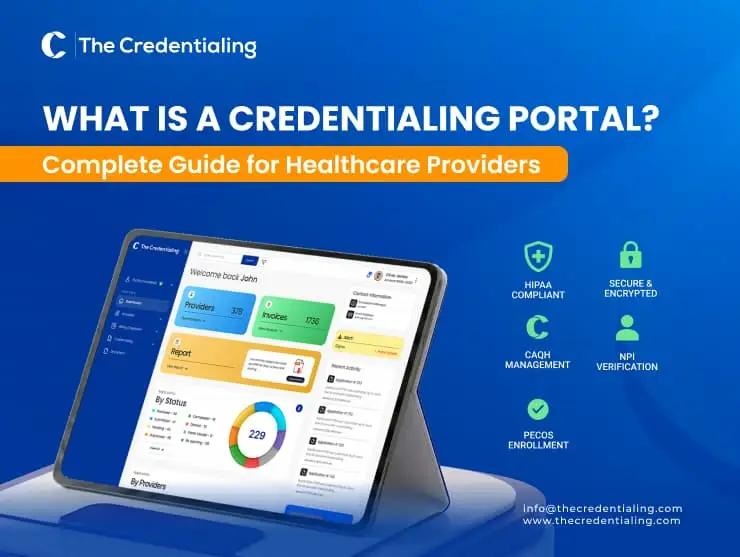
A credentialing portal is a secure platform that helps healthcare providers and organizations manage provider credentialing, licensing, CAQH profiles, payer enrollment, and document management from an all-in-one centralized dashboard. It helps the providers focus more on patient care.
Key Takeaways
-
Manage Provider Credentialing From One Dashboard.
-
Track Licensing and Provider Enrollment.
-
Reduce Credentialing Delays.
-
Improve HIPAA Compliance.
-
Monitor Credentialing Progress.
-
Manage Single Providers or Large Medical Groups.
-
Reduce Burden and Spend More Time Delivering Patient Care.
Introduction
Healthcare organizations like practices, hospitals, and other healthcare facilities are facing a growing administrative burden. Administrative burden refers to all the paperwork required to run their facilities. Because their primary focus is on delivering exceptional patient care, there is very little time to handle the paperwork. They can’t handle both at the same time.
They struggle to manage new enrollments, re-enrollments, dis-enrollments, validations, licensing, and signups, CAQH profile updates, and maintain accurate provider documents. Medical credentialing is a complex and time-consuming process because it demands regular verification and renewals.
Medical providers have no time to dive into the complex administrative procedures. Actually, they need a centralized credentialing dashboard that manages everything in one place.
What Is a Credentialing Portal?
To explain the credentialing portal, first, we need to go through the definition of medical credentialing. Medical credentialing refers to the process of verifying healthcare providers, whether they are qualified to deliver medical services and meet the requirements of insurance companies.
On the other hand, a credentialing portal is a secure cloud-based online platform built specifically for healthcare providers (Individual & Groups), medical practices, and hospitals to manage all the processes of medical credentialing in one centralized platform.
Who Should Use a Credentialing Portal?
A credentialing portal is generally used by independent providers and managers of hundreds of clinicians. A credentialing portal helps reduce paperwork and improve compliance, along with operational efficiency.
Credentialing Portal is built for:
1. Independent & Multi-Disciplinary Practices
2. Allied Health & Rehabilitation Services
3. Facility-Based & Acute Care Networks
4. Administrative & Integrated Health Models
What Can A Credentialing Portal Manage?
A provider credentialing portal can manage a few or all the given services below:
-
State Licenses: Authorization issued by a state government for physician credentialing. State licensing portals allow a doctor or a medical facility to operate within the jurisdiction of the specific state.
-
Accreditation: Accreditation is a recognition by a third party that confirms that a medical organization meets the standards of safety and quality.
-
PLI/COI: PLI means Professional Liability Insurance. It provides coverage for malpractice claims. COI stands for Certificate of Insurance, and it acts as documented proof that such coverage is active.
-
CLIA: CLIA stands for Clinical Laboratory Improvement Amendments. It is a program that sets federal standards for all the medical laboratory testing (on Humans) in the U.S.
-
Hospital Affiliation: Hospital Affiliation is the formal agreement between a healthcare provider and a hospital. Hospital Affiliation grants the provider all the medical staff privileges.
-
Surety Bond: Provided by a third party, a Surety Bond is a financial guarantee that ensures a business fulfills its contractual obligations to a client.
-
PECOS: PECOS stands for Provider Enrollment, Chain, and Ownership System. It is an online CMS system designed for healthcare providers to enroll and update their information for Medicare.
-
NPPES: NPPES is a short name for the National Plan and Provider Enumeration System, a federal database that is used to assign NPI numbers to healthcare providers.
-
CAQH: Council for Affordable Quality Healthcare (CAQH) provides a centralized and electronic database for medical providers to submit credentialing information to several health plans for insurance credentialing.
-
DEA: DEA stands for Drug Enforcement Administration, a registration that authorizes a healthcare professional to prescribe or dispense substances.
-
Profile Screening: Profile Screening refers to a process of verifying a medical provider's background, including criminal records, sanctions, and exclusions. Profile screening is a necessary step that ensures all the providers meet professional and ethical standards.
All in one digital dashboard.
Why Healthcare Providers Need A Credentialing Portal?
As we discussed in the beginning, healthcare providers go through a vast array of problems. Their main issue is time. They can barely invest a few minutes to an hour managing the administrative work. Their main focus is to deliver exceptional care to patients. That is why most of their time is consumed delivering patient care and lacks the management of:
-
Spreadsheets: Time spent on manually updated sheets is the time obtained from clinic time, which is just like a disaster for a healthcare provider.
-
Emails: Emails can also distract healthcare professionals from patient care, as they have to manage unorganized threads for document collection.
-
PDFs: Searching for scattered current documentation forces a medical provider to spend time on administrative work instead of providing clinical care.
-
Expiration Dates: If a provider begins managing all the expiration dates of different documents, a significant amount of time is wasted, distracting the provider from clinical care.
-
Credentialing Delays: Looking at the management of credentialing delays also requires an excessive amount of time. A healthcare professional involved in this administrative work drastically reduces his clinical efficiency.
-
Denied Claims: As a provider, solving billing discrepancies caused by credentialing errors bites a big chunk of time and forces providers to work as office administrators rather than doctors.
This is why medical providers need a credible medical credentialing portal to manage all their processes in one dashboard, which can be easily tracked.
Now that we've explored what a credentialing portal is and why healthcare organizations rely on one, let's see how these concepts are applied in practice through TheCredentialing Portal.
Typical Credentialing Timeline in the United States
While every insurance payer follows its own credentialing requirements, most provider credentialing processes in the United States follow a similar workflow. Understanding this timeline helps healthcare organizations prepare documents in advance and reduce avoidable delays.
|
Timeline |
Credentialing Stage |
Key Activities |
|
Week 1–2 |
Document Collection & Verification |
Collect provider documents |
|
Week 2–3 |
CAQH Profile Preparation |
Complete or update the CAQH profile |
|
Week 3–4 |
Application Submission |
Submit credentialing applications to commercial insurance payers |
|
Week 4–10 |
Payer Review & Verification |
Primary source verification Insurance payer review Respond to additional document requests (if required) |
|
Week 8–16 |
Approval & Enrollment |
Receive credentialing approval |
How Does TheCredentialing Portal Work?
Keeping all providers’ credentialing requirements in mind, TheCredentialing platform has designed a robust portal called TheCredentialing Portal, where you not only submit your documents but also check live reports, invoices, and financial overview, along with provider onboarding status and operational efficiency graphs, and can easily track your applications.
Watch Complete Portal Walkthrough (From Sign-Up to CAQH Profile Creation)
Watch this complete walkthrough to learn how healthcare providers register, verify their accounts, update their profiles, add providers, and submit credentialing requests through TheCredentialing Portal. This video demonstrates the complete onboarding process, making it easier to understand each step before getting started.
Step 1
Sign in with your Google account or using sign up option to create a new account.

Step 2
You will receive a 4-digit OTP as a two-step verification, for example, 1122 or 3412. Enter the received OTP to log in securely to maintain privacy.

Step 3
You will land directly on our centralized dashboard that gives you maximum visibility to track all of your invoices, attestations, and submitted applications.

Step 4
Click on “Profile Update” on the left sidebar and fill in all the query boxes. This section may ask you a few things, like uploading your profile picture and filling in some query boxes. Click the submit button when you choose a profile picture.

After you upload your profile picture, start adding your user information below, which asks you to fill in your:
-
First Name
-
Last Name
-
Email
-
Phone Number

Soon after you fill in the user information, you scroll down a little and see practice information, which includes putting in the following data:
-
Practice Name
-
Group NPI
-
TIN/EIN
-
Speciality
-
Unique Group Id

Enter the details in the format: Group Number - Group Name - Group ID. If you don’t have a group ID, leave it empty. Scroll down a little more, and you will find Address Information, which may ask you to put in:
-
Address
-
Mailing Address
-
Pay-To Address
-
DBA
-
TIN
-
Contact Number
-
Group NPI

After you fill in all the required provider information, you simply have to click on the “Proceed to Account Verification” button.
Step 5
Fill out the required info, and your account will be verified within a few minutes. This section may ask you to select your “State Issued Photo ID or State License” followed by uploading the relevant file.

After your account gets verified, click on the “Add Provider” tab on the left sidebar to proceed further.
Step 6
As you click on add provider, you will see another form with several query boxes that require data to fill. In the Add Provider section, you will have to fill in the following boxes:
Select Your Practice Role, A button that shows multiple roles to select when clicked)
-
Mark Yes or No To The Question “Do you have NPPES/PECOS Profile?”
-
Enter NPI Number
-
Enter First Name
-
Enter Middle Name
-
Enter Last Name
-
Enter Practice Location Address
-
Select State
-
Enter ZIP

Further followed by:
-
Enter Business Phone Number
-
Select Gender
-
Mark Yes or No To The Question “Do you have a CAQH profile?”
-
Enter SSN
-
Enter Date of Birth
-
Select Specialty

After filling in all of the above boxes, you can click on submit or proceed to group settings (if you require group settings).
These were the easy steps to know how to set up your TheCredentialing portal.
How CAQH Works Inside TheCredentialing Portal?
Step 1
Choose “Credentialing” on the left sidebar, and click on “Licensing & Sign Up”. Click on the box named “Select Preferences”. You will see multiple services like:
-
State Licenses
-
Accreditation
-
PLI/COI
-
CLIA
-
Hospital Affiliation
-
Surety Bond
-
PECOS
-
NPPES
-
CAQH
-
DEA
-
Profile Screening

Choose any service that fits your needs, for example, CAQH, and proceed. Initially, our portal will ask the provider to fill in the form “Provider.”
Step 2
After selecting CAQH, a new form will appear asking you to fill in the following data:
-
Provider’s Username
-
State Where The Provider is Serving
-
Provider’s Full Name
-
Provider’s Date of Birth
-
Provider’s Phone Number
-
Provider’s Social Security Number (SSN)
-
Provider’s NPI Number
-
Provider’s License Number
-
Zip Code
-
Provider’s Email

The provider also must fill out the “Home Address” form, asking for:
-
Address Line 1
-
Address Line 2
-
City
-
State
-
ZIP Code
-
Phone Number
-
Fax Number

Once submitted, our credentialing specialists manage the remaining process and give providers a stable breathing room to focus on their patients and a centralized dashboard to track their status without any discrepancies.
We are proud to say that we serve over a thousand medical specialties with 100% HIPAA compliance and have achieved 100% client satisfaction to date, because our credentialing portal is specifically built to be oversimplified.
What is CAQH?
CAQH stands for Council for Affordable Quality Healthcare. It is a non-profit alliance consisting of health plans and industry networks. This alliance manages administrative processes in the US healthcare system. Here, the administrative processes refer to professional and licensing information, which allows multiple insurance companies and healthcare organizations to easily access and verify their credentials.
For further information, read our complete blog “What is CAQH?”
How TheCredentialing Portal Simplifies CAQH Management?
One of the most critical, but time-consuming steps in credentialing for healthcare providers in the United States is the management of a CAQH profile. Failure to submit an attestation by the deadline, submission of incorrect information, or incomplete provider data can cause delays in insurance enrollment and reimbursement.
TheCredentialing Portal simplifies CAQH management by setting the entire process into one dashboard. Using TheCredentialing Portal, providers can organize credentialing documents, submit requests, monitor progress, and communicate with credentialing specialists, as well as avoid tracking documents through spreadsheets, emails, or multiple systems.
TheCredentialing Portal helps reduce administrative workload and gives healthcare organizations complete visibility of the credentialing process, including the creation of a new CAQH profile, completing your mandatory 120-day attestation, or preparing for payer enrollment.
Credentialing Portal vs. CAQH Provider Data Portal
|
TheCredentialing Portal |
CAQH Provider Data Portal |
|
Manages the complete credentialing lifecycle |
Stores provider credentialing information |
|
Tracks provider onboarding and enrollment |
Shares provider information with participating payers |
|
Supports licensing, enrollment, and compliance |
Focuses on provider profile management |
|
Provides workflow tracking and dashboards |
Requires providers to complete attestation every 120 days |
|
Supports multiple providers and organizations |
Designed for individual provider profile management |
Did You Know?
One of the most common reasons for credentialing delays in the United States is an outdated CAQH profile. Completing your CAQH attestation every **120 days**, keeping your provider information accurate, and maintaining updated supporting documents can help prevent payer enrollment delays and reimbursement issues.
Learn More About the CAQH Provider Data Portal
Explore our comprehensive guide to the CAQH Provider Data Portal: Login, Attestation & Complete Guide (2026). If you're looking for a detailed walkthrough of the CAQH Provider Data Portal, our blog walks you through:
-
How to register for a CAQH account
-
How to log in to the CAQH Provider Data Portal
-
Documents required for CAQH credentialing
-
How the 120-day attestation process works
-
Common mistakes that delay provider credentialing and enrollment
-
Best practices for maintaining an active CAQH profile
Why Providers Need CAQH?
Medical Providers require CAQH to simplify the medical credentialing process. This helps them speed up reimbursements and reduce administrative work. Instead of submitting paperwork again and again to multiple insurance companies, medical providers just create a single and highly secure profile.
How CAQH Connects To Insurance Companies?
Instead of submitting paperwork to multiple insurance companies, medical providers create a single profile in the CAQH Provider Portal, which can be referred to as CAQH credentialing. This portal is where the providers grant direct access to their data to authorized payers to process network enrollments.
This Connection involves several key steps:
-
Data Centralization
-
Payer Access
-
Reimbursement
-
Continuous Updates
How Credentialing Companies Manage CAQH for Providers Using TheCredentialing Portal?
By centralizing professional data into CAQH Proview, credentialing management companies, just like TheCredentialing manage CAQH for healthcare providers, gathering important documents, like State Licenses, DEA, Malpractice insurance, etc. Credentialing companies build a profile and ensure mandatory re-attestation every 120 days to avoid profile suspension/expiry.

Managing CAQH effectively requires a proper, structured approach:
-
Initial Data Gathering
-
Document Upload & Verification
-
Payer Authorization
-
Profile Maintenance
What Documents Are Required For CAQH?
For CAQH, TheCredentialing portal requires several documents that include digital copies of NPI, state medical licenses, DEA registrations, board certifications, and a current malpractice insurance face sheet.
Common Credentialing Mistakes That Delay Provider Enrollment
Experienced healthcare organizations can also experience credentialing delays. Below are the common issues that cause credentialing delays. Identifying these issues on time helps avoid unnecessary delays and keeps providers eligible for enrollment.
The most common credentialing mistakes include:
-
Expired CAQH attestation.
-
Outdated provider profile.
-
Outdated Malpractice Insurance.
-
Incorrect Practice or Mailing Address.
-
Missing W-9 or Tax.
-
Incorrect National Provider Identifier.
-
Expired Medical Licenses.
-
Missing or Inactive DEA Registration.
-
Incomplete Board Certification Records.
-
Missing Provider Signatures.
By keeping provider information updated, healthcare organizations can reduce credentialing delays and considerably improve approval timelines.
How Attestation Works in TheCredentialing Portal?
CAQH attestation is a formal process where a professional reviews and verifies the accuracy of the provider’s professional and personal data. This data includes the verification of the provider’s qualification, licenses, and practice details.
For Attestation/Validation in TheCredentialing Portal, you would need to fill out a short form containing the directories of:
-
Select Provider
-
State Selection
-
Payer Details
If you want a change in information, there is another section present named“Change in Information”. It contains 4 tabs, which will ask for different queries like:
If you click on the “Name” tab, you will have to fill in:
-
First Name
-
Middle Name
-
Last Name
If you click the “Address” tab, you may see more queries asking for:
-
Address 1
-
Address 2
-
City
-
State
-
ZIP Code
-
Phone No. 1
-
Phone No. 2
-
Email
-
DBA
And a selection box named “Select Address type”. By clicking on it, you choose to select:
-
Home Address
-
Primary Address
-
Mailing Address
There is a third tab named “contact” which contains three query boxes that would require filling:
-
Phone 1
-
Phone 2
And a selection box where you select one of the following:
-
Home Contact
-
Primary Contact
-
Mailing Contact
After you fill in all the query boxes above, TheCredentialing Portal asks you if you have special instructions. If yes, you would need to write your special instructions in the box below and proceed. This way, our credentialing experts would receive all the information they need to get you attested properly and effectively.
Why Provider Credentialing Gets Delayed
Provider credentialing is a complex and detailed process of verification that involves healthcare organizations, licensing boards, insurance companies, and government agencies. Many delays can be prevented through accurate documentation and credential management.
Reasons why credentialing takes longer than expected:
-
Incomplete Applications
-
Missing Documents
-
Delayed Responses From Payers
-
Primary Source Verification Delays
-
Expired Licenses & Certifications
-
Outdated CAQH Profile
-
Hospital Privilege Verification Delays
-
State Licensing Board Processing Times
-
Incorrect Demographics
A credentialing portal coming with a centralized dashboard not only helps organizations monitor application status but also responds quickly to documentation requests and reduces delays that can be avoided.
Stop letting administrative burdens dictate your schedule. Reclaim your time for patient care by automating your credentialing process today.

HIPAA-Compliant Security & Data Protection
TheCredentialing Portal understands that healthcare organizations handle highly sensitive provider information, due to which security and compliance become a necessity, and this is why it commits to the protection of confidential data, along with supporting regulatory compliance.
Key security advantages include:
-
Secure Cloud-Based Document Storage
-
Role-Based User Access
-
Encrypted Provider Information
-
Centralized Document Management
-
Secure Credentialing Workflows
-
Protected Provider Communication
-
Audit-Ready Document Organization
-
HIPAA-Conscious Operational Processes
Maintaining secure access to provider credentials protects sensitive information and also improves collaboration across credentialing teams and healthcare organizations.
Why U.S. Healthcare Organizations Choose TheCredentialing Portal
Healthcare organizations across the United States choose TheCredentialing portal because they are actively looking for faster and more transparent ways to manage provider credentialing.
TheCredentialing Portal simplifies all the administrative processes and gives organizations complete visibility of the credentialing lifecycle.
Healthcare organizations choose TheCredentialing Portal because it helps them:
-
Centralize Provider Information
-
Manage Individual Providers & Medical Groups
-
Track Credentialing Status in Real Time
-
Simplify CAQH Profile Management
-
Organize Licensing & Enrollment Documentation
-
Improve Operational Efficiency
-
Reduce Workload
-
Support Ongoing Provider Compliance
-
Monitor Renewals
The platform provides a streamlined experience for today's U.S. healthcare environment that is actively supporting a single physician practice as well as large organizations of healthcare.
Estimated Time Savings Using a Credentialing Portal
Manual credentialing requires a significant amount of time-consuming spreadsheet tracking and continuous follow-up with providers and payers. Practices and organizations of healthcare can reduce administrative burden and improve their overall efficiency if they centralize all the credentialing activities digitally using a credentialing portal.
|
Traditional Process |
TheCredentialing Portal |
|
Manual spreadsheets |
Centralized dashboard |
|
Email document collection |
Secure document repository |
|
Manual follow-up |
Live workflow tracking |
|
Multiple systems |
One unified platform |
|
Difficult renewal tracking |
Organized renewal management |
|
Limited visibility |
Real-time status updates |
A digital credentialing platform allows administrative teams to spend less time managing paperwork. While they get diverted from administrative duties, they dedicate more time to supporting provider onboarding, compliance, and patient care initiatives.
Benefits of TheCredentialing Portal
TheCredentialing portal is specifically built with a long-term plan and effective philosophy that includes a time-saving, benefit-oriented approach for healthcare providers. The main goal of TheCredentialing portal is to simplify provider credentialing workflow through centralized management and real-time visibility. With more than 50 regularly updated features, TheCredentialing portal provides several benefits as given below:
-
Real-Time Credentialing Visibility: Get 24/7, instant access to the current statuses of every application and enrollment.
-
Centralized Management of Practice: Access all your provider data, medical facility information, and documentation in a single dashboard.
-
Secure Document Management: All your sensitive provider information is compliant, well-protected, and highly encrypted.
-
Multi-Provider Management: Ability to manage the credentialing lifecycles of multiple providers.
-
Performance Analytics & Reporting: Data-driven insights and automated reports of all the bottlenecks and turnaround times.
-
Direct Communication with Credentialing Experts: Dedicated support by credentialing experts to resolve complex issues and ensure successful submissions.
Why Digital Credentialing Is Becoming the Standard in U.S. Healthcare
Healthcare organizations in the U.S is moving away from the traditional spreadsheet-based credentialing towards a digital and centralized setting. As provider networks expand and payer requirements become increasingly complex, these organizations are now requiring secure, fast, and reliable systems.
A digital credentialing portal helps healthcare organizations:
-
Reduce Administrative Workload
-
Organize Credentialing Documentation
-
Monitor Application Progress in Real Time
-
Simplify CAQH Profile Management
-
Support Licensing & Payer Enrollment
-
Reduce Avoidable Credentialing Delays
Digital and dashboard-style credentialing tech has become an important operational upgrade for all healthcare facilities and medical groups throughout the United States.
Ready to Simplify Provider Credentialing?
Administrative work should never stand in the way of quality patient care.
TheCredentialing Portal helps simplify provider credentialing, licensing, CAQH profile management, payer enrollment, and compliance through one secure, centralized platform for you. It supports multiple entities, like independent physicians, medical groups, and healthcare organizations, through one dedicated credentialing software.
Our credentialing specialists work alongside your team to reduce administrative burdens and offer several services- from provider onboarding to ongoing credential maintenance, while improving visibility of the credentialing lifecycle.
Why Trust TheCredentialing?
-
HIPAA-Optimized Credential Management
-
Dedicated Credentialing Specialists
-
Support for Multiple Medical Specialties
-
Provider Management Through One Software
-
Secure Organization of Documents
-
Real-Time Visibility of Progress
See how TheCredentialing Portal can help your organization improve efficiency and simplify credentialing workflows.
Disclaimer: TheCredentialing Portal is an independent third-party credentialing management platform and is not affiliated with, endorsed by, or operated by any U.S. government agency or official credentialing portal, including CMS, Medicare, Medicaid, CAQH, PECOS, NPPES, or the DEA. References to these organizations are for informational and compatibility purposes only.
Frequently Asked Questions
What is a credentialing portal?
A credentialing portal is a secure, cloud-based online platform built specifically for healthcare providers, medical facilities, and hospitals to manage all the processes of medical credentialing in one centralized platform.
Is a credentialing portal the same as CAQH?
No, CAQH is a centralized database. It is used to store and share provider information with payers. On the other hand, a credentialing portal, also called a healthcare credentialing portal, is a management platform that monitors the entire credentialing lifecycle. A credentialing portal can possibly include CAQH profile, licenses, and renewals.
Who uses credentialing software?
Provider credentialing software is generally used by hospitals, private practices, surgery centers, and medical billing teams.
How does provider enrollment work?
Provider enrollment is a process in which a healthcare provider submits their credentials to an insurance payer using a provider enrollment portal to be officially recognized as an in-network provider.
Can I manage multiple providers?
Yes, you can manage multiple providers by integrating their credentialing lifecycles and enrollment statuses into a centralized dashboard, as in TheCredentialing Portal.
How long does credentialing take?
The credentialing process takes between 60 and 120 days, though these timelines can extend up to 6 months because it depends on different payers' rules and state regulations.
How often should CAQH be updated?
The CAQH profile must be updated every 120 days through the CAQH portal to ensure your data remains accurate and prevent your profile from suspension and expiration.
What is hospital credentialing?
A process by which a hospital evaluates and verifies a provider’s professional qualifications and experience is called hospital credentialing.
What is provider licensing?
Provider licensing is a mandatory authorization issued by a state government. It grants a medical professional the right to practice medicine and provide services within the state.
What is healthcare compliance?
Healthcare compliance is the process of adhering to all the rules of complex federal and state laws, along with regulations and ethical standards. This ensures the quality and data privacy of medical billing.
What is PECOS?
PECOS stands for Provider Enrollment, Chain, and Ownership System. It is an online CMS system built specifically for medical providers to enroll and update their information for Medicare.
Can I manage multiple practice locations from one credentialing portal?
Yes. A centralized credentialing portal allows healthcare organizations to manage multiple practice locations, providers, and credentialing workflows from a single dashboard. This helps reduce administrative complexity while maintaining consistent provider information across locations.
Is TheCredentialing Portal suitable for solo providers?
Absolutely. Whether you are an independent physician, nurse practitioner, behavioral health provider, dentist, or part of a large healthcare organization, TheCredentialing Portal provides scalable credentialing solutions that fit practices of every size.
Does TheCredentialing Portal help with CAQH profile maintenance?
Yes. TheCredentialing Portal helps healthcare providers organize documentation required for CAQH profile creation, profile updates, and periodic attestation while providing centralized visibility into credentialing activities.
Can credentialing documents be stored securely?
Yes. Provider licenses, malpractice insurance, board certifications, DEA registrations, NPI documentation, and other credentialing documents can be securely organized within one centralized platform, helping providers maintain accurate records.
Why should healthcare organizations use a centralized credentialing portal?
A centralized credentialing platform improves efficiency by reducing manual paperwork, organizing provider information, improving visibility into credentialing progress, and simplifying ongoing provider management across healthcare organizations.
Sit Back and Relax! Let The Pros Handle Credentialing For You!
thecredentialing has built a strong portfolio while providing credentialing services to clients over the years. Our service includes helpful features that you won’t find anywhere else.
Schedule Free Demo Today!