Before the First Patient: The Hidden Administrative Work Behind Provider Credentialing
Explore the provider credentialing process, hidden administrative workload, payer enrollment requirements, CAQH management, and ways to simplify credentialing for healthcare practices.
Schedule Free Demo Today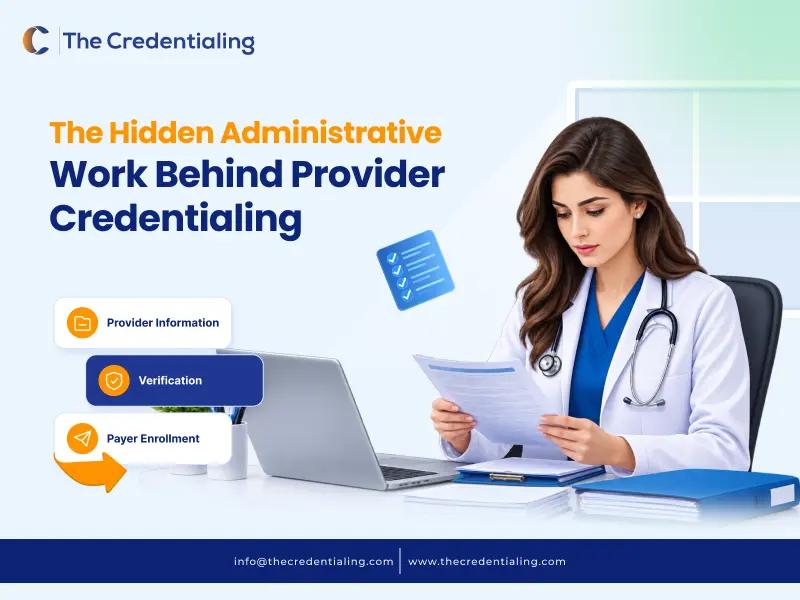
A healthcare provider may be ready to see patients, but that does not automatically mean they can participate in every insurance network. Before a physician, nurse practitioner, physician assistant, or other eligible clinician can provide in-network care, several administrative steps may need to be completed.These steps include collecting provider information, verifying professional qualifications, maintaining CAQH profiles, submitting payer applications, responding to requests for additional information, and tracking enrollment decisions.This work happens largely behind the scenes. However, it directly affects provider onboarding, network participation, and the administrative workload of healthcare practices.Understanding the provider credentialing process helps practice owners and administrators identify where time is spent, why applications may be delayed, and how better coordination can make the process easier to manage.
What Happens Before a Provider Can See In-Network Patients?

Before a provider participates in an insurance network, the practice generally needs to complete the applicable credentialing and enrollment requirements of each payer.
Although the exact requirements vary by payer, provider type, and enrollment situation, the process commonly involves:
-
Collecting provider information and supporting documents.
-
Verifying education, licenses, certifications, and other qualifications.
-
Reviewing and maintaining provider information in CAQH, when required.
-
Completing insurance credentialing and payer enrollment applications.
-
Responding to payer requests and correcting missing or inconsistent information.
-
Monitoring application status and confirming network participation.
Credentialing and enrollment are related, but they are not the same thing. Credentialing evaluates a provider's professional qualifications, while enrollment establishes the provider's participation and billing relationship with a specific payer.For a broader explanation, read our guide to What Is Provider Credentialing in Healthcare?.
1. Collecting Provider Information and Documents
The administrative work often begins before an application is submitted.A practice must gather accurate provider information and supporting documents.
Depending on the provider and payer, these may include:
-
National Provider Identifier (NPI)
-
State medical or professional license
-
DEA registration, when applicable
-
Board certification, when applicable
-
Education and training information
-
Work history and professional references, when requested
-
Malpractice insurance details
-
Professional liability coverage information
-
Practice locations and contact details
-
Tax identification and business information
-
Disclosure and authorization forms
The information must be consistent across applications, supporting documents, provider records, and payer systems.For example, an outdated practice address, inconsistent legal name, missing license information, or incorrect NPI can create additional work during application review.Practices can use a centralized document checklist to track what has been collected, what is missing, and what needs updating.For a detailed breakdown, see Documents Required for Provider Credentialing.
2. Verifying Provider Qualifications
Collecting documents is only one part of credentialing. Payers and credentialing organizations may also need to verify information directly with authoritative sources.This is commonly referred to as primary source verification (PSV).
Depending on the provider and applicable requirements, verification may include:
-
Professional licenses
-
Education and training
-
Board certifications
-
Work history
-
Malpractice history and coverage
-
Sanctions and exclusions
-
Other professional qualifications and disclosures
The purpose is to establish whether the information submitted by the provider is accurate and whether the provider meets the applicable credentialing criteria.Verification requirements are not identical across all payers. Some information may need to be obtained directly from the issuing organization or another recognized primary source.For practices managing several providers, coordinating these checks can become a recurring administrative responsibility.
3. Maintaining CAQH Provider Information
CAQH profile management is another important part of the administrative workload for many providers.The CAQH Provider Data Portal allows participating providers to maintain professional and practice information that health plans may use during credentialing and related processes.
Depending on payer requirements, a provider may need to maintain:
-
Personal and professional details
-
Education and training history
-
License and certification information
-
Practice locations
-
Malpractice insurance details
-
Work history
-
Supporting documents
-
Required attestations
Keeping the profile accurate and current helps reduce inconsistencies when payers review provider information.However, completing or attesting to a CAQH profile does not automatically complete insurance credentialing or payer enrollment. Each payer may have its own application, documentation, verification, and approval requirements.That distinction matters. A practice can have an updated CAQH profile and still have separate enrollment applications pending with individual insurance companies.
4. Completing Insurance Credentialing and Payer Enrollment
After the required information is collected and reviewed, the practice must address the applicable requirements of each insurance payer.Commercial insurance companies may have their own credentialing criteria, applications, document requirements, and review procedures.Medicare enrollment follows a separate federal process.For Medicare, eligible providers and suppliers generally use the Provider Enrollment, Chain, and Ownership System (PECOS) to submit enrollment applications and supporting information. Medicare Administrative Contractors (MACs) process applications and may request additional documentation.According to the Centers for Medicare & Medicaid Services (CMS) Medicare Provider Enrollment guidance, applicants must provide the required information, signatures, and supporting documentation. When a MAC requests additional information, the applicant should respond within the specified 30-day period to avoid possible rejection.Medicaid enrollment requirements are administered through state-specific programs, so practices must follow the applicable state and program requirements.The important point is that provider enrollment is not a single universal application. Requirements depend on the payer, provider type, location, and enrollment circumstances.
5. Following Up on Applications and Payer Requests
Submitting an application does not mean the process is finished.Payers may request additional documents, clarification, corrections, or updated information during their review.
Practice administrators may need to:
-
Monitor application status.
-
Review payer correspondence.
-
Identify missing or incomplete information.
-
Coordinate responses with providers.
-
Submit requested documents.
-
Correct inconsistent application details.
-
Record follow-up dates.
-
Confirm the payer's final enrollment decision.
Without a clear tracking process, applications can become difficult to manage, particularly when a practice is working with multiple providers and insurance networks.A centralized tracking system helps administrators understand which applications are submitted, pending, awaiting additional information, or completed.
The Hidden Administrative Workload Behind Credentialing

The amount of administrative work involved in credentialing can be substantial, especially for practices managing multiple providers and payer relationships.A November 2026 article published by DataSpring, powered by CAQH, reported findings from a survey of more than 50 clinical and administrative practice staff.
According to the published findings, practices reported spending an average of:
-
502 hours annually on initial credentialing and enrollment.
-
592 hours annually on recredentialing.
The figures represent survey-reported averages, not a guaranteed workload for every practice. Actual administrative time can vary depending on provider volume, payer requirements, internal processes, and the quality of provider data.The findings nevertheless illustrate that credentialing is not simply a matter of completing one form. It involves repeated information collection, verification, application management, follow-ups, and ongoing maintenance.Read the original DataSpring research: Before the First Patient: The Hidden Hours Behind Every Network Clinician.
Why Provider Credentialing Applications May Be Delayed
Credentialing delays can happen for several reasons. Some are related to incomplete provider information, while others depend on payer review procedures and external verification requirements.
Common causes include:
Incomplete Documentation
Missing licenses, insurance documents, signatures, or other required information can prevent an application from moving forward.
Inconsistent Provider Information
Differences in provider names, practice addresses, NPIs, tax information, or other application details may require clarification or correction.
Outdated CAQH Profiles
An outdated profile or missing attestation may create additional work when a payer needs current provider information.
Separate Payer Requirements
Each insurance company may have its own application process, documentation requirements, and review criteria. Information prepared for one payer may not satisfy another payer's requirements.
Delayed Responses to Additional Requests
When a payer requests clarification or supporting documentation, a slow response can extend the overall process.
Limited Administrative Capacity
Small practices may not have dedicated staff to manage provider records, multiple payer applications, and recurring follow-ups alongside daily operations.Not every delay is within a practice's control. Payer review times, verification procedures, and other external factors can also affect the process.
Why Credentialing Becomes More Difficult as a Practice Grows
Managing credentialing for one provider is different from coordinating it for a group of physicians, nurse practitioners, physician assistants, and other clinicians across multiple locations.
As a practice grows, the administrative workload can increase because:
-
More provider records need to be maintained.
-
Different licenses and certifications have different expiration dates.
-
More payer applications need to be completed.
-
Each payer may request different information.
-
Practice locations and provider affiliations may change.
-
Recredentialing and enrollment maintenance become recurring responsibilities.
Without a consistent process, administrators may find it difficult to identify missing documents, track pending applications, and maintain accurate provider information.A structured credentialing workflow can help practices keep provider records organized and make application follow-ups easier to manage.
How Healthcare Practices Can Reduce Credentialing Workload
Practices cannot control every payer requirement or review timeline. However, they can improve how credentialing information and applications are managed internally.
1. Maintain a Centralized Provider Record
Keep provider details, licenses, certifications, practice locations, and supporting documents organized in one accessible record.
2. Review Information Before Submission
Check provider names, NPIs, addresses, tax information, and other application details for accuracy before submitting them to a payer.
3. Keep CAQH Profiles Updated
Review profile information and supporting documents regularly. Complete required attestations and address outdated information when changes occur.
4. Track Every Payer Application
Maintain a record of submission dates, payer contacts, application status, outstanding requests, and follow-up activities.
5. Monitor Recredentialing and Renewal Requirements
Track relevant expiration dates and payer recredentialing requirements to reduce the risk of missed updates.
6. Assign Clear Administrative Responsibility
Make sure someone is responsible for collecting documents, monitoring applications, responding to payer requests, and updating provider records.
7. Consider Dedicated Credentialing Support
Practices with limited administrative capacity may consider working with a credentialing service provider to manage applicable provider credentialing and payer enrollment tasks.
How TheCredentialing Supports Provider Credentialing and Enrollment
Managing provider credentialing, payer enrollment, CAQH information, and ongoing updates can place additional pressure on healthcare practices.TheCredentialing provides credentialing and enrollment support for healthcare providers and practices. Its services include assistance with provider credentialing, insurance payer enrollment, CAQH profile management, Medicare and Medicaid enrollment support, and ongoing credentialing-related requirements.
Depending on the practice's needs, support may include:
-
Provider credentialing and enrollment coordination
-
Commercial insurance payer enrollment
-
Medicare and Medicaid enrollment support
-
CAQH profile management
-
Provider information and document coordination
-
Recredentialing and enrollment maintenance
Practices looking for assistance can explore Provider Enrollment and Credentialing Services to understand the available support.For ongoing enrollment and compliance requirements, visit Revalidation and Compliance Services.The appropriate support depends on the provider type, payer requirements, practice structure, and services needed.
Frequently Asked Questions About the Provider Credentialing Process
What is the provider credentialing process?
The provider credentialing process involves reviewing and verifying a healthcare professional's qualifications, licenses, education, training, and other required information. It helps determine whether a provider meets the applicable requirements of a healthcare organization or insurance payer.
How long does provider credentialing take?
The timeline varies by payer, provider type, application completeness, verification requirements, and review procedures. Commercial insurance credentialing and government program enrollment may follow different processes. Practices should confirm expected timelines with the relevant payer or enrollment authority.
What is the difference between credentialing and payer enrollment?
Credentialing verifies a provider's professional qualifications and eligibility under applicable criteria. Payer enrollment establishes the provider's participation and billing relationship with a specific insurance program or health plan. Both may be required before a provider can participate in a network.
Does CAQH complete insurance credentialing?
No. Maintaining and attesting to a CAQH profile does not automatically complete credentialing or enrollment with every insurance payer. Health plans may use CAQH information, but they can still require separate applications, documents, verification, and approval.
What documents are commonly required for provider credentialing?
Requirements vary, but commonly requested information includes an NPI, professional license, education and training details, board certification when applicable, malpractice insurance, work history, practice location information, and other supporting documents. Individual payers may have additional requirements.
What causes delays in provider credentialing?
Common causes include incomplete applications, missing documents, inconsistent provider information, outdated CAQH profiles, delayed responses to payer requests, and payer-specific review requirements. External verification and payer processing times can also affect the timeline.
What is provider recredentialing?
Provider recredentialing is the periodic review of an existing provider's qualifications and information to confirm continued compliance with applicable credentialing requirements. The frequency and requirements depend on the payer or organization.
Can a healthcare practice outsource provider credentialing?
Yes. A healthcare practice can work with an external credentialing service provider for applicable credentialing, payer enrollment, CAQH management, and related administrative tasks. The scope of support should be confirmed based on the practice's providers, payers, and requirements.
Manage the Work Behind Provider Network Participation
Provider credentialing involves more than submitting an application. It requires accurate provider information, document coordination, verification, payer enrollment, application follow-ups, and ongoing maintenance.For healthcare practices managing multiple providers and insurance networks, these responsibilities can become a significant administrative workload.A structured process and appropriate credentialing support can help practices organize provider information, manage payer requirements, and keep enrollment activities on track.Need support with provider credentialing or payer enrollment? Explore TheCredentialing's provider enrollment and credentialing services to learn how your practice can get assistance.
Sit Back and Relax! Let The Pros Handle Credentialing For You!
thecredentialing has built a strong portfolio while providing credentialing services to clients over the years. Our service includes helpful features that you won’t find anywhere else.
Schedule Free Demo Today!