Medicare Open Enrollment 2026: What Providers Need to Know About Network Changes and Credentialing
Learn how 2027 Medicare Advantage network changes affect provider credentialing, payer enrollment, NPPES records, and provider directory accuracy.
Schedule Free Demo Today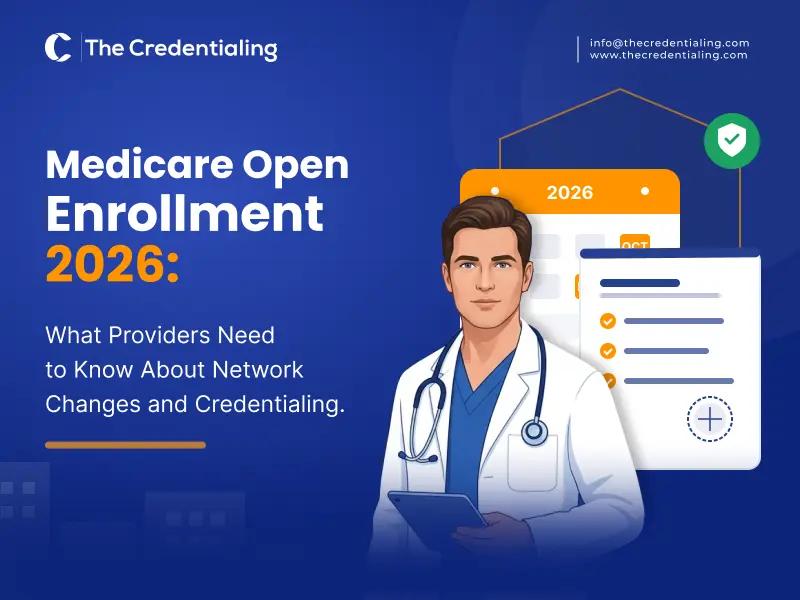
Medicare Open Enrollment 2026 is an important time for healthcare providers to review their Medicare Advantage network participation, provider enrollment records, and directory information before the 2027 plan year begins.
From October 15 through December 7, 2026, eligible Medicare beneficiaries can review their coverage and make changes for the upcoming year. These decisions can affect which Medicare Advantage plans patients choose and which providers they can access through their selected networks.
For medical practices, physicians, nurse practitioners, specialists, and healthcare organizations, the enrollment season is also a useful opportunity to review payer participation, confirm provider information, and identify administrative issues that may affect network visibility.
However, Medicare Open Enrollment does not automatically require every healthcare provider to repeat credentialing. The steps a provider needs to take depend on the payer, plan, existing participation agreement, and any changes to the provider's information or network status.
This guide explains what healthcare providers should review during Medicare Open Enrollment 2026 and how credentialing and payer enrollment support can help practices manage their administrative responsibilities.
What Is Medicare Open Enrollment 2026?

Medicare Open Enrollment, also called the Medicare Annual Election Period, runs from October 15 through December 7 each year.
During this period, eligible beneficiaries can make certain changes to their Medicare coverage, including switching Medicare Advantage plans, changing Medicare drug coverage, or moving between Original Medicare and Medicare Advantage.
Coverage changes made during this period generally take effect on January 1 of the following year.
For the 2026 enrollment season, the relevant planning period is the 2027 coverage year.
Official resource: Medicare.gov - Joining a Medicare Plan.
Why does Medicare Open Enrollment matter to healthcare providers?
Patients may choose a different Medicare Advantage plan for the upcoming year. Their new plan may have different participating providers, network arrangements, or coverage requirements.
Healthcare practices should therefore review whether their existing payer relationships and provider records accurately reflect their current participation.
Key areas to review include:
-
Medicare Advantage plan participation and contract status.
-
Provider credentialing and payer enrollment records.
-
National Provider Identifier (NPI) and NPPES information.
-
Practice locations and service addresses.
-
Provider specialties and directory listings.
-
Changes to payer requirements or network participation.
-
Recredentialing dates and outstanding payer requests.
These checks can help practices identify administrative discrepancies and determine whether any follow-up is necessary before the new plan year.
How Medicare Advantage Network Changes Affect Healthcare Providers
Medicare Advantage plans are offered by private organizations approved by Medicare. These plans establish provider networks according to their plan structures, contracts, and applicable requirements.
A provider who participates in one Medicare Advantage plan is not necessarily in-network with every plan offered by the same insurance company.
Network participation can vary by plan, product, location, and contract.
1. Existing network participation may not cover every plan
Healthcare providers should verify participation at the individual plan level instead of relying only on an insurance company's name.
For example, a medical practice may participate in one Medicare Advantage product but not another product offered by the same payer.
Before treating a patient as an in-network member, practices should verify the patient's specific plan and the provider's current participation status.
2. Provider directory information needs attention
Incorrect provider information can make it difficult for patients to determine whether a practice participates in their plan.
Common discrepancies include:
-
Incorrect practice addresses.
-
Outdated telephone numbers.
-
Missing provider locations.
-
Incorrect specialties or credentials.
-
Providers listed under the wrong practice.
-
Inaccurate network participation information.
Practices should review payer directories and report errors through the appropriate payer channels.
CMS issued 2027 Medicare Plan Finder provider directory preview guidance on September 2, 2026. The guidance allows Medicare Advantage organizations to check how provider records are represented in the plan finder, including provider names, NPIs, specialties, locations, and network indicators.
Official resource: CMS - Contract Year 2027 Provider Directory Plan Preview.
Although the preview process is intended for Medicare Advantage organizations, its emphasis on accurate provider records highlights why healthcare practices should maintain consistent information with their participating payers.
3. New or changed participation may require administrative follow-up
If a practice joins a new plan, adds a provider, opens another location, or changes relevant provider information, the payer may require updates, supporting documentation, or additional enrollment steps.
The requirements depend on the payer and the nature of the change.
Practices should confirm the applicable process directly with each payer rather than assuming that an existing credentialing approval automatically covers every new plan or location.
Provider Credentialing vs. Medicare Enrollment: What's the Difference?
Provider credentialing and Medicare enrollment are related but distinct processes. Understanding the difference helps practices identify which administrative steps apply to their situation.
|
Process |
What it generally involves |
|
Provider credentialing |
Reviewing a provider's qualifications, credentials, professional history, and other information required by a payer or organization. |
|
Medicare enrollment |
Establishing or maintaining a provider's enrollment with Medicare under applicable CMS requirements. |
|
Medicare Advantage network participation |
Establishing and maintaining the provider's participation with a specific Medicare Advantage organization and applicable plan. |
|
Provider directory maintenance |
Keeping provider names, specialties, locations, contact details, and participation information accurate in payer directories. |
|
Recredentialing |
Periodic review of provider qualifications and information according to the relevant payer or organization's requirements. |
Completing one process does not automatically establish completion of the others.
For example, a provider's Medicare enrollment status does not, by itself, confirm participation in every Medicare Advantage plan. Likewise, a commercial payer's credentialing approval does not automatically establish Medicare enrollment.
Practices should identify the exact requirement before submitting an application or requesting a change.
Medicare Open Enrollment 2026: Provider Credentialing Checklist

Healthcare practices can use the following checklist to review their records before the 2027 plan year.
1. Confirm current Medicare Advantage participation
Identify the Medicare Advantage plans in which the practice and its providers currently participate.
Check the relevant payer records or contact the payer to confirm participation status, applicable products, and any known network changes.
Do not assume that participation in one plan guarantees participation in another plan from the same insurance company.
2. Review NPI and NPPES information
Confirm that each provider's National Provider Identifier is correct and that relevant information in the National Plan and Provider Enumeration System (NPPES) is current.
Review applicable details such as:
-
Provider name and credentials.
-
NPI.
-
Taxonomy and specialty information.
-
Practice addresses.
-
Other information relevant to the provider's enrollment and directory records.
An NPI is an identifier; it is not proof of credentialing approval or network participation. Updating NPPES also does not automatically update every payer's records.
Official resource: CMS - National Plan and Provider Enumeration System.
3. Check payer enrollment and credentialing records
Review the status of provider applications, outstanding documentation requests, and any payer-specific maintenance requirements.
Determine whether an application is pending, approved, incomplete, or requires further action.
Keep copies of relevant submissions and payer communications so your team can follow up on outstanding items.
4. Verify practice locations
Confirm that each applicable payer has the correct practice locations on file.
A provider may have more than one service location, and payer records may not always reflect every location automatically.
Check whether additional location enrollment, credentialing, contracting, or directory updates are required.
5. Review recredentialing dates
Check the recredentialing requirements and deadlines for each participating payer.
Do not assume that Medicare Open Enrollment creates a universal recredentialing deadline. The relevant timing depends on the payer's requirements and the provider's circumstances.
Maintain a tracking system for application status, expiration dates where applicable, and outstanding requests.
6. Follow up on discrepancies
If a payer directory or enrollment record contains incorrect information, contact the responsible payer department and follow its correction process.
Keep a record of the issue, the date it was reported, and any confirmation received.
Directory corrections and network updates may take time to process, so practices should avoid assuming that a submitted request has already been completed.
How NPPES, CAQH, and PECOS Fit Into Provider Enrollment
Healthcare practices may need to manage information across several systems. Each serves a different purpose, and information in one system does not necessarily update all the others.
NPPES
NPPES is the federal system used to maintain NPI records. Practices should verify that provider identification and applicable information are accurate.
An NPI alone does not establish payer participation.
CAQH
CAQH ProView is used by participating organizations to collect and maintain provider credentialing information.
Depending on the payer and its requirements, providers may need to maintain current information, complete attestations, or provide supporting documentation.
Maintaining a CAQH profile does not, by itself, guarantee credentialing approval, payer enrollment, or network participation.
PECOS
The Provider Enrollment, Chain, and Ownership System (PECOS) supports Medicare provider enrollment activities.
Providers and organizations should review their Medicare enrollment information and determine whether a particular enrollment application or update is necessary.
An update in PECOS should not be assumed to update a Medicare Advantage organization's separate network or directory records automatically.
Why coordination matters
When information differs between provider records, payer applications, and directory listings, additional clarification may be needed.
A practice should identify which system or payer record needs correction, follow the applicable procedure, and verify the result.
Common Medicare Credentialing and Enrollment Mistakes to Avoid
During the Medicare Open Enrollment season, healthcare practices should avoid these common administrative mistakes.
Assuming all plans from one payer are equivalent. Network participation can differ across products and contracts. Verify the specific plan.
Treating an NPI as proof of participation. An NPI identifies a provider; it does not confirm that the provider is credentialed, enrolled, or in-network with a particular plan.
Assuming CAQH updates every payer record. Payers may have separate requirements and systems. Confirm whether additional updates or submissions are needed.
Waiting until a patient reports a directory problem. Periodic reviews can help practices identify incorrect locations, specialties, or contact details before those discrepancies create confusion.
Submitting duplicate applications without checking status. First determine whether an existing application is pending, incomplete, or awaiting documentation. Follow the payer's instructions for resolving the issue.
Assuming every provider must be recredentialed before January 1. Recredentialing requirements and deadlines vary. Verify the applicable payer requirements instead of relying on a universal deadline.
Assuming a submitted update is already effective. Follow up with the responsible payer and confirm when the change has been processed.
When Should a Practice Consider Outsourcing Provider Credentialing?
Credentialing and payer enrollment administration can become difficult to manage when a practice works with multiple insurance companies, employs several providers, or operates across multiple locations.
A practice may consider external credentialing support when:
-
New providers need to be credentialed and enrolled with multiple payers.
-
Existing applications require status tracking and follow-up.
-
Provider information needs to be maintained across payer systems.
-
The practice is adding locations or expanding its payer relationships.
-
Recredentialing and payer maintenance tasks are difficult to coordinate internally.
-
Administrative staff need support managing documentation and payer communications.
Before selecting a service provider, clarify the scope of support, the payers involved, the documents required, the process for tracking applications, and how updates will be communicated.
The appropriate scope depends on the practice's needs. Outsourced credentialing support does not eliminate payer review requirements or guarantee approval, a particular completion date, or network participation.
How TheCredentialing can support your practice
TheCredentialing provides provider credentialing and enrollment services for healthcare providers and practices in the United States.
Depending on the agreed scope, support can include coordinating credentialing and enrollment requirements, managing application documentation, tracking application status, and following up on outstanding payer requests.
If your practice is reviewing its payer participation or preparing for provider enrollment changes, explore our Provider Enrollment and Credentialing Services to understand the available support.
Discuss your practice's providers, target payers, locations, and current enrollment needs to determine the appropriate next steps.
Frequently Asked Questions
When is Medicare Open Enrollment 2026?
Medicare Open Enrollment runs from October 15 through December 7, 2026. Changes made during this period generally take effect January 1, 2027.
Does Medicare Open Enrollment require providers to repeat credentialing?
No. The annual beneficiary enrollment period does not automatically require every healthcare provider to repeat credentialing. Providers should follow the applicable payer requirements and review any changes to participation, enrollment, or provider information.
Do Medicare Advantage network changes affect provider enrollment?
They can create a need to review network participation and related administrative records. Whether a new application, contract, or update is required depends on the payer, plan, and circumstances.
Does having an NPI mean a provider is in-network with Medicare Advantage?
No. An NPI identifies a healthcare provider. It does not establish that the provider has been approved for participation in a specific Medicare Advantage plan.
Should providers update NPPES before January 2027?
Providers should maintain accurate NPPES information and correct applicable errors. However, there is no universal rule that every provider must make an update before January 2027. The necessary action depends on the provider's records and circumstances.
Does updating CAQH automatically update Medicare Advantage directories?
Not necessarily. CAQH information and payer directory records may be maintained through separate processes. Providers should confirm the applicable requirements with each payer and verify that requested changes have been processed.
How can practices check Medicare Advantage provider directory accuracy?
Practices can review the relevant payer's provider directory and confirm that provider names, specialties, locations, contact information, and network participation are correct. Report discrepancies through the payer's designated process and verify the correction.
When should a practice seek credentialing support?
A practice may benefit from credentialing support when it is enrolling new providers, working with multiple payers, adding locations, managing recredentialing requirements, or following up on pending applications.
Prepare Your Practice for 2027 Medicare Advantage Network Changes
Medicare Open Enrollment 2026 is a useful time for healthcare practices to review payer participation, provider enrollment information, and directory accuracy ahead of the 2027 coverage year.
The most important step is to verify the requirements that apply to your practice rather than assume that every provider needs to repeat credentialing or that one database update will correct every payer record.
By maintaining accurate provider information, monitoring outstanding applications, and confirming plan-specific participation, practices can manage credentialing and enrollment responsibilities more systematically.
If your practice needs assistance managing provider credentialing or payer enrollment, visit TheCredentialing's Provider Enrollment and Credentialing Services to learn more about available support.
Disclaimer: This article provides general educational information for U.S. healthcare providers and practices. It is not legal, billing, or payer-specific advice. Requirements vary by payer, plan, provider type, and circumstances. Confirm applicable requirements with the relevant payer or government agency.
Sit Back and Relax! Let The Pros Handle Credentialing For You!
thecredentialing has built a strong portfolio while providing credentialing services to clients over the years. Our service includes helpful features that you won’t find anywhere else.
Schedule Free Demo Today!