Nurse Practitioner Credentialing: Requirements, Process, Timeline, and Services
Learn nurse practitioner credentialing requirements, insurance enrollment steps, timelines, CAQH, Medicare, Medicaid, and credentialing services.
Schedule Free Demo Today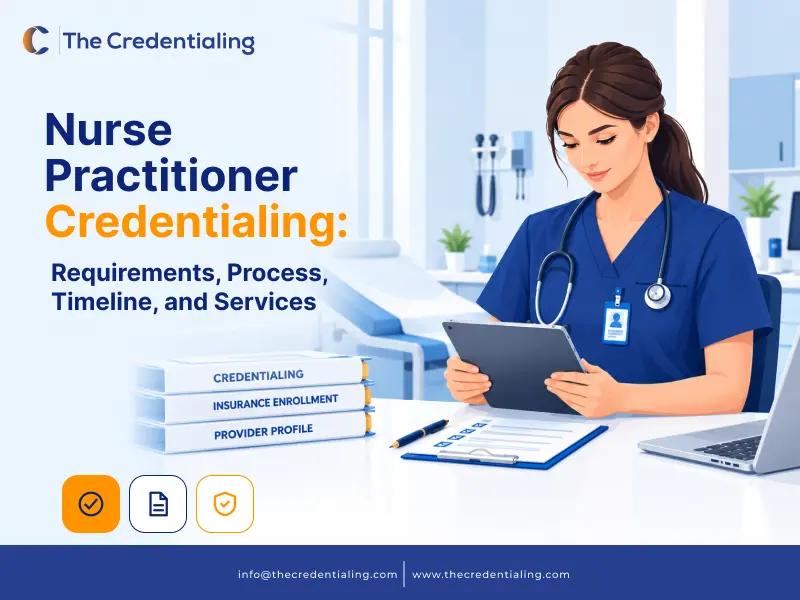
Nurse practitioner credentialing is an essential step for healthcare professionals who want to participate in insurance networks, establish a private practice, or provide covered services through a medical group. The process involves verifying a nurse practitioner's education, licensure, certifications, professional history, and other qualifications before a health plan or healthcare organization makes a credentialing decision.
For nurse practitioners (NPs) in the United States, credentialing may involve commercial insurance companies, Medicare enrollment, state Medicaid programs, hospitals, and other healthcare organizations. Each process has its own requirements, forms, review procedures, and timelines.
Understanding these requirements before submitting applications can help reduce avoidable delays, prevent incomplete submissions, and support a more organized path toward network participation.
This guide explains nurse practitioner credentialing requirements, the application process, common delays, insurance enrollment considerations, and how professional nurse practitioner credentialing services can support individual providers and medical practices.
Nurse Practitioner Credentialing at a Glance
Nurse practitioner credentialing is the process of verifying an NP's professional qualifications and eligibility for participation in a health plan or healthcare organization. Depending on the payer and practice arrangement, the process may involve reviewing state licensure, advanced practice authorization, national certification, education, work history, malpractice coverage, and other supporting documentation.
Credentialing is not the same as insurance enrollment or contracting. Credentialing generally focuses on verifying qualifications; enrollment establishes the provider's participation or billing record within a particular program or payer system; and contracting establishes the applicable contractual relationship when required.
Nurse practitioners should confirm the specific requirements of each payer, state, and healthcare organization before beginning the process.
What Is Nurse Practitioner Credentialing?
Nurse practitioner credentialing is a formal review of an NP's professional qualifications and practice-related information. Health plans and healthcare organizations use this process to determine whether a provider meets their applicable participation standards.
Depending on the organization, credentialing may include primary-source verification of licenses, education, board certification, professional history, and other credentials.
For nurse practitioners, the process can be particularly important when joining an established medical practice, opening an independent practice, expanding into a new state, or seeking participation in additional insurance networks.
Credentialing requirements are not identical across all payers. A commercial insurer may have different application requirements from Medicare, a state Medicaid agency, a hospital, or another healthcare organization.
Why Is Nurse Practitioner Credentialing Important?
A well-managed credentialing process can help nurse practitioners and their practices:
-
Prepare more complete payer applications.
-
Identify missing or inconsistent provider information before submission.
-
Organize licenses, certifications, insurance documents, and practice details.
-
Track application progress and requests for additional information.
-
Coordinate credentialing with enrollment and contracting requirements.
-
Confirm approval status and applicable participation effective dates before relying on network participation.
-
Maintain accurate provider information when licenses, practice locations, or other details change.
Credentialing approval alone does not guarantee reimbursement for every service. Payment also depends on applicable payer policies, coverage rules, provider eligibility, billing arrangements, claim requirements, and other contractual or regulatory conditions.
Nurse Practitioner Credentialing Requirements
Before applying for insurance credentialing, nurse practitioners should assemble the documents and information requested by each target payer. The exact requirements depend on the NP's specialty, state of practice, professional history, practice arrangement, and the organization's policies.
Common requirements include the following.
1. Active State RN License and Nurse Practitioner Authorization
Nurse practitioners generally need an active registered nurse license and the state-specific authorization required to practice as an NP. Terminology and regulatory requirements vary by state.
Some states use an advanced practice registered nurse (APRN) license or recognition process, while others use different authorization structures. Providers should verify their status directly with the relevant state nursing board or licensing authority.
A license in one state does not automatically authorize practice in another state. NPs providing services across state lines, including through telehealth, should verify the applicable requirements in each relevant jurisdiction.
2. National Board Certification
Payers may request evidence of national certification appropriate to the nurse practitioner's population focus or specialty.
The accepted certification depends on the payer, specialty, and applicable requirements. Providers should confirm that their certification is current and that the certifying organization and credential meet the specific application criteria.
For certification information, consult the American Nurses Credentialing Center (ANCC).
3. National Provider Identifier (NPI)
The National Provider Identifier is a unique identification number used in covered healthcare administrative transactions. Nurse practitioners commonly need an individual NPI for payer credentialing and enrollment workflows.
Providers can apply for or manage NPI information through the National Plan and Provider Enumeration System (NPPES). An NPI does not itself establish an insurance contract, confirm credentialing approval, or guarantee Medicare enrollment.
4. Education and Professional Training
Depending on the payer, credentialing application, and practice setting, an NP may need to provide education and training details, such as:
-
Graduate nursing education.
-
Relevant academic institutions and completion dates.
-
Advanced practice education.
-
Specialty-related training, where applicable.
-
Supporting documents requested by the payer.
All information should be consistent with the provider's official records and application history.
5. Work History and Professional Background
Credentialing applications may request professional work history, explanations of employment gaps, and details about previous practice settings.
Some payers also ask questions about disciplinary actions, malpractice history, professional liability claims, or other matters relevant to their credentialing policies.
Providers should answer these questions accurately and supply explanations or supporting documents when requested. Incomplete disclosures can lead to additional review or delays.
6. Professional Liability Insurance
A payer or healthcare organization may require proof of professional liability or malpractice insurance. Required coverage limits, policy documentation, and other conditions vary.
Before submitting an application, confirm whether the policy meets the payer's requirements and whether the listed insured name, practice details, and coverage dates are accurate.
7. CAQH Provider Profile and Supporting Documents
Participating health plans may use a provider data platform to collect and review professional information. Many credentialing workflows use the CAQH Provider Data Portal or other payer-designated provider data systems.
Providers should maintain accurate profile information, upload requested documents, complete applicable attestations, and authorize access for participating organizations when required.
A completed profile does not mean that every payer application is complete or that credentialing has been approved. Each health plan may still require separate forms, authorizations, or supporting information.
For further guidance, read our CAQH Credentialing Guide.
8. Practice and Group Information
Nurse practitioners applying through a medical group or clinic may need to provide practice-related information, including:
-
Legal business name and applicable tax identification information.
-
Practice addresses and contact details.
-
Billing arrangements and group affiliation.
-
Relevant group identifiers and reassignment information, where applicable.
-
Service locations and specialties.
-
Additional ownership or organizational details requested by the payer.
Accurate alignment between individual provider records and practice information can help reduce avoidable application corrections.
Nurse Practitioner Credentialing Checklist
Use this checklist to organize common credentialing documents before submitting applications. It is a preparation tool, not a universal list of requirements for every payer.

Item |
What to verify |
|
State licensure |
Active RN license and required NP/APRN authorization |
|
Board certification |
Current certification accepted by the relevant payer |
|
NPI |
Correct individual NPI and associated provider information |
|
Education |
Accurate education and training history |
|
Work history |
Complete professional history and requested explanations |
|
Liability insurance |
Current policy and required coverage documentation |
|
Provider profile |
Accurate information and completed applicable attestations |
|
Practice details |
Correct addresses, group affiliations, and billing information |
|
Payer applications |
All required forms, signatures, and attachments |
|
Medicare or Medicaid |
Applicable program enrollment requirements |
|
Follow-up tracking |
Submission dates, outstanding requests, and status updates |
|
Final confirmation |
Approval status, effective date, and any remaining participation steps |
The Nurse Practitioner Credentialing Process: Step by Step

Although requirements vary, most nurse practitioner credentialing projects follow a series of preparation, submission, verification, and follow-up activities.
Step 1: Review Licensure and Professional Credentials
Confirm that the NP's license, advanced practice authorization, national certification, and other applicable credentials are current.
Resolve discrepancies in names, dates, or professional information before submitting applications whenever possible.
Step 2: Identify Target Insurance Payers
Determine which commercial insurers, government programs, or healthcare organizations are relevant to the practice.
Eligibility and participation options may vary by specialty, location, payer network, and practice arrangement. A provider should confirm that the relevant payer accepts applications for the intended provider type and service location.
Step 3: Prepare the Provider's Information
Collect the provider's professional details, practice information, supporting documents, and any payer-specific forms.
A centralized document checklist helps the practice identify missing items before the application reaches the payer.
Step 4: Complete the Provider Data Profile
If the payer uses CAQH or another provider data platform, complete or update the applicable profile.
Review the information carefully, upload requested documentation, complete required attestations, and authorize access where necessary. Check whether each payer requires additional application steps beyond the profile.
Step 5: Submit the Payer Credentialing Application
Complete the relevant health plan's application and submit the required documents through its designated process.
Keep a record of the submission date, confirmation number if available, supporting files, and the contact or portal used for submission.
Step 6: Complete Medicare or Medicaid Enrollment When Applicable
Medicare and Medicaid requirements should be assessed separately from commercial payer credentialing.
For Medicare, eligible practitioners should consult the Centers for Medicare & Medicaid Services (CMS) enrollment guidance to determine the appropriate process. Depending on the provider's circumstances, Medicare enrollment may involve NPI information, an application through the Provider Enrollment, Chain, and Ownership System (PECOS), supporting documentation, and coordination with the relevant Medicare Administrative Contractor (MAC).
Medicaid enrollment is administered through state-specific programs. Requirements and procedures therefore vary by state.
A nurse practitioner may need to coordinate multiple related tasks, but one application's submission or approval should not be treated as proof that all other enrollment or credentialing requirements are complete
Step 7: Respond to Requests for Additional Information
Payers may request clarification, updated documents, missing information, or explanations during the review process.
Respond within the stated deadline, retain copies of the response, and record the date the information was provided. If a request is unclear, confirm exactly what the payer needs before resubmitting documents.
Step 8: Track Each Application
Monitor each payer's application status and follow up through the appropriate payer channel when needed.
A useful tracker should distinguish between:
-
Not yet submitted.
-
Submitted.
-
Receipt confirmed.
-
Under review.
-
Additional information requested.
-
Approved.
-
Effective for participation.
-
Closed, withdrawn, or denied, where applicable.
These are practical tracking labels, not standardized status definitions used by every payer. Always confirm what a particular payer's status means.
Step 9: Confirm Approval and Effective Dates
When a payer issues a decision, review the approval communication and verify the applicable effective date, provider identity, practice location, group affiliation, and participation details.
Do not assume that an application is approved simply because it has been submitted or has remained under review for a long period.
Before submitting claims as an in-network provider, confirm the payer's participation requirements, effective date, billing arrangements, and any remaining contractual or operational steps.
Step 10: Maintain Credentials and Provider Information
Credentialing is not necessarily a one-time activity. Providers may need to renew licenses and certifications, update provider data, respond to recredentialing requests, and report relevant changes.
Keep a calendar for renewal dates and a process for updating payers when practice locations, professional credentials, or other reportable information changes.
How Long Does Nurse Practitioner Credentialing Take?
There is no single credentialing timeline that applies to every nurse practitioner or payer.
The overall process can take several weeks or longer, depending on the health plan, application completeness, verification requirements, network circumstances, and whether the provider also needs separate enrollment or contracting steps.
The timeline may be affected by:
-
Missing or inconsistent information.
-
Pending license or certification verification.
-
Incomplete provider profiles or attestations.
-
Additional payer documentation requests.
-
Group affiliation or billing-related requirements.
-
Multiple practice locations or jurisdictions.
-
Medicare or state Medicaid enrollment requirements.
-
Payer-specific review procedures and application backlogs.
For planning purposes, practices should obtain the current estimated processing time directly from each payer and avoid promising a specific approval date to the provider or practice owner.
A credentialing service can help organize applications, monitor requests, and support follow-up. It cannot guarantee a payer's review speed or final approval decision.
Common Nurse Practitioner Credentialing Delays and How to Prevent Them
Incomplete Applications
Missing signatures, supporting documents, or required fields can lead to requests for corrections
How to reduce the risk: Use a payer-specific checklist and perform a completeness review before submission.
Inconsistent Provider Information
Differences in names, addresses, professional dates, identifiers, or group details can require clarification.
How to reduce the risk: Reconcile information against official records and verify that individual and practice details are accurate.
Outdated Provider Profiles
An outdated provider profile or incomplete attestation may affect a payer's ability to review the information it needs.
How to reduce the risk: Review the profile regularly and confirm the specific requirements of each participating payer.
Delayed Responses to Payer Requests
Unanswered requests can leave an application pending.
How to reduce the risk: Assign responsibility for monitoring payer communications, record deadlines, and document every response.
Confusion Between Credentialing and Enrollment
A practice may complete one process while another remains outstanding.
How to reduce the risk: Track credentialing, Medicare or Medicaid enrollment, contracting, and billing setup as separate workstreams whenever they apply.
Assuming Approval Without Confirmation
An application acknowledgment is not the same as final approval or an effective participation date.
How to reduce the risk: Obtain written confirmation or verify the status through the payer's official channel before treating the provider as approved for the intended arrangement.
Nurse Practitioner Credentialing for Commercial Insurance, Medicare, and Medicaid
The correct process depends on the payer and the NP's practice circumstances. These categories should be evaluated separately.
Commercial Insurance Credentialing
Commercial health plans generally apply their own credentialing standards and participation procedures. Requirements may differ by payer, network, specialty, location, and whether the NP is joining an existing group or applying through an individual practice.
The practice should verify the payer's application requirements, provider eligibility, group participation arrangements, contracting steps, and effective date.
Medicare Enrollment for Nurse Practitioners
Nurse practitioners who need to bill Medicare should review CMS's official provider enrollment instructions.
Depending on the circumstances, Medicare enrollment may involve NPI information, a PECOS application, applicable supporting information, and coordination with the relevant Medicare Administrative Contractor (MAC).
Official guidance is available on the CMS Medicare enrollment website. Requirements depend on the provider's situation, so practitioners should confirm the applicable enrollment pathway rather than rely on a generic checklist alone.
State Medicaid Enrollment
Medicaid is administered by individual states under federal and state requirements. The applicable application process, documentation, screening, and provider eligibility rules can vary.
Nurse practitioners should consult the relevant state Medicaid agency and verify whether separate enrollment, group affiliation, or additional payer-related steps are required.
Telehealth and Multi-State Practice
Nurse practitioners providing telehealth services or practicing in more than one state should assess both professional authorization and payer-specific participation requirements.
A provider's eligibility in one state does not automatically establish eligibility in another. Confirm licensing, telehealth rules, service-location requirements, and payer policies for the actual practice arrangement.
What Are Nurse Practitioner Credentialing Services?
Nurse practitioner credentialing services provide administrative support for preparing, submitting, monitoring, and maintaining credentialing-related applications.
Depending on the provider's needs and the service agreement, support may include:
-
Reviewing credentialing document readiness.
-
Organizing professional and practice information.
-
Assisting with payer application preparation.
-
Supporting provider profile maintenance.
-
Tracking submissions and application status.
-
Coordinating responses to payer requests.
-
Monitoring outstanding requirements and follow-up dates.
-
Helping distinguish credentialing tasks from enrollment and contracting tasks.
-
Maintaining records of application activity and payer communications.
The exact scope differs by provider. Before engaging a service, confirm which payers and programs are included, who is responsible for signing applications, how status updates are provided, and which activities require separate authorization or fees.
Credentialing services support the administrative process; they do not replace the payer's review or guarantee approval, network participation, reimbursement, or a specific completion date.
When Should a Nurse Practitioner Hire a Credentialing Company?
Professional support may be useful when credentialing work becomes difficult to manage alongside clinical and administrative responsibilities.
Consider evaluating a credentialing service if:
-
You are opening a new practice and need to coordinate multiple payer applications.
-
Your practice is adding nurse practitioners or expanding to new locations.
-
You need a more consistent way to track applications and payer requests.
-
Your administrative team has limited credentialing experience.
-
You need to coordinate commercial insurance applications with applicable government-program enrollment.
-
You are experiencing avoidable errors, missed follow-ups, or unclear application status.
-
Your practice needs a documented process for credential maintenance and updates.
A credentialing company is not necessary for every practice. The right choice depends on application volume, internal expertise, available time, payer requirements, and the level of administrative support required.
How to Choose the Right Nurse Practitioner Credentialing Service
Before selecting a credentialing partner, evaluate the following factors.
1. Scope of services: Confirm whether the service supports the specific commercial payers, Medicare, Medicaid, and practice arrangements relevant to your organization.
2. Process transparency: Ask how applications are prepared, submitted, monitored, and escalated when additional information is requested.
3. Status reporting: Confirm how frequently you will receive updates and whether the service maintains a clear record of outstanding tasks.
4. Responsibility and authorization: Establish who supplies documents, reviews information, signs applications, authorizes access, and responds to payer requests.
5. Data security: Ask how sensitive provider information is collected, transmitted, stored, and accessed. Confirm that the service uses appropriate safeguards and follows applicable privacy and security obligations.
6. Pricing and scope: Obtain written details of included services, exclusions, additional charges, and the process for handling work outside the original agreement.
7. Realistic expectations: Be cautious of guaranteed approval claims or promises of a fixed timeline when final decisions depend on external payers and regulators.
A reliable credentialing partner should explain its workflow clearly and distinguish administrative support from decisions controlled by insurers and government agencies.
Nurse Practitioner Credentialing Services from TheCredentialing
Managing multiple credentialing and enrollment tasks can create additional administrative work for nurse practitioners, independent practices, and healthcare organizations.
TheCredentialing.com offers provider enrollment and credentialing-related services for healthcare providers. If you need support organizing payer applications, tracking outstanding requirements, or coordinating credentialing-related administrative work, review the service details to determine whether they match your practice's needs.
Before starting, prepare your provider information, relevant licenses and certifications, practice details, current payer relationships, and a list of the insurance networks you want to pursue.
Ready to discuss your credentialing needs?
Explore our Provider Enrollment & Credentialing Services and contact TheCredentialing.com to discuss your requirements, service scope, and next steps.
The appropriate workflow and expected timeline will depend on your provider profile, target payers, practice arrangement, and the requirements applicable to each application.
Frequently Asked Questions About Nurse Practitioner Credentialing
1. What is nurse practitioner credentialing?
Nurse practitioner credentialing is the process of verifying an NP's qualifications and professional information for participation in a health plan or healthcare organization. Requirements vary by payer, state, specialty, and practice arrangement.
2. What documents are needed for nurse practitioner credentialing?
Commonly requested items include state licensure and NP authorization, national certification, an individual NPI, education and work history, professional liability insurance, provider profile information, and practice details. Each payer may require additional documentation.
3. How long does nurse practitioner credentialing take?
The timeline varies by payer and application. It may take several weeks or longer depending on verification, application completeness, additional information requests, and other enrollment or contracting requirements. Confirm current estimates with the relevant payer.
4. Is CAQH required for nurse practitioner credentialing?
Some health plans use CAQH or another provider data platform. Requirements vary, and completing a provider profile does not automatically complete every payer's application or guarantee approval.
5. Do nurse practitioners need an NPI for insurance credentialing?
An individual NPI is commonly required for payer credentialing and relevant enrollment workflows. The specific requirements depend on the payer and program. An NPI by itself does not establish credentialing approval or insurance network participation.
6. Is Medicare enrollment the same as nurse practitioner credentialing?
No. Medicare enrollment is a separate process with its own requirements. A nurse practitioner who needs Medicare billing privileges should follow the applicable CMS enrollment guidance and confirm the relevant steps for their circumstances.
7. Can a nurse practitioner be credentialed with multiple insurance companies?
Potentially, yes. Each payer has its own application and participation requirements. Approval with one health plan does not automatically mean the NP is approved by another.
8. Can a nurse practitioner provide telehealth services across state lines?
That depends on applicable state licensure and practice rules, the provider's authorization, and the relevant payer's policies. NPs should verify requirements for each state and service arrangement before providing care.
9. What is the difference between credentialing, enrollment, and contracting?
Credentialing focuses on verifying professional qualifications. Enrollment establishes the provider's record or participation within a payer or government program, where applicable. Contracting establishes a contractual relationship when required. These processes can overlap, but completing one does not automatically complete the others.
10. Can a credentialing company guarantee approval?
No responsible service should guarantee a payer's final decision when approval is controlled by the payer or relevant authority. A credentialing company can provide administrative support, help organize applications, track outstanding requests, and support follow-up.
11. What happens after credentialing approval?
Review the payer's confirmation, effective date, provider details, practice location, and any remaining participation or contracting requirements. Confirm billing arrangements and applicable payer rules before submitting claims under the intended network arrangement.
12. Why should a practice use professional nurse practitioner credentialing services?
Professional support can help practices organize applications, monitor progress, coordinate payer requests, and maintain records. Whether outsourcing is appropriate depends on the practice's workload, internal expertise, budget, and service requirements.
Final Thoughts
Nurse practitioner credentialing requires accurate provider information, appropriate documentation, careful application management, and follow-up with each relevant payer. Commercial insurance credentialing, Medicare enrollment, state Medicaid enrollment, and contracting may involve related but distinct requirements.
Preparing a payer-specific checklist, maintaining current professional records, responding promptly to information requests, and confirming final approval and effective dates can help practices manage the process more effectively.
For nurse practitioners and healthcare organizations that need administrative support, TheCredentialing.com provides provider enrollment and credentialing-related services that can be evaluated against their specific requirements.
Take the next step: Visit TheCredentialing.com Provider Enrollment & Credentialing Services to review available services and discuss your credentialing needs.
Disclaimer: This article is for general informational purposes and is not legal, regulatory, billing, or payer-specific advice. Requirements vary by state, payer, provider type, and practice arrangement. Always confirm current requirements with the relevant licensing authority, health plan, state Medicaid agency, or CMS.
Authoritative Resources
Related Resources on TheCredentialing
Sit Back and Relax! Let The Pros Handle Credentialing For You!
thecredentialing has built a strong portfolio while providing credentialing services to clients over the years. Our service includes helpful features that you won’t find anywhere else.
Schedule Free Demo Today!